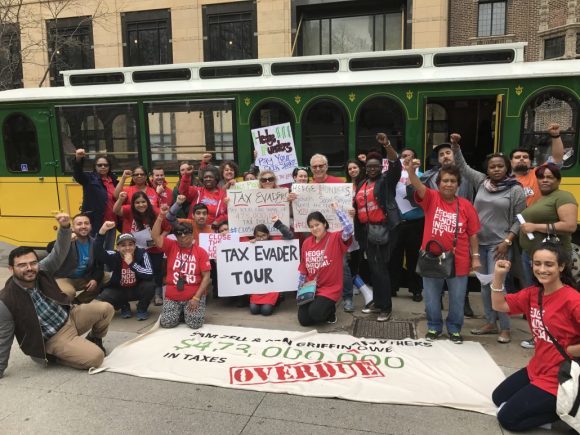
How would the Illinois legislation work? The bill would impose a “privilege tax” at a rate of 20 percent on the fees earned by managers of private equity and hedge funds. According to Michael Kink of the Strong Economy for All Coalition, there are good prospects that a New York carried interest bill could move forward in the near future. Legislators have introduced similar bills in five other states (New Jersey, Connecticut, Rhode Island, Massachusetts, and Maryland) and activists are developing campaigns in several more.
The Illinois legislation states that the tax would disappear if the federal government eliminated the loophole at the national level. Sen. Tammy Baldwin (D-Wis.) and Rep. Sandy Levin (D-Mich.) have introduced bills that would do just that. But the chances of passage in the near future are slim.
On the campaign trail, President Trump promised repeatedly to get rid of the carried interest loophole, saying it allowed hedge fund managers to “get get away with murder.” But now that he’s surrounded himself with Wall Street insider advisors, Trump has issued a tax plan that doesn’t mention this loophole.
As for next steps in Illinois, Illenberger said she expects the bill to pass through the House chamber before the regular legislative session ends on May 31. Then, she foresees a “spirited fight” to get Republican Governor Bruce Rauner, a former private equity fund manager, to sign the bill into law.
Despite the challenges ahead, Illenberger believes an equitable resolution to the state’s economic crisis is almost inevitable. “The current levels of inequality are just wrong and unsustainable,” she said. “If we don’t reverse direction, I don’t know if our society can handle it.”