Low-wage U.S. workers have faced multiple rising threats to their economic and personal security over the past year.
Aggressive ICE actions have terrorized immigrant workers, who are disproportionately represented at the bottom of the corporate ladder. Congress approved the largest cuts in history to public assistance programs that millions of low-wage workers have to rely on to get by. And the Trump administration has attacked diversity, equity, and inclusion (DEI) programs designed to expand opportunities for disadvantaged employees.
How have the largest employers of low-wage workers responded to these threats? This year’s edition of the annual Institute for Policy Studies Executive Excess report takes a look by zeroing in on the 100 S&P 500 firms with the lowest median wages, a group we’ve dubbed the “Low-Wage 100.” The country’s most profitable retailers, fast food chains, and hospitality firms dominate the list.
Low-Wage 100 CEOs have remained silent about threats to workers
Our key finding: Low-Wage 100 CEOs have raised nary a peep about ICE attacks on their employees or the gutting of our social safety net. And, with few exceptions, they have obediently rolled back DEI programs.
How did these corporate leaders choose to deploy their vast political power instead? Passage of the July 2025 budget bill was a top priority. This legislation will throw millions of Americans off Medicaid and SNAP to pay for more tax cuts for the rich and a massive increase in ICE funding.
Under the bill’s reduced top marginal tax rate, chief executives will be able to take home an even greater share of their fat paychecks. In 2025, average CEO compensation within the Low-Wage 100 hit $17.5 million. By contrast, the group’s average median worker pay sat at just $36,571 and their average CEO-worker pay gap came to 614 to 1.
Low-Wage 100 firms won tax cuts for the rich, paid for with cuts to aid programs their employees rely on
We reviewed public statements about this budget legislation by Low-Wage 100 firms and the corporate lobby groups that represent them. Each statement cheered the law’s tax cuts, which will overwhelmingly benefit the wealthy. The International Franchise Association even praised the doubling of the estate tax exemption, a tax break that will benefit less than 0.2 percent of the population.
Not one statement expressed concern about the law’s drastic Medicaid and SNAP cuts. A recent GAO report lists the top employers of workers receiving Medicaid and SNAP in a sampling of states where this information is available. Low-Wage 100 firms dominate the lists.
Long-term trends of executive excess
Given past trends, Low-Wage 100 CEOs’ muted response to the increased threats against their employees is hardly a surprise. The pandemic opened the eyes of many Americans to the essential value of frontline low-wage workers. But even that national crisis did not lead to more equitable sharing of corporate wealth.
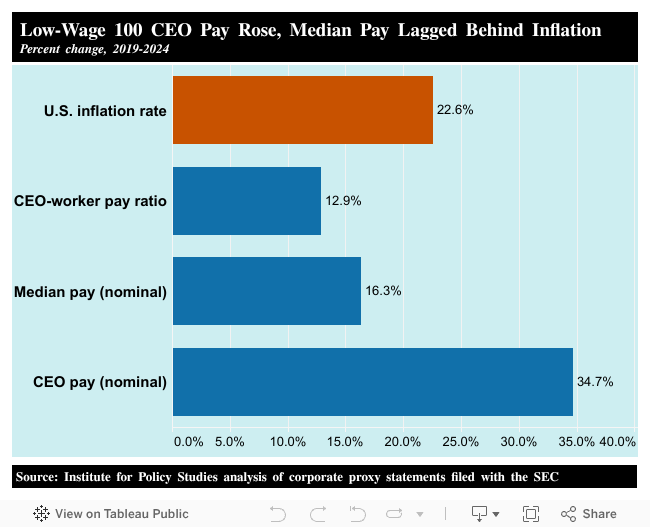
Between 2019 and 2025, the Low-Wage 100’s average CEO pay rose 41.4 percent, double the 20.7 percent increase in their average median worker pay.
A technical note: we did not adjust these figures for U.S. inflation because median pay figures in corporate SEC filings are based on a company’s global workforce. But many Low-Wage 100 firms have the vast majority of their employees in the United States. In fact, that’s the case for five of the 10 Low-Wage 100 corporations with the lowest median pay (Ross Stores, Ulta Beauty, TJX, Yum! Brands, and Dollar Tree).
Buybacks bonanza
To further enrich their wealthy executives, Low-Wage 100 firms have spent over $718 billion repurchasing their own stock over the past seven years. This formerly illegal financial maneuver artificially boosts the value of a company’s shares and, in the process, pumps up the value of the stock-based compensation that makes up about 80 percent of corporate CEO compensation.
Every dollar spent on buybacks represents a dollar not spent on worker wages or long-term productive investments. The Lowe’s home improvement store’s $46.8 billion expenditures on buybacks over the past seven years could have covered the cost of a $24,235 bonus for each of their 276,000 employees every year during that period. Median pay at Lowe’s in 2025: $37,371.
Policy changes to curb executive excess
The Low-Wage 100 represent a business model designed to deliver staggering personal gains for top executives by squeezing their workers. This predominant model is shredding our social fabric and threatening our democracy. We clearly need to build worker power and raise the minimum wage to a living wage. But to solve this problem we also need to curb runaway CEO pay.
Governments at all levels should explore options for leveraging tax policies and procurement and subsidy policies against executive excess. These policy solutions have serious bipartisan potential.
For instance, one survey found that 89 percent of Democratic and 71 percent of Republican likely voters support a tax hike on corporations that pay their CEO over 50 or more times what they pay their median employees. A bipartisan provision in the pending Senate defense authorization bill would bar military contractors from engaging in CEO pay-inflating stock buybacks.