The Build Back Better agenda under negotiation in Congress would improve the lives of millions of Americans by creating good jobs, expanding access to affordable child care and home care, and other vital public investments. Several tax reforms on the table to help pay for the plan would also reduce our country’s skyrocketing wealth inequality.
Fairly taxing wealth is critically important because our country’s wealth gaps are even bigger than our income gaps. (“Wealth” is the difference between what you own versus what you owe. “Income” refers to your revenue stream from wages and investments.)
And these wealth gaps are completely out of control, undermining our economic health and threatening our democracy. Today, the richest 1 percent owns more wealth than the entire U.S. middle class (defined as the middle 60 percent), according to Federal Reserve data. It hasn’t always been this way. In 1990, the middle class held more than twice as much wealth as the top 1 percent.
Billionaires Income Tax
The most innovative wealth tax proposal on the table is a Billionaires Income Tax supported by Senate Finance Chair Ron Wyden and President Biden. While the details are still to come, this reform would require billionaires to pay annual taxes on their increased wealth, just like workers pay taxes on their paycheck income each year. This tax on just the 700 or so richest U.S. households could raise hundreds of billions of dollars for vital public investments.
To say that this elite group is well-positioned to contribute more to our nation’s economic recovery is an understatement. In the 19 months since the beginning of the pandemic, U.S. billionaires have seen their wealth grow by $2.1 trillion to a total of $5 trillion, according to Institute for Policy Studies and Americans for Tax Fairness analysis of Forbes data. The five richest men have seen their fortunes expand even more rapidly than the U.S. billionaire class as a whole.
Closing the stepped-up basis loophole
President Biden has also called for the closure of a capital gains loophole that favors the wealthiest Americans. The “stepped-up basis” loophole allows the ultra-rich to avoid capital gains taxes on assets they pass on their heirs. Under current rules, people owe capital gains taxes when they sell an asset that has increased in value. But the ultra-rich can afford to hold onto their assets and simply borrow money at low rates if they ever need extra cash. Then when a family member inherits that property, the capital gains since their deceased ancestor first purchased it are reset to zero.
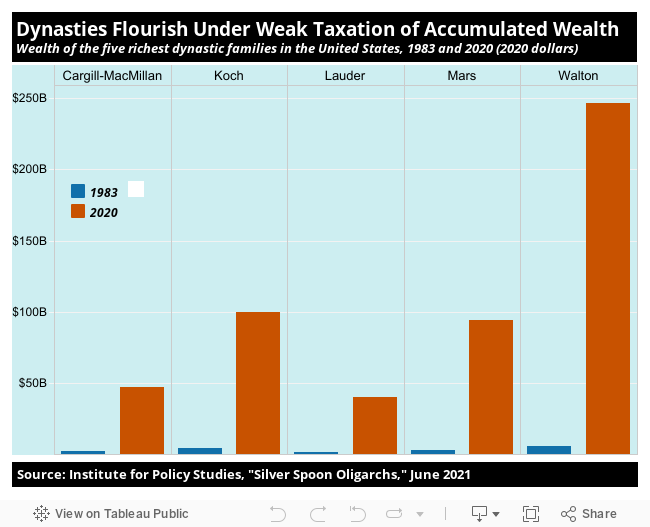
This “step up in basis” is a major factor in the entrenching of oligarchic dynasties. According to Institute for Policy Studies research, America’s 50 wealthiest family dynasties together held $1.2 trillion in assets in 2020. The five wealthiest dynasties (the Walton, Koch, Mars, Lauder, and Cargill-MacMillan families) saw their wealth increase by a median 2,484 percent from 1983 to 2020.
Biden’s original proposal would require inheritors to pay taxes on the full value of unrealized capital gains as soon as they receive the inherited assets (with strong exceptions for family farms and businesses). In the face of intense lobbying pressure, lawmakers are reportedly considering a revised approach: taxes would still be owed on the full capital gains (no stepped-up basis) but not until the heirs sell the asset.