
Executive Excess at Low-Wage Corporations
‘Low-wage 100’ CEOs have focused on enriching themselves while turning blind eyes to threats against their workers.
After the 2008 financial meltdown, the U.S. unemployment rate and median household income did not return to pre-crisis levels for many years. Since that national tragedy, Congress and regulators have taken some important steps to prevent such crises. But financial institutions still extract too much wealth from working families and funnel too much of that wealth into executive bonuses that encourage excessive risk.
And, as we saw with the regional bank failures of 2023, reckless executives can still drive their firms into the ground and walk away with grand fortunes while relying on taxpayer money to contain the damage.
Tax policy is one tool for ensuring that our financial system contributes to a healthy economy instead of short-term speculation to pump up CEO pay. As Congress prepares for the 2025 tax debate, lawmakers should consider two questions:
In my view, the answer to both questions is “yes.”
Here are a few reasons the financial industry is undertaxed:
First, big profitable firms pay nowhere near the statutory corporate tax rate. Citigroup and Bank of America paid just a 4 percent effective tax rate in the first four years after the 2017 tax reform. The new 15 percent minimum will help, but we need to do more to close loopholes.
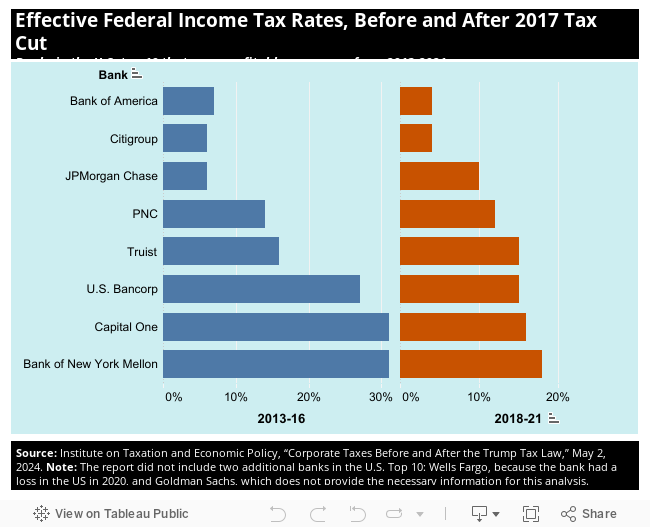
Second, most Americans are used to paying sales taxes when they purchase a car or a restaurant meal, but a Wall Street trader pays no sales tax at all on millions of dollars’ worth of stocks or derivatives. This has contributed to the explosion of high frequency trading that drains profits from ordinary investors and adds virtually no value to the economy.
Third, financial executives reap huge windfalls from our tax code’s bias in favor of income from investment over income from work. We’ve got billionaires paying a lower tax rate than teachers and firefighters. And investment fund managers still get to pay the lower capital gains rate on their carried interest compensation.
Fourth, the 2017 Tax Cuts and Jobs Act gave big real estate investors’ yet another tax break through the 20 percent pass-through deduction meant for small businesses.
Clearly, the financial sector can and should contribute more.
Today, the Senate Budget Committee held a hearing on “Making Wall Street Pay Its Fair Share.” @SarahDAnderson1 from @IPS_DC talks about tax two-fers – taxing excessive CEO pay, financial transactions, and stock buybacks – to make the economy more fair and curb excessive CEO pay pic.twitter.com/jqouduch2c
— Take On Wall St (@TakeOnWallSt) June 12, 2024
We can use tax policy to both raise additional revenue and encourage long-term value over short-term speculation and excessive CEO pay. Here are a few examples of what I like to call “two-fers.”
First, we could increase taxes on companies that pay their CEO more than 50 times their typical worker pay, as proposed in the Curtailing Executive Overcompensation Act and the Tax Excessive CEO Pay Act.
A recent poll found overwhelming support for this, including 77 percent of Independents and 71 percent of Republicans. Companies would have two choices: 1) narrow their pay gaps, which would likely boost profits since huge gaps tend to lower employee morale and productivity or 2) face a bigger IRS bill. It’s their choice.
Second, we could introduce a financial transactions tax to encourage long-term investment while generating new revenue. The targets would be the high-flyers in the financial casino, while the cost for pension funds and traditional stock-and-bond-holders would be less than typical portfolio management fees.

Finally, we could increase the new stock buybacks tax. Whether you were for or against the 2017 reform, I think we should all be angry that corporations took their tax cut windfalls and blew $1 trillion on stock buybacks instead of on worker raises or innovation. And unfortunately buybacks are expected to break records again in 2025.
For too long, Wall Street has wielded excessive power to shape our tax code so their firms and executives can avoid paying their fair share and continue practices that benefit the few while putting the rest of us at risk. The 2025 tax debate is an opportunity to fix these problems, as part of a much-needed overhaul of our tax code to make our economy stronger and more equitable.
Advocates for the Trump tax cuts claimed corporations would reinvest profits back into the economy — but as @SarahDAnderson1 from @IPS_DC points out, companies began pouring huge sums of money into stock buybacks instead. @SenateBudget pic.twitter.com/I6FTqQmIMC
— ITEP (@iteptweets) June 12, 2024
This commentary is drawn from oral testimony Sarah Anderson presented at a June 12, 2024 Senate Budget Committee hearing on “Making Wall Street Pay Its Fair Share: Raising Revenue, Strengthening Our Economy.” Her written testimony, with relevant citations, is available here.
Sarah Anderson directs the Global Economy Project and co-edits Inequality.org at the Institute for Policy Studies.