
The Struggle Against Industrial Expansion in Cancer Alley
Communities in Louisiana are fighting, including against their own governments, to block new polluting projects.
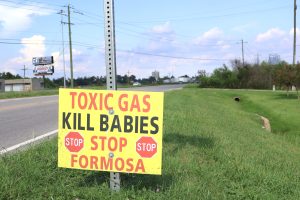
RISE St. James was founded in 2018 by Sharon Lavigne to combat Formosa Plastics’ attempt to build a massive chemical plant in St. James Parish’s majority-Black 5th District. That legal fight against the proposed plant, entitled the “Sunshine Project,” is still ongoing, and has thus far been arduous but successful. Formosa Plastics has yet to build the plant. However, it has received a fourth preconstruction permit from the Louisiana Department of Environmental Quality, even though Formosa Plastics is unable to meet revised safety standards.
“We’re going up against $1 billion companies with limited resources, so it can be pretty difficult. We rely on our faith that things will be better, and if we keep fighting, we can stop some of these polluters from killing us,” Lavigne said.
The environmental advocacy group has since expanded its operations to help other local groups fight against industrial expansion in neighboring parishes, including Ascension and St. John the Baptist. One of their many ongoing battles is against the St. James Parish council itself.
RISE St. James, alongside Inclusive Louisiana and Mount Triumph Baptist Church, has accused St. James Parish of violating Black residents’ rights and constitutional protections through greenlighting petrochemical development and rezoning majority-Black areas for industrial use.
The Center for Constitutional Rights and the Tulane Environmental Law Clinic are providing legal support to the plaintiffs. They are seeking a moratorium on new petrochemical construction projects, with the ultimate goal of freeing the parish’s economy from petrochemical companies.
That coalition initially filed its lawsuit in March 2023, kickstarting a yearslong legal slugfest with St. James Parish, which filed a motion to dismiss the lawsuit in June 2023. The Eastern District of Louisiana, a U.S. federal district court, dismissed many of the plaintiff’s claims in November 2023.
The setback did not deter the local advocacy groups; instead, they filed an appeal in the U.S Fifth Circuit Court of Appeals, and in April 2025, the court ruled the case could move forward. It was a monumental win, and it kept the fight against environmental racism in St. James Parish alive.
Once again, St. James Parish filed to dismiss the lawsuit in November 2025, bringing the case back to the Eastern District of Louisiana. That set up a hearing on Jan. 28 in New Orleans and a decision on Feb. 9.
The federal case against St. James Parish
The plaintiffs allege St. James Parish has violated several constitutional, federal and state rights through their land use patterns in majority-Black areas. Among them are alleged violations of the Thirteenth Amendment, the Fourteenth Amendment, the Religious Land Use and Institutionalized Persons Act and the right to historical and cultural preservation in the Louisiana Constitution.
The Thirteenth Amendment abolished slavery outside of prison. Subsequent cases affirmed Congress’ “power to pass all laws necessary and proper for abolishing all badges and incidents of slavery in the United States.” RISE St. James, Inclusive Louisiana and Mt. Triumph Baptist Church allege St. James Parish conjured the “badges and incidents,” or the historical consequences, of slavery through their discriminatory pattern of land use.
They cite a 2014 land use plan, which has since been amended, that redesignated majority-Black areas in the parish as “industrial” or “residential/future industrial.” Additionally, since the first plant was constructed in the parish in 1958, at least 28 out of 32 plants have been built in the majority-Black 4th and 5th districts. These plants are often built directly on former plantations. The “badges and incidents of slavery” in this case are clear: several thousand acres of plantation land once used for slavery is now being used to house sprawling chemical plants that dilute Black communities with carcinogens.
The plaintiffs also allege St. James Parish violated the Fourteenth Amendment’s Equal Protection Clause through their land use pattern. Alongside the disproportionate buildout of chemical plants in majority-Black areas, they cite how the 2014 land use plan was adopted to prevent Wolverine Terminals Corporation and Petroplex International from building oil storage facilities in majority-white areas. The plan also concentrated most two-mile buffer zones in majority-white areas in the parish. Majority-white churches and schools were afforded some level of protection from exposure to chemical pollution; majority-Black institutions were not provided such mercy.
Finally, the advocacy groups allege that industrial development on burial sites of the formerly enslaved violates their state constitutional “right of the people to preserve, foster, and promote their respective historic linguistic and cultural origins” and the 1993 Religious Land Use and Individualized Persons Act.
The Code Noir, a set of laws governing the practice of slavery during French and Spanish rule in the 17th and 18th centuries, required slave owners to bury enslaved people on consecrated ground.
“Enslaved people were generally buried on uncultivated land in the back of the plantation, further away from the Mississippi River and in or at the edge of the forest…By the time of Emancipation there were likely several cemeteries of enslaved people within each plantation,” the initial 2023 moratorium complaint said.
These were typically unmarked graves, and plantation owners seldom recorded enslaved people’s deaths. Loved ones planted trees to mark burial sites, but beyond that, identifying enslaved people, finding burial sites and tracing family lineages is tragically cumbersome. Forensic Architecture identified potential unmarked cemeteries across several former plantations that now house petrochemical plants. According to them, this means “hundreds, if not thousands, of cemeteries [are] at risk from industrial activity.”

Indeed, plants including the Rain CII calcined coke plant and the Mosaic Faustina fertilizer plant have desecrated unmarked cemeteries in the parish, according to the complaint.
RISE St. James, Inclusive Louisiana and Mount Triumph Baptist Church lay out an argument of explicit racial and ecological discrimination against St. James Parish due to its patterns of land use. Their greenlighting of petrochemical projects in majority-Black areas and treatment of the formerly enslaved tie directly to historical vestiges of slavery. Black residents are burdened by chemicals and high cancer risk, they cannot pray over their deceased ancestors and their ancestors themselves cannot rest in peace.
Their arguments thoroughly convinced the Eastern District of Louisiana. In February, the federal district court allowed each claim to proceed, stating that St. James Parish’s land use pattern “quite literally originated in slavery.”
“How many of us have to die? This ruling affirms what we know in our hearts and our faith: God did not create our communities to be sacrificed,” Lavigne from RISE St. James said.
State and local government collaboration with industry
The fight against St. James Parish is now in the discovery phase. Though the parish lost mightily to its own residents, it still continues to support industrial development.
On June 17, the council voted to redesignate the majority-Black town Romeville from “agricultural” to “industrial,” opening the door for even more development in Black communities. RISE St. James, Inclusive Louisiana and Mount Triumph Baptist Church filed a motion for a temporary restraining order the following day.
“We feel left out, because every time we go to the council meeting or the planning commission, it seems like their minds have already been made up [to be] pro-industry,” said Inclusive Louisiana co-founder Barbara Washington.
St. James Parish’s behavior is typical of local and state governments desperate for industry money. The Louisiana Department of Environmental Quality’s excessive permit granting to polluters, non-disclosure agreements between Ascension Parish officials and Hyundai Steel and a non-disclosure agreement between Meta and Louisiana Gov. Jeff Landry himself are all examples of local and state officials selling Louisianians out to any massive company who wants to set up shop in the state.
These officials parrot lies about high-paying jobs and economic prosperity, which has yet to come to Cancer Alley’s Black communities. In fact, Black residents are underrepresented in the highest-paying chemical manufacturing jobs and overrepresented in the lowest-paying jobs in the industry. Louisiana leaders are responsible for creating and expanding Cancer Alley.
“It’s just sad. It’s sad that the politicians are putting profit over people,” Lavigne said.
The sheer will and love for community expressed by local advocacy groups is an inspiring thing to witness. RISE St. James, Inclusive Louisiana and Mount Triumph Baptist Church have all brushed up against the overwhelming forces of the parish, the state and the judicial system multiple times over, and refuse to back down from environmental racism. Their concerted efforts, though, reveal an ugly truth. The parish and the state, these machines of oppressive power, are invested in the degradation of Black life.
Several studies on Cancer Alley reaffirm the monstrous health risks for the corridor’s disproportionately Black residents. The facts are inarguable. These residents continue to voice their opposition to petrochemical development in council meetings, through environmental and racial organizing and through the legal system. Still, the parishes and the state persist. Louisiana must house more chemical plants, it must allow companies to pollute our bodies with toxic waste. It must sacrifice Black lives, and the beautiful, culturally rich landscapes along the Mississippi River, at the altar of maximum capital accumulation.
This is nothing new. As the Eastern District put it, this is a pattern of suffering originated in slavery. Regardless of the mode of production or its exports, regardless if the industry is dominated by bondage or rife with carcinogens, the capital class accumulate wealth by harvesting Black anguish. In this region, Black bodies must be condemned to death, one way or another.
Get involved
While the plaintiffs prepare for the next court hearing, these advocacy groups are organizing residents and supporters against the parish council and chemical companies. Head to RISE St. James’social media and website for ways to get involved, such as donating, attending council meetings, signing petitions or attending community meetings.
The three-headed monster of white supremacy, capitalism and environmental degradation is alive and well in south Louisiana. Its strategy is different from the days of slavery, but terror it inflicts on Black communities remains the same. RISE St. James, among many other local advocacy groups, is fighting against this suffering, and scoring victories along the way.
“It’s a lot of legal fights,” Lavigne said. “It’s been so much I can’t keep up with them all. But, it’s necessary to stop these polluters from poisoning us.”
This struggle reminds us that life does not have to be like this in Cancer Alley. There doesn’t need to be a Cancer Alley at all. Industrial development is not inevitable, and neither is Black suffering. These organizations are paving a path toward a future free from chemical plants and the sight of loved ones succumbing to disease. In this future, the economy is equitable and people’s needs are sufficiently addressed.
In this future, our ancestors finally get to rest in peace. Advocacy groups like RISE St. James are leading the way, and it is imperative that local residents in St. James Parish, and all throughout Cancer Alley, follow their lead.

Kennith RaShaun Woods II is a 2026 Henry A. Wallace fellow at the Institute for Policy Studies.