
I Was Already Suspicious of the Data Center Boom. Then I Stood In Data Center Alley
Pockets of opposition to the data center boom are emerging all over the country.
Even if you’ve never stood next to a data center, you’ve probably felt its impacts. For instance, if you’re one of the 65 million people served by regional transmission giant PJM in the eastern United States, a huge spike in projected demand for electricity, driven almost entirely by proposed data centers, has raised your electric bills. But standing next to a data center — or worse, living next to one — is where you can really feel the totality of its impact. I didn’t fully realize this until I spent time in the belly of the beast.
In January, I took a trip to Loudoun County, Virginia, home of the notorious Data Center Alley, to do research for my new podcast project for the Institute for Local Self-Reliance called “The Data Centers Are Coming.” I wanted to learn about how ever-expanding data center facilities impact their neighbors. Nothing could have prepared me for what I saw as I crested a rise on the freeway: 199 operational data centers laid out before me and around 100 more under construction, densely packed together and sprawling to the horizon. So much digging and building left everything covered in red dust, giving the whole scene an eerie, Martian feel. The noise was unbelievable, clanking metal and chugging diesel engines all atop a deep industrial hum.
The people that live here are experiencing negative health effects stemming from pollution and chronic severe noise exposure. I talked to people in neighborhoods where folks no longer hang out in their yards because of the noise, in turn becoming isolated from their neighbors. I heard about people spending thousands on renovations just so they can sleep through the noise. One Loudoun County resident measured the noise at 70 dB on his front porch — equivalent to a vacuum cleaner that never turns off.
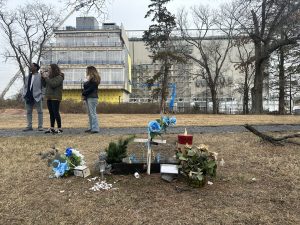
People die here, too. I visited Tippets Hill Cemetery, a historic Black burial ground dating to before the Civil War, now surrounded on three sides by monumental, noisy data centers. It was like nothing I’d ever seen or heard.
This is Big Tech’s vision for America. Their behavior reveals an air of entitlement to turn any community they choose into another Data Center Alley, extracting massive resources and tax breaks in the process. Elon Musk built what he called the world’s biggest supercomputer next to the Boxtown neighborhood in Memphis, Tennessee. Dismayed at the idea of waiting for a grid connection to power his massive electricity needs, he plopped more than 30 huge generators in the parking lots next to his Colossus data center, essentially building an unregulated gas power plant himself. This, of course, circumvented any regulatory processes, spewing dangerous pollution into adjacent Boxtown.

Danny Caine is the author of several books, including How to Resist Amazon and Why. A former owner of the Raven Book Store in Lawrence, Kansas, he is a content creator at the Institute for Local Self-Reliance.