
The Global Economy Runs on Care
Leaders of the G20 largest economies should transform the global care economy to improve labor conditions for these essential workers.
Some of the most important work in the global economy happens far from offices and trading floors. It’s happening in the intimacy of our homes.
This work can look like a home care worker helping an older or disabled person out of bed. Or it can look like a nanny comforting and caring for a child whose parents have already left for work. It’s work that happens inside the privacy of our homes – from preparing a meal to helping someone bathe with dignity.
Care is deeply intimate. Domestic workers often enter our lives amidst life’s major transitions: a newborn, a new home, an accident or a diagnosis. They are trusted with the people we love most and our very homes. Yet despite this deep-rooted care, the people doing this work remain among the least protected and least valued workers in our global economy.
There are 381 million workers in the global care economy. At least 75.6 million are domestic workers, and the vast majority of them are women and women of color. More than 80 percent of domestic workers are informally employed, leaving millions without the labor protections and social security that many other workers take for granted. And nearly one in five domestic workers is an immigrant.
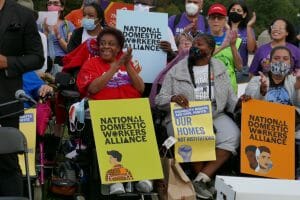
Care may happen privately, but it’s a global concern. Care connects families, communities, economies, and crosses borders. Around the world, women leave their natal countries in search of opportunity and become the trusted workers caring for our homes, children, and aging and disabled loved ones in another country – sometimes all while relying on relatives or other workers to help care for their own families back home.
These relationships are part of a larger “global care chain,” a term that refers to the personal links between people across the globe based on paid or unpaid caregiving work. Behind that term are millions of conversations and decisions happening around who will care, who can afford care, who must leave their homes (or countries) to find work, and what happens to the people they leave behind.
June Barrett has lived in many parts of that chain. Born in Jamaica, they began working as a domestic worker as a teenager. After coming to the United States, they settled in Miami, where they worked as a nanny and later as a home care worker.
June’s work required tremendous responsibility. But the dignity of the work did not always translate into dignity on the job. During one live-in caregiving job, June experienced sexual harassment and assault. Like many domestic workers, they feared that reporting what was happening could mean losing the livelihood they needed for their housing, their health, and support for their family abroad.
The isolation June experienced is one of the defining and complex vulnerabilities that exist within domestic work. When your workplace is someone else’s home, there are likely no coworkers beside you and no established boundary between the personal demands of your employer and the professional standards that should protect you as a worker.
For immigrant workers, the imbalance of power is exacerbated by precarity of status and oftentimes a reliance on your employer for your legal status.
But June’s story is also about what happens when isolation translates to organizing.
Today, June is an organizer with the National Domestic Workers Alliance, where their experience helps other domestic workers find their agency and power to fight for better working conditions in the United States and across the globe. They also serve as second vice president of the International Domestic Workers Federation, joining domestic worker leaders worldwide in a movement for dignity and improved working conditions for all.

June’s journey from a domestic worker in Jamaica to a care worker in Miami to an organizer and international labor leader reflects the domestic worker movement’s ongoing evolution.
For generations, domestic work has been treated as something that happens in isolation, beyond labor standards and largely outside public concern. In response, domestic workers have organized across languages, borders, and politics to remind us that care happening in a home does not make it less valuable than other forms of labor.
After years of organizing by domestic workers and their supporters, the International Labor Organization Convention 189, adopted in 2011, established the first international labor standards specifically for domestic work. Convention 190, adopted in 2019, was later the first international treaty to establish that everyone deserves to belong to a workplace free from violence and harassment.
These standards are important and welcomed. But they must be matched by increased public investment and even stronger systems of care.
Many governments have approached care as an individual family problem – find someone to look after your child, figure out how to support an aging parent, and somehow manage the cost of caregiving, which is valued at approximately $1 trillion in the United States.
Globally, we are overly reliant upon overstretched family caregivers and underpaid care workers. A better care economy would recognize that our care needs are necessary and require collective prioritization and investment.
Some countries are beginning to build toward that shared collective vision. Brazil has adopted a National Care Policy that recognizes care as a right and a responsibility shared across society, while explicitly addressing decent work and protections for care workers. Indonesia has developed a long-term care economy roadmap that brings together child care, elder care, social protection, and leave policies in addition to passing landmark domestic workers protection laws.
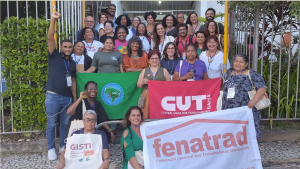
Uruguay also has the most comprehensive and progressive framework for domestic workers, ensuring equal status to other formal employees with a guaranteed 8-hour workday, mandatory overtime pay, minimum wage, and paid leave.
In the United States, we’ve been able to pass Domestic Workers Bills of Rights in 13 states, 2 cities, and Washington D.C. These laws typically guarantee domestic workers basic rights like minimum wage, overtime pay, rest breaks, and safe working conditions, and some include paid leave and anti-discrimination protections.
While collectively, we are still evolving, each country’s progress represents an important shift where care is beginning to be understood not as a private burden but as part of a nation’s social and economic infrastructure.
The G20 can accelerate that shift.
G20 members can help strengthen international labor standards for domestic and care workers, support investments in stronger and more accessible care systems, and ensure that domestic workers themselves have a voice in shaping the policies that determine their lives and livelihoods.

Ai-jen Poo is the President of the National Domestic Workers Alliance.