
The global trend towards extreme wealth and income concentration has dramatically strengthened the economic and political power of those individuals — overwhelmingly male — at the top. In the United States and around the world, women continue to be underrepresented in high-level, highly paid positions and overrepresented in low-paying jobs. Women of color and transgender individuals experience particularly high levels of poverty, unemployment, and other economic hardships. Gender discrimination and sexual harassment in the workplace contribute significantly to these persistent economic divides.
Gender Income Gaps
Gender Wealth Gaps
Gender Poverty Gaps
Transgender Economic Gaps
Inequality and Reproductive Rights
Inequality Across Gender Diversity and Covid-19
Gender Income Gaps
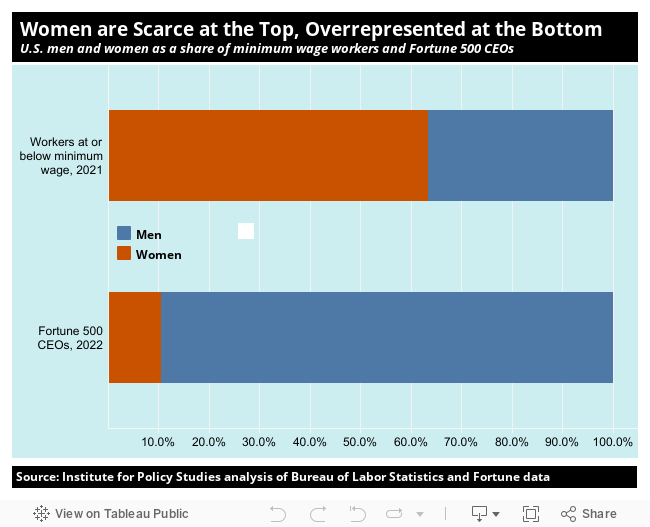
As of June 2025, the CEOs of Fortune 500 corporations included 55 women – just 11 percent of an elite group that earned $18.9 million on average in 2024. By contrast, according to the Bureau of Labor Statistics, women make up 61.7 percent of workers earning the federal minimum wage, a rate stuck at $7.25 since 2009.
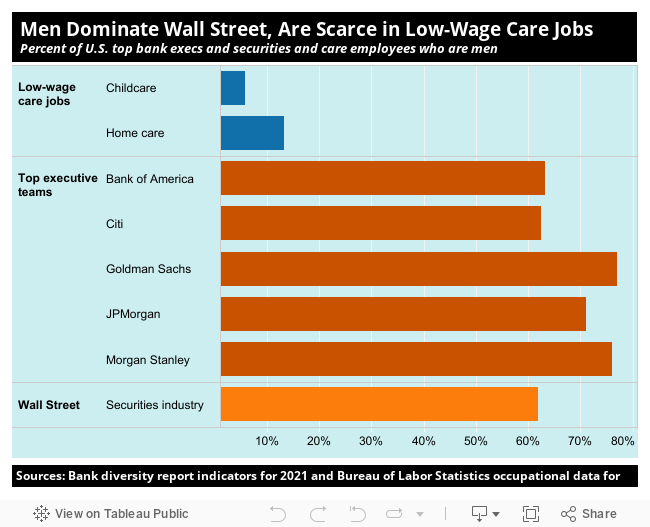
Men particularly dominate highly lucrative financial industry jobs. According to Institute for Policy Studies analysis, the share of the five largest U.S. investment banks’ senior executives and top managers who are male: JPMorgan Chase: 71 percent, Goldman Sachs: 77 percent, Bank of America: 63 percent, Morgan Stanley: 76 percent, and Citigroup: 62 percent. Nationwide, men make up 62 percent of all securities industry employees but just a tiny fraction of workers who provide care services that are in high demand but continue to be very low paid. Men make up less than 6 percent of childcare workers, an occupation that pays $26,680 per year, on average. Men make up just 13 percent of home health aides, who average $29,260 per year.
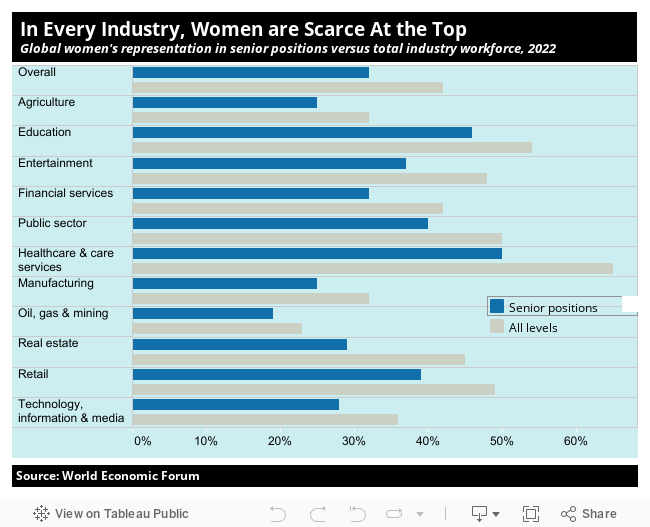
The gender gaps at the top of corporate hierarchies are a global phenomenon. According to World Economic Forum analysis of LinkedIn data, women worldwide continue to be outnumbered by men in senior leadership positions across all industries. Overall, women made up just 32.2 percent of senior leadership positions in 2022, nearly 10 percentage points lower than women’s total workforce representation of 41.9 percent.
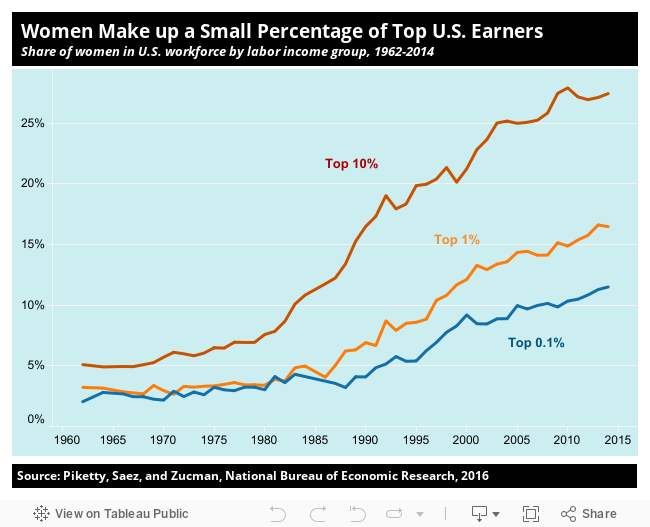
Men make up an overwhelming majority of top earners across the U.S. economy, even though women now represent almost half of the country’s workforce. Women comprise just 27 percent of the top 10 percent, and their share of higher income groups runs even smaller. Among the top 1 percent, women make up slightly less than 17 percent, while at the top 0.1 percent level, they make up only 11 percent.
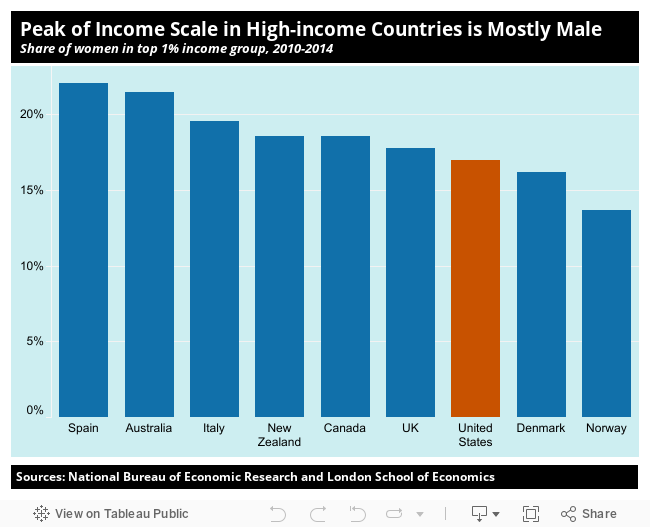
Other major economies show similar trend lines. A study of eight high-income countries from the London School of Economics found that women made up just 14 percent to 22 percent of the top 1 percent of earners. These surveys were conducted during the 2010-2014 period. The U.S. figure for 2012 is from the National Bureau of Economic Research.
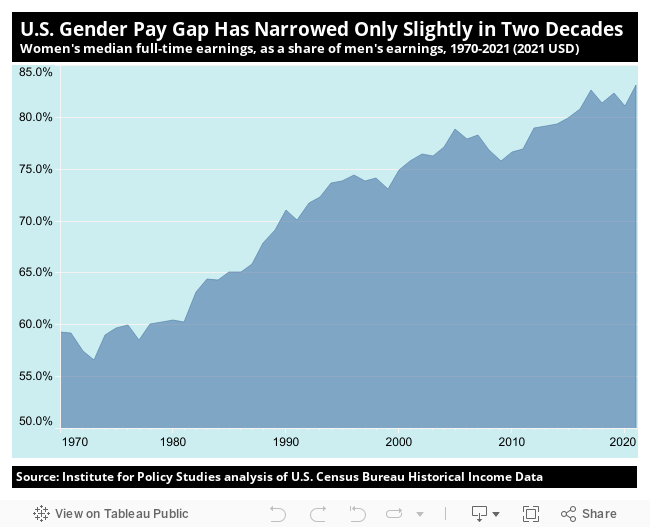
Throughout the U.S. workforce, women remain vastly underpaid. U.S. Census Bureau Data shows that among full-time workers, women earned an average of 81 cents for every dollar a man earned in 2024, up from 77 cents in 2004. The narrowing of the pay gap has slowed in the past two decades compared to earlier decades when women were joining the workforce in large numbers. If part-time workers were included in these calculations, the gap would be even wider, since women are more likely to work reduced schedules, often in order to manage childbearing and other caregiving work.

Within racial groups, Bureau of Labor Statistics data show the largest pay gaps between men and women appear among whites and Asians — not because Latinas and Black women have made faster progress towards equity but because average pay for men in these groups falls far below the compensation of white and Asian men. Hispanic/Latina women are the lowest-paid of any group, making just 50 cents for every dollar an Asian male earns and 65 cents for every dollar a white male earns.
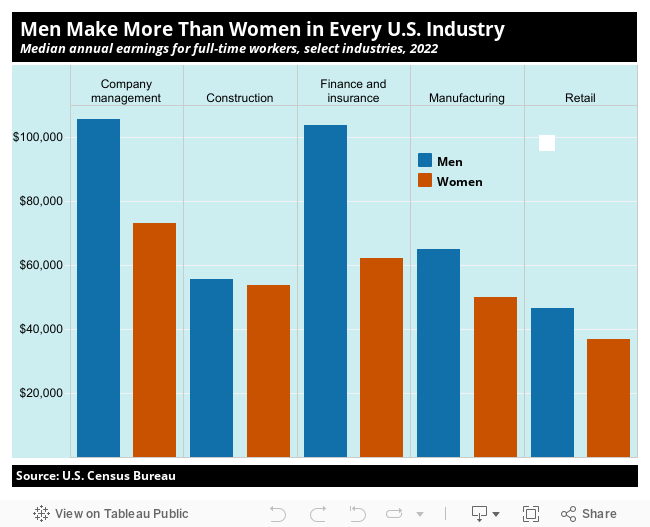
American women earn less than men in all industries. The largest pay gaps are in financial and insurance positions, where median earnings for men stood at $103,707 in 2022, compared to just $62,214 for women. The smallest gap appears in the construction sector, but women make up only 10.8 percent of workers in this industry.

The U.S. gender pay gap, while unacceptably large, is not the world’s widest. But accurately measuring these gaps across countries can be difficult. Within the OECD group of higher-income nations, South Korea holds the widest gap, with men earning 37 percent more than women, on average. The country with the narrowest gap: Luxembourg, where men make just 3.4 percent more than women. Gaps have been smallest in OECD countries where the share of workers covered by collective bargaining agreements hits at least 80 percent and widest in countries with weak collective bargaining and no or very low minimum wages.
The International Labor Organization concedes that more work needs to be done to develop more accurate global gender gap analyses. One factor skewing the numbers: Women do considerably more unpaid work, from housekeeping to caring for children and the elderly. Among the 15 countries reporting data for at least one year during the 2020-2023 period, Kenya had the greatest imbalance, with men devoting just 19 percent as much time to unpaid domestic and caregiving work as women. The United Kingdom, where men spend 77 percent as much time on these activities as women, ranked at the top.
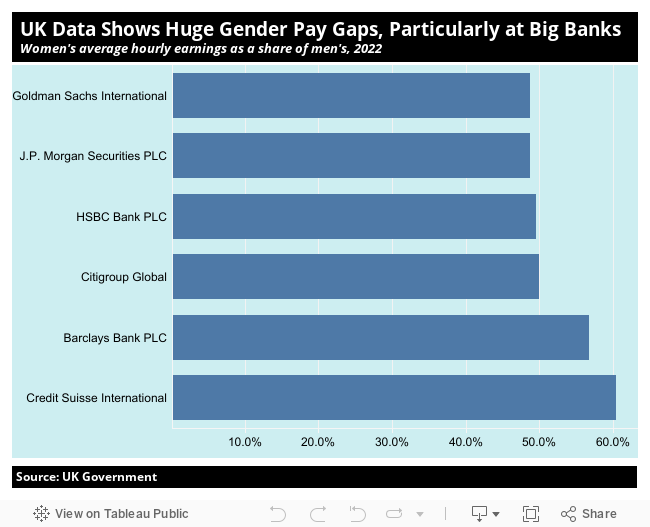
Since 2017, the UK government has required corporations with more than 250 employees to disclose the pay gaps between the men and women on their payrolls. Large financial firms have among the widest divides because of the scarcity of women in top positions. In 2022, Goldman Sachs International reported the biggest gap in this sector, with women making just 48.7 cents on average for every $1 earned by men at the bank.
Gender Wealth Gaps
Most inequality analysis focuses on income (the wages earned from a job or from capital gains) rather than wealth (the sum of one’s assets minus debts). Income inequality, while stark, pales in comparison to wealth inequality. The divides become even more dramatic when viewed through a gender lens.
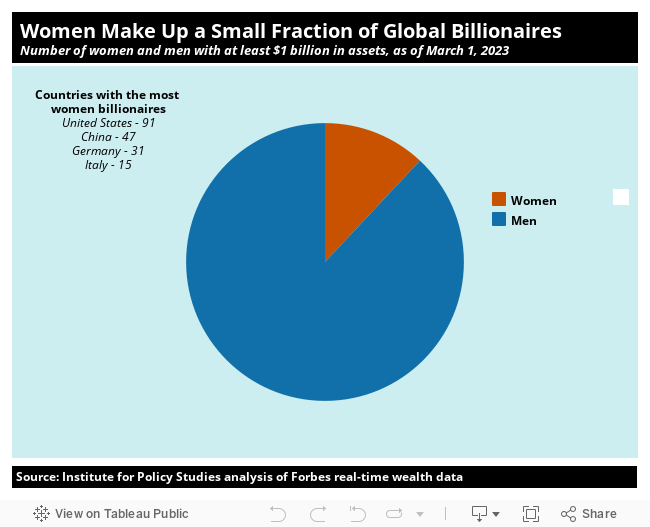
At the top end, we have no more striking sign of increasing global wealth concentration than the rise of the billionaire class. The number of individuals with fortunes worth at least $1 billion has more than doubled since 2010, while remaining overwhelmingly male. As of March 1, 2023, only 298 women ranked among the world’s 2,489 billionaires, accounting for less than 12 percent. Ninety-one of them hail from the United States, nearly double the number in any other country.
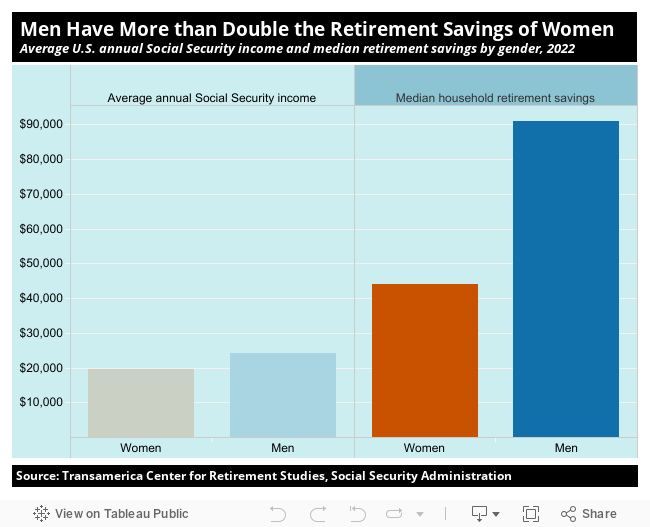
The retirement gap is a key factor in our country’s gender inequality. According to the Transamerica Center for Retirement Studies, American women in late 2022 held $44,000 in median retirement savings, compared to $91,000 for men. The gender pay gap contributes to these disparities, since both pension plan and Social Security payouts are partially based on past earnings. In December 2022, women’s average annual Social Security benefit of $19,656 lagged the benefit for men by $4,584. Women’s smaller retirement nest eggs also have to stretch further because women have longer life expectancies.
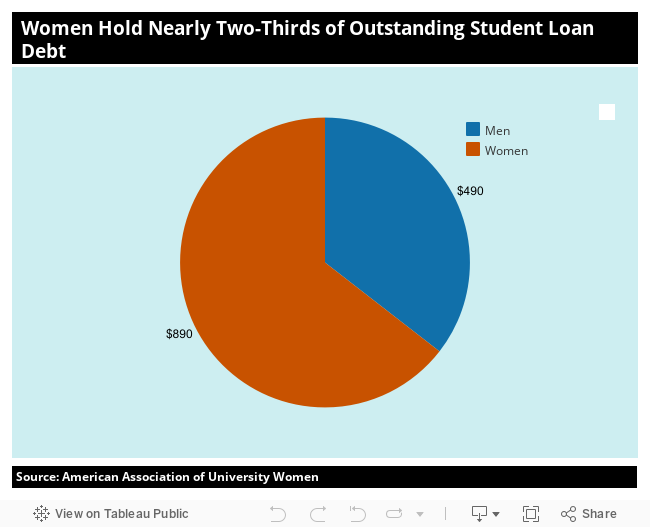
Debt also significantly impacts wealth. Crushing student loan debts drag many young Americans far into the negative side of the wealth line, with women bearing the heaviest burdens. Women comprise 56 percent of college students, but hold nearly two-thirds of outstanding student loan debt, according to the American Association of University Women.

Black, Hispanic, and white women are more likely to have student debt than men in their racial or ethnic group. According to Center for Economic and Policy Research analysis of Americans who have attended college, Black women are most likely to be shouldering this financial burden. More than 43 percent of this group have student loan debt, compared to less than 16 percent of white men.
Gender Poverty Gaps
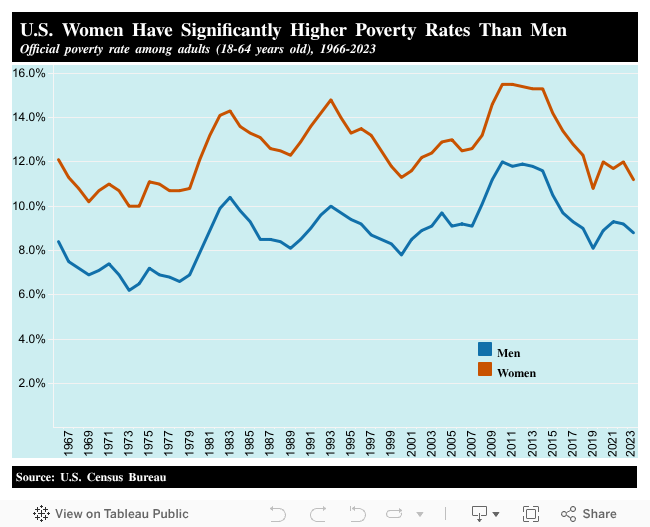
The gender poverty gap has not improved significantly over the past half decade. In 1966, 12.1 percent of women and 8.4 percent of men aged 18-64 lived below the official poverty line. In 2023, 11.2 percent of women in this age group were living in poverty, compared to 8.8 percent of men. In 2023, the poverty threshold for a single person was $14,580 in annual income. Households led by single women with children faced poverty rates of 21.8 percent that year, nearly double the 11.4 percent poverty rate for households led by single men with children, according to the U.S. Census Bureau.

Poverty is a particularly acute problem for women of color. In 2023, Native American women had the highest official poverty rate, at 20.4 percent – three times the 6.8 percent poverty rate for white American men. Black women had the second-highest poverty rate, at 16.8 percent, according to the National Women’s Law Center.
Transgender Economic Gaps
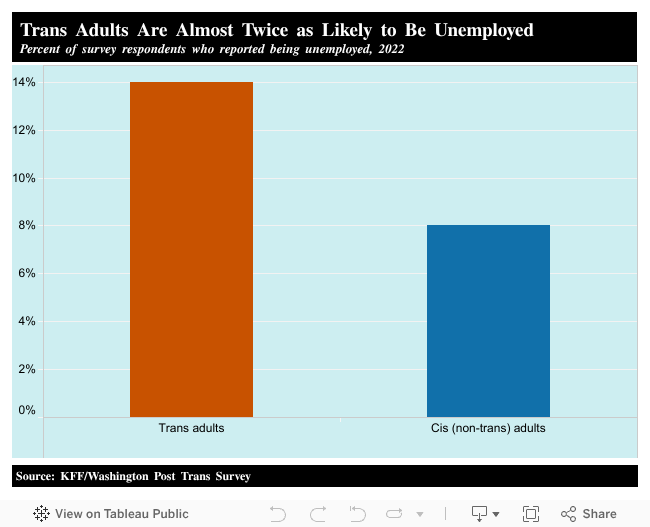
According to a KFF/Washington Post Trans Survey, a larger share of trans adults report being unemployed (14 percent vs. 8 percent) compared to cisgender (non-trans) adults. These findings reflect the significant barriers trans individuals already face in employment access and opportunity. In the National Center for Transgender Equality’s 2022 U.S Trans Survey, more than one in ten (11 percent) of respondents who had ever held a job said they had been fired, forced to resign, or laid off because of their gender identity or expression.
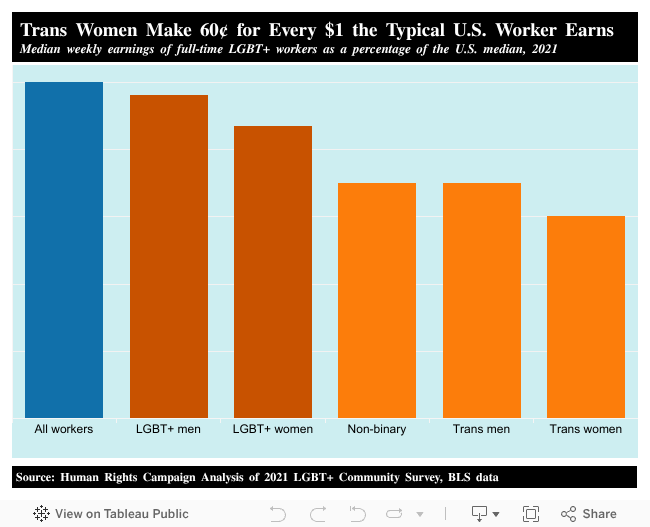
People in the LGBTQ+ community tend to earn significantly less than the typical U.S. worker. Transgender women experience the largest gap, earning only 60 cents for every dollar earned by the typical U.S. worker, according to Human Rights Campaign analysis. Trans men earn just 70 percent of U.S. median pay. This analysis focuses only on full-time workers, meaning the wage gap for transgender individuals may be even larger, since they are more likely to be unemployed or underemployed.

Transgender individuals also experience exceptionally high poverty rates. The Williams Institute at the UCLA Law School analyzed results from CDC surveys conducted between 2014 and 2017. They found that the overall poverty rate among trans people stood at 29.4 percent — nearly twice the 15.7 percent poverty rate among cisgender straight people. Racial and gender disparities further exacerbate the disparities. The Williams Institute found that 38.5 percent of Black transgender and 48.4 percent of Latinx transgender adults were experiencing poverty. White cis-straight men had by far the lowest poverty rate, at just 7.6 percent.
Inequality and Reproductive Rights
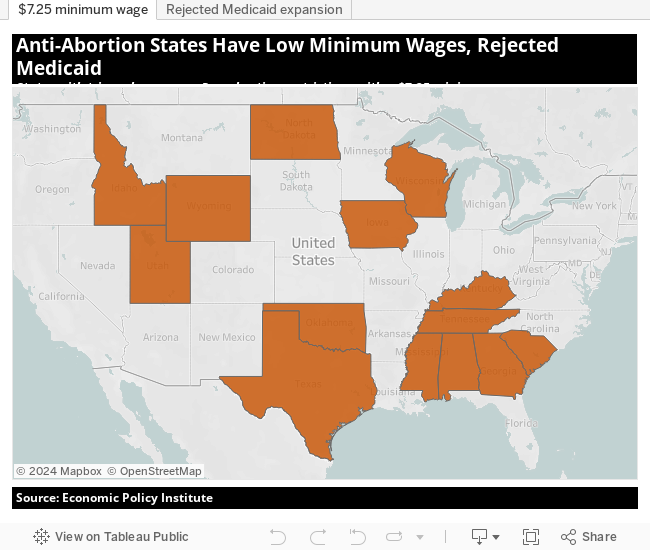
The impact of the Supreme Court decision striking down Roe v. Wade will be most severe for low-income people in states with long histories of restricting abortions. As shown by Economic Policy Institute research, many of the states with either trigger laws (which automatically banned abortion upon Roe’s overturn) or pre-Roe abortion bans or restrictions are also states that have not raised their state minimum wage above the federal floor or have rejected federal support to allow Medicaid expansion. Eight states – Georgia, Alabama, South Carolina, Wisconsin, Wyoming, Texas, Louisiana, and Mississippi – have both rejected Medicaid expansion and have a $7.25 minimum wage.
Inequality Across Gender Diversity and Covid-19
The Covid-19 pandemic has exacerbated long-standing gender inequalities. Women are more likely than men to work in service occupations, including domestic work, restaurant service, retail, tourism, and hospitality, that require face-to-face interactions and have been hard-hit by layoffs. Because of the nature of these jobs, teleworking is not an option for many women.
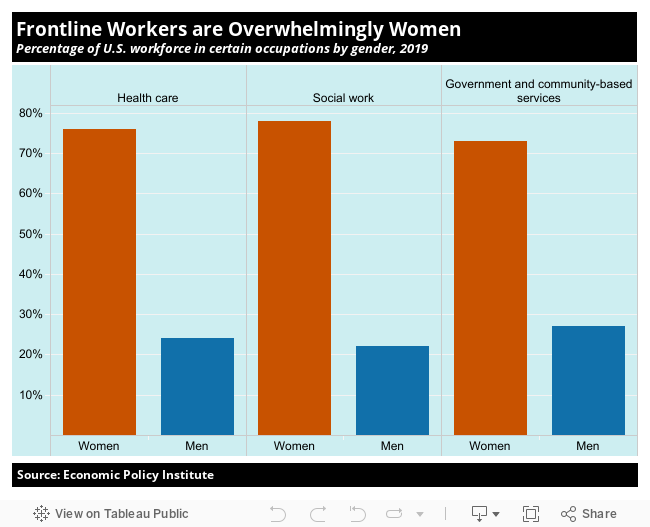
Frontline jobs, which are the ones most often deemed “essential” and require people to work in-person, are also heavily staffed by women. The health care, social work, and government and community-based services occupations are overwhelmingly made up of women, according to research from the Economic Policy Institute. Women make up 73 percent of government and community-based services workers, 76 percent of health care workers, and 78 percent of social workers.
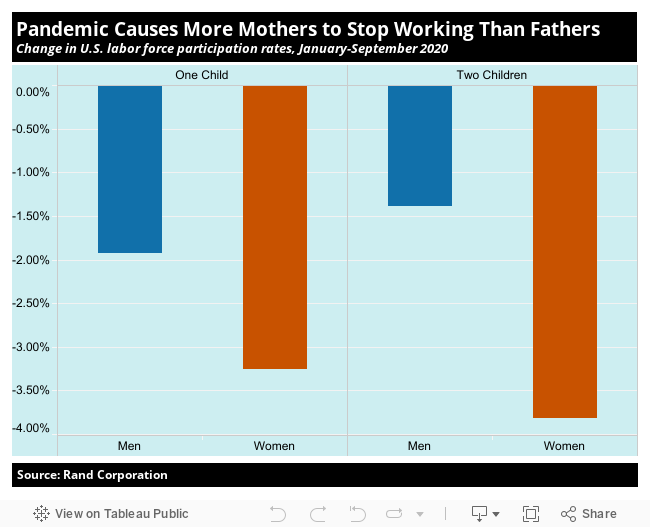
The official U.S. unemployment rate does not include people who have not looked for work in the past four weeks. Because women tend to bear more responsibility for family caregiving, women with children were more likely than men to drop out of the labor force when schools and care centers closed due to Covid. Rand Corporation research reveals that the steepest decline in labor force participation in the first phase of the pandemic was among women with two children, at 3.82 points, compared to a 1.39 point drop for men with two children. More recently, the shortage of affordable childcare services has emerged as a barrier for women in returning to jobs in restaurants and other low-wage sectors, contributing to staffing challenges.
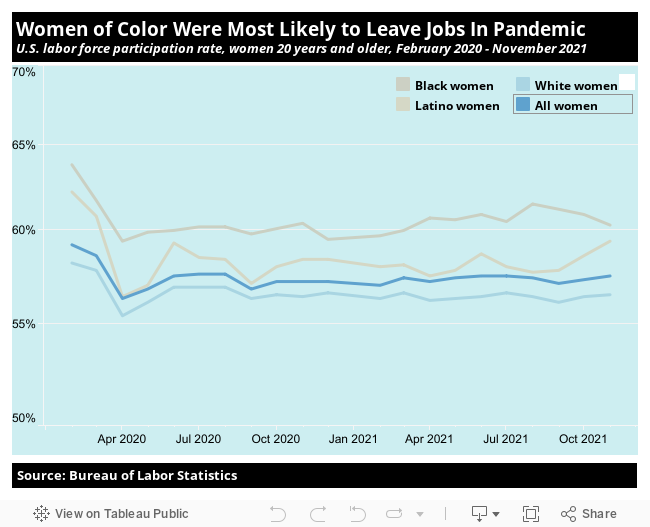
Among U.S. women who’ve stopped looking for work during the pandemic, the steepest drops have been among women of color. Between February 2020 and November 2021, Black women had a 3.5 percentage point drop in labor force participation and Latinx women had a 2.8 point drop, compared to 1.7 for white women. Several factors may have contributed to women of color becoming discouraged from seeking work. On top of gender inequities, women of color face racial discrimination in hiring and layoffs and they are disproportionately concentrated in service and care sector jobs with high risks of Covid exposure.
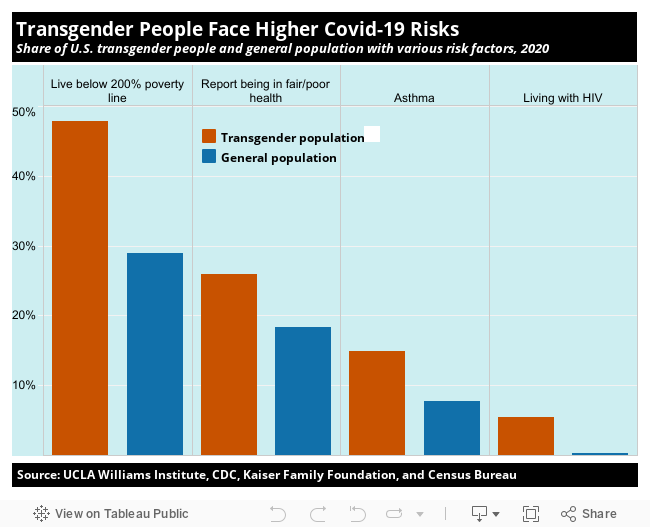
Transgender people are always in a precarious position, but the Covid-19 pandemic has made them particularly vulnerable. According to research from the Williams Institute at UCLA, transgender Americans are at a higher risk for Covid-19 for several reasons. They are more likely to be low-income, with 47.7 percent of transgender people living below 200 percent of the official U.S. poverty line, compared to 28.9 percent of the general U.S. population. They are also significantly more likely to suffer from asthma and HIV, conditions that put people at higher risk of mortality if they contract Covid-19. And they experience high barriers to receiving health care.
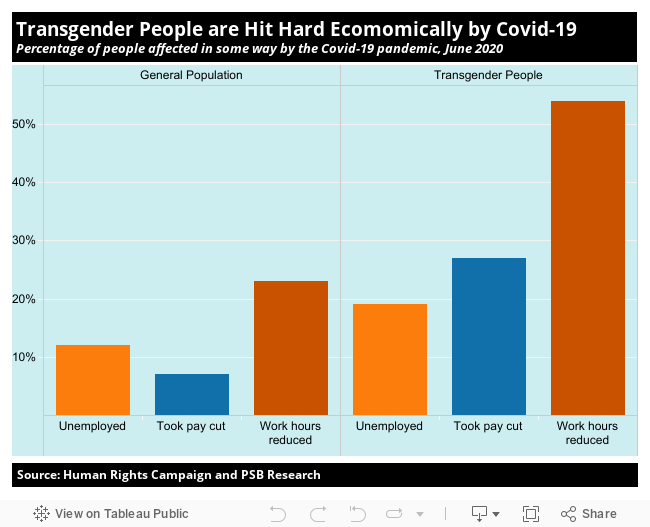
The pandemic has also hit transgender Americans especially hard economically. A poll from the Human Rights Campaign and PSB Research shows that as of June 2020, 54 percent of transgender people had experienced reduced work hours — more than double the 23 percent of the total U.S. workforce that faced a similar reduction. Twenty-seven percent of transgender people had experienced pay cuts, compared to just 7 percent of the U.S. workforce. And 19 percent had become unemployed due to the pandemic, a significantly larger share than the general population.