
Billionaire Wealth Concentration Is Even Worse than You Imagine
The share of U.S. wealth held by the top 0.1 percent has grown nearly 60 percent since 1989.
Shutterstock
Nvidia's Jensen Huang joins the oligarchic dozen, a group that has more influence over our media and politics than ever.
The collective net worth of America’s top twelve billionaires has surpassed $2 trillion as of December 3.
This is an unsettling new milestone for wealth concentration in the United States. The oligarchic dozen is richer than ever, and they are endowed with extreme material power that can be used to pursue narrow political interests at the expense of democratic majorities.
There is one newcomer to the moneyed club that we surveyed back in 2020: Jensen Huang. He replaces Walmart heiress Alice Walton.
The collective wealth of this iteration of the oligarchic dozen has increased by more than $1.3 trillion, or 193 percent, since Forbes published its 34th annual list of global billionaires in April 2020.
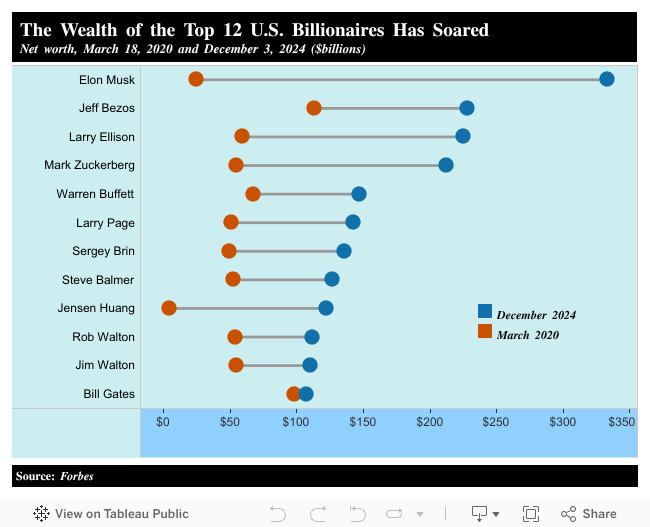
The ascendancy of Huang is noteworthy. As cofounder and CEO of Nvidia, his wealth has skyrocketed from $4.7 billion in 2020 to $122.4 billion — a mind-boggling 2,504 percent increase — over the last four years.
Huang’s surging wealth is directly tied to the hype surrounding artificial intelligence. The demand from Big Tech for Nvidia’s semiconductor chips to power AI has pushed the company’s stock market value to new heights. To put that demand into perspective, Huang could have been the world’s first trillionaire if his ownership stake in Nvidia, currently at 3.5 percent, mirrored Larry Ellison’s 40 percent stake in software giant Oracle.
The looming expansion of the oligarchic dozen’s carbon footprint is worrisome. Every single individual owns or is a controlling shareholder of a business that is investing billions of dollars in artificial intelligence.
The energy that data centers demand to power AI is effectively delaying the green energy transition. The lack of green energy supply compels data centers to rely on new and existing fossil fuel infrastructure to meet its ever-expanding power consumption needs.
Elon Musk and Jeff Bezos, along with others in the billionaire class, have unsurprisingly used the power of their wealth to expand their political and economic influence. They have both purchased large media platforms, which has granted them the ability to set the terms of public debate with the hopes of influencing public opinion in their favor.
Musk has not been shy about his support for president-elect Donald Trump. It is reported that his super PAC spent $200 million to ensure the Republican ticket’s electoral victory. In return, Trump is expected to repeal tax credits for electric vehicles to the competitive advantage of Musk’s Tesla.
Bezos did not directly join the fray, but he staged a coup of The Washington Post’s editorial board and prevented them from making a presidential endorsement, keeping Amazon’s current contracts with the federal government in good standing and protecting future ones.
We see the effects of this growing concentration of wealth and economic inequality everywhere – plutocratic influence on our politics, wealth transfers from the bottom to the top, and the acceleration of climate breakdown.
Omar Ocampo is a researcher at the Program on Inequality and the Common Good at the Institute for Policy Studies.
by Chuck Collins and Omar Ocampo
The share of U.S. wealth held by the top 0.1 percent has grown nearly 60 percent since 1989.
by Omar Ocampo and Maya Khadr
As private grocers abandon low-income neighborhoods, Zohran Mamdani’s public ownership proposal offers a solution to market failures.
by Omar Ocampo
Increasing state taxes on the wealthy raised revenue without triggering millionaire flight, a new study found.
Inequality.org
→ In Your Inbox
Get the indispensable guide to the latest on our unequal world, in your inbox every Wednesday.
You can unsubscribe any time. We do not sell or share your information with others.
Click to close
Inequality.org
→ In Your Inbox
Get the indispensable guide to the latest on our unequal world, in your inbox every Wednesday.
You can unsubscribe any time. We do not sell or share your information with others.
Click to close
Inequality.org
→ In Your Inbox
Get the indispensable guide to the latest on our unequal world, in your inbox every Wednesday.
You can unsubscribe any time. We do not sell or share your information with others.
Click to close
Inequality.org
→ In Your Inbox
Get the indispensable guide to the latest on our unequal world, in your inbox every Wednesday.
You can unsubscribe any time. We do not sell or share your information with others.
Click to close
Inequality.org
→ In Your Inbox
Get the indispensable guide to the latest on our unequal world, in your inbox every Wednesday.
You can unsubscribe any time. We do not sell or share your information with others.
Click to close