
Sixteen Billionaires Who Made Their Fortunes Off the Backs of Low-Wage Workers
Such obscene inequality is spurring actions to use tax policy to shrink billionaire fortunes.
President Trump and Elon Musk have expressed an interest in selling off the U.S. Postal Service to for-profit corporations. Even piecemeal privatization of this public agency would have wide-ranging effects on postal customers, employees, businesses, and our broader economy. One nearly certain result: a dramatic increase in package delivery prices.
Unlike the for-profit carriers, the Postal Service has a universal service obligation to provide affordable deliveries to all Americans, regardless of where they live or work. Currently, USPS parcel rates are about 25 percent to 60 percent below FedEx and UPS prices.
Without competition from this public service, for-profit firms would jack up delivery fees on as many customers as possible. Who would be hit hardest? Most likely those who live or work in ZIP codes where private carriers already impose surcharges because deliveries to these addresses are less profitable.
A new Institute for Policy Studies report finds that UPS and FedEx area surcharges now apply to retail customers sending parcels using their own packaging to addresses in ZIP codes where 102 million Americans live. Not surprisingly, these include addresses in Hawaii, Alaska, and rural and remote areas. But they also cover many small towns and neighborhoods just outside major cities.
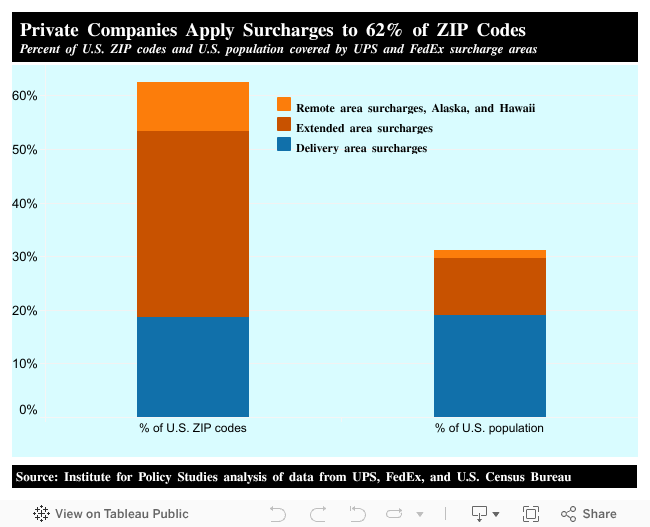
UPS and FedEx charge around $43 extra for shipments to Alaska and about $15 extra for deliveries to Hawaii and remote areas where nearly 4 million Americans live. The private carriers slap “extended area surcharges” of $8.30 on home deliveries in rural ZIP codes with a combined population of 35 million. Residential delivery surcharges run a little over $6 in suburban and small-town ZIP codes where 64 million people live.
Unlike the public Postal Service, the private carriers also impose extra charges for Saturday delivery, for fuel (based on distance), for package pick-up, and for residential delivery. These charges reflect the higher costs for companies that, unlike USPS, aren’t already visiting every address six days a week.

Sarah Anderson directs the Global Economy Project and co-edits Inequality.org at the Institute for Policy Studies. Bluesky: @sarahanderson.bsky.social