Philanthropy in America — the transfer of wealth out of private hands, ostensibly to non-profit organizations working for public benefit — is being captured by Wall Street’s wealth defense industry.
The country’s biggest philanthropists become wealthier every day from the appreciating value of their stockholdings and unrealized assets. Most of today’s mega-rich Americans live off the “buy, borrow, die” philosophy, skimming cash off their pools of wealth and using lines of credit to avoid incurring taxable income. And their philanthropic practices mirror their tactics to accrue, preserve, and defend their wealth.
Financial services advisors understand that by including philanthropy management in their portfolio of services, they can make money and generate tax benefits for clients.
Wealthy donors use donor-advised funds (DAFs) and private foundations to get tax deductions immediately but maintain control over the disbursement of the money. Federal law mandates that private foundations must disburse just 5 percent of their assets each year, while donor-advised funds have no such requirement at all.
With the help of professionals, donors are also pioneering the use of financialized instruments such as LLCs, impact investing, and recoverable grants. In Bank of America’s most recent Study of High Net Worth Philanthropy, the number of wealthy households participating in impact investing had doubled over the past three years, and 40 percent were using that impact investing in place of some or all of their charitable giving. And venture capitalists and fintech companies are eyeing opportunities to generate fees off “frictionless” charitable transactions.
These choices have made our working charities fragile, over-dependent on fewer donors, and vulnerable to profit-seeking from emerging technology and investment trends. This is dangerous for our society and for nonprofits, who increasingly must accommodate the priorities and behaviors of wealthy donors.
In other words, our system effectively classifies pools of capital under management as charities — which both increases inequality and shortchanges groups on the ground doing actual charity work.
When Congress formed the laws that govern our charities over 50 years ago, they didn’t intend for things to look this way.
This report, the fourth installment in our Gilded Giving series since 2016, examines these trends in detail and recommends several policy fixes to make sure philanthropy serves the public interest, not the bottom lines of wealthy donors and investors. Key chapters explore how the financial sector drives the expansion of DAFs and how financial sector instruments blur the line between charity and investment.
The full version includes much more background and detail, including charts, citations, and methodology.
KEY FINDINGS
The share of giving to intermediaries keeps getting bigger.
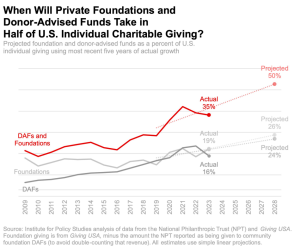
- Donor-advised funds (DAFs) and foundations together take in 35 percent of all individual giving in the United States. If these two types of intermediaries continue to grow at the rate they have for the past five years, by 2028 they will take in half of all U.S. individual giving.
- With each passing year, an additional 2 cents of each dollar donated by individuals is funneled into intermediaries and away from working charities. Assuming that their assets will grow at the same rate they have over the past five years, the assets held in DAFs and foundations will eclipse $2 trillion by 2026. That’s $2 trillion sidelined from flowing immediately to nonprofit organizations working to solve problems — but where the donors have already gotten their tax deduction.
Tech and finance companies are seeking opportunities to profit from “charitable” giving, reducing how much money actually reaches working charities.
- More and more technology companies are promoting DAF-related platforms, apps, and widgets as tools to ensure charity remains largely under their control. These companies profess that their products will make DAF giving more bountiful, effective, and efficient — while charging fees, promoting DAFs as tax-avoidance vehicles, and telling investment advisors that their tools will help them “maintain AUM” (the acronym for assets under management, in industry parlance).
- Four DAF sponsors closely affiliated with the tech sector — PayPal, Endaoment, Daffy, and Charityvest — have a combined total of $127 million in assets, and they collectively grew by 237 percent from 2020 to 2022.
- The financial industry is helping to blur the distinction between investment and philanthropy, encouraging the idea of a seamless continuum from traditional for-profit investment through ESG screening and micro-loans to “traditional” philanthropy. Investment advisors often position philanthropy as part of a suite of spending behaviors, rather than something qualitatively different — something that, by its nature, requires individuals to relinquish personal interest and control.
- Bank of America’s most recent Study of High Net Worth Philanthropy in 2021 found the number of wealthy households participating in impact investing had doubled over the previous three years, and 40 percent were using that impact investing in place of some or all of their charitable giving. Impact investing has fewer reporting requirements than charitable giving, so investors do not have to reveal which businesses, nonprofits, or campaigns they fund.
- Recoverable grants are increasing in popularity, offering one more way that private foundations can get around mandatory payout requirements, and one more way that DAF sponsors can increase the amounts in their investment portfolios.
- DAFs are increasingly marketing their products for perpetuity, which can have destructive consequences on the speed of giving. Our recent analysis estimates that a hypothetical national sponsor that has a strong emphasis on charitable grantmaking on their website would pay out at 62 percent, while a hypothetical national sponsor that has a strong emphasis on extrinsic donor benefits would pay out at just 6 percent.
- Of the more than 107,000 private foundations that filed annual tax returns electronically in 2022, 18,941 of those foundations — almost 18 percent — paid compensation to at least one trustee that was a bank, a trust company, or a wealth management company.
Status quo defenders are spending millions to lobby against common sense reforms.
- From 2018 to early 2023, 21 organizations spent an estimated $11 million to lobby around DAFs, fueling major organized opposition to the reform of donor-advised funds’ fee structures and payout requirements. Most, if not all, of this money was likely spent fighting the common-sense reforms that would make our charitable system more responsive and transparent.
- An estimated $3 million of that total was spent to defeat the ACE Act, a bipartisan effort to boost DAF payout. And when the IRS proposed new regulations to tax DAF money managers, it received 236 public comments on those proposals, the vast majority of which were submitted by DAF sponsors, DAF advocacy groups, DAF lobbying firms, law firms, and trade associations for the investment industry.
WHAT WE CAN DO
Congress last codified the rules that shape how money flows through our charitable sector in 1969. Wealth inequality was at one of its lowest points in modern American history, in part due to progressive top marginal tax rates. Late-sixties legislators did not anticipate the massive growth of concentrated wealth or the expansion of the financial industry into the charitable sector.
Now, with creeping profit incentives and deepening struggles for working charities, it’s time for legislators to act. We recommend a number of common sense reforms:
- Enact tougher regulations to ensure donations to charity actually reach working charities in a timely manner, instead of sitting for years or decades in donor-controlled intermediaries that continue to provide fees for money managers.
- Enact reforms to eliminate the shell games and tax dodges that financial advisors craft to diminish and delay the flow of funds to qualified charities.
- Organize a coalition — of smaller DAF-sponsoring organizations like community foundations, other nonprofit professionals who are exasperated by the status quo of mega-giving, and donors who recognize the perils of such imbalanced power over the sector — to pressure Congress and state governments into taking action.
- Uplift the positive examples of DAF sponsors who facilitate generous and steady giving even though laws do not yet require it.
You can read about these ideas in much more depth in the full version of our report. And if you’d like to get involved, you can sign up to join our latest campaigns, the Donor Revolt for Charity Reform and Stop Hoarding Charity Dollars.
