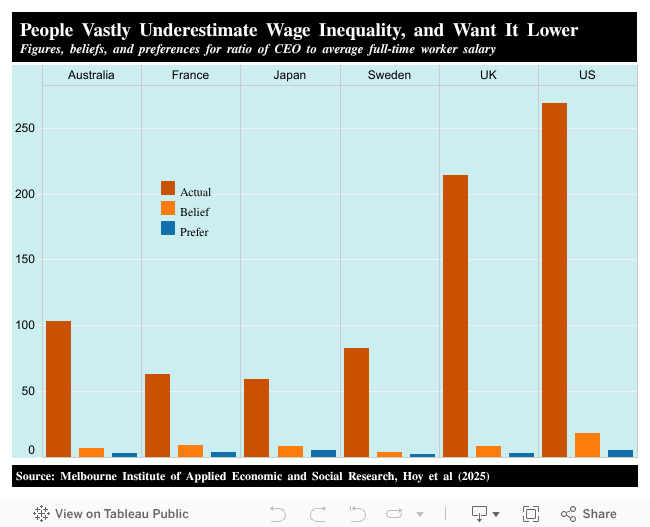
How do people of different political leanings respond to information on the wage gap?
To understand how people’s preferences change when they learn about the extent of wage inequality, we randomly assigned respondents to one of three groups. A control group received no information about actual wage gaps. Two “treated” groups received simple facts about wage inequality: either the pay ratio between CEOs and average workers, or the ratio of wages at the top 10 percent to the bottom 10 percent of the distribution.
On average, providing these facts had little impact on increasing people’s preferences for redistribution – except among those on the far right. After learning about actual wage disparities, these respondents became much more supportive of redistribution. We observe this pattern across a wide range of questions, including support for raising taxes on the highest 1 percent of wage earners. In some cases, the treatment dramatically narrowed the gap in redistribution preferences between far-right and far-left voters.
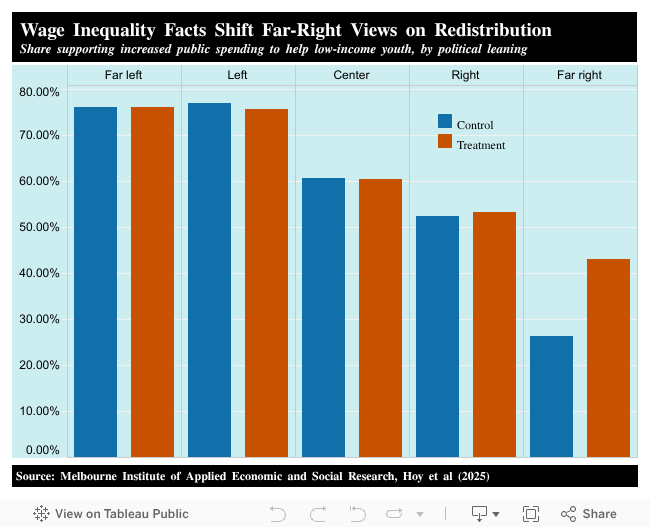
For example, the chart below shows the share of total respondents (across all countries) who support increased public spending on education to foster greater opportunities for children from low-income households, broken down by how respondents self-identify politically.
Note: Treatment groups received simple facts about wage inequality in their country, whereas the control groups received no information. See Hoy et al (2025) for further details.
For the control group – those not given further information about actual wage gaps – the divide between the left and right is stark, with nearly 80 percent of respondents on the left supporting higher spending on low-income households compared to just over 20 percent on the far right. By contrast, for treatment groups — those who received information about wage inequality — the gap significantly narrows, with almost half of those on the far right supporting this.
Implications for inequality and politics
Our findings show that opposition to redistribution isn’t just based on values or ideology. Misperceptions of reality also play a significant role. For most citizens, preferences stay consistent even when facts are presented. However, among far-right voters, correct information can significantly influence attitudes. We find that far-right respondents did not alter their beliefs about meritocracy or their behavior, such as their willingness to join a union. Rather, our findings appear to be driven by far-right respondents viewing the current level of wage inequality as so extreme — and perhaps unfair — that government intervention is necessary.
This matters because far-right parties, which are as popular as they have been in 80 years, often mobilize support around economic grievances while opposing redistributive policies. This leads many to believe that far-right voters’ preferences would not be influenced by correct information about wage inequality (indeed, our study includes a poll of 100 experts who predicted results in line with that sentiment). In fact, they turn out to be the most affected. As such, the political space for redistributive policies is larger than commonly believed.
For those concerned about rising polarization and inequality, the message is cautiously optimistic: communication matters, even among groups often assumed to be unmoved by facts.
Originally published by LSE Inequalities, a blog is run by the International Inequalities Institute at the London School of Economics.