
New York Is Getting Richer. Most New Yorkers Aren’t.
Data shows that New York City has grown richer since the pandemic, but the gains have flowed overwhelmingly to the top.
Most bookstores are organized around a familiar, “basic economics” retail formula. New releases occupy the front tables, bestseller lists anchor prominent displays, and space is intentionally designed to encourage purchase before customers leave.
Bol Bookstore, a worker-owned cooperative in Washington, D.C., feels different as soon as you walk in. Housed in a studio space with large garage-style doors opening onto the street, its shelves feature works like C.L.R. James’ Beyond a Boundary and Walter Rodney’s How Europe Underdeveloped Africa.
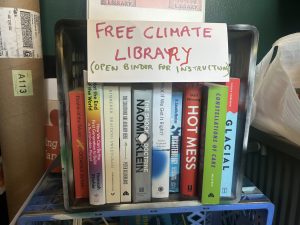
A large wooden table and chairs occupies most floor space, where community members gather for reading groups, author talks, and other events. Alongside the bookshelves, a zine library offers quick political education, while a “free climate library” invites readers to explore environmental justice through books such as Robin Wall Kimmerer’s Braiding Sweetgrass: Indigenous Wisdom, Scientific Knowledge, and the Teachings of Plants and What If We Get It Right? Visions of Climate Futures by Ayana Elizabeth Johnson.
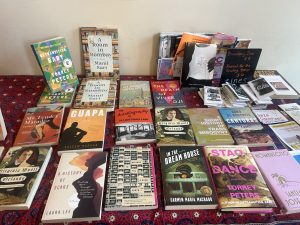
Taken together, Bol Bookstore appears just as much a community institution as a conventional bookselling space. Bol’s brick-and-mortar location launched on November 15, 2025. “It felt very communal,” said Matthew Rivera, a D.C. resident who was there that day, told Inequality.org. “It was community success at the end of the day.”
Today, the bookstore continues to function as both a place to buy books as well as a neighborhood space for public education. According to bookstore leadership, those differences are intentional and a result of its ownership structure.
Unlike most bookstores, Bol is owned collectively by the people who operate it. Rather than reporting to a single proprietor or outside investors, worker-owners share responsibility for major decisions — from the books they stock to the events they host and the long-term direction of the cooperative.
“Economic justice says we need to redistribute wealth, we need to keep wealth in our neighborhoods, we need workers who are owners so that [business] isn’t exploitative in the same way,” Arjun Shankar, a worker-owner who helped found Bol in 2021, told Inequality.org.
Worker cooperatives remain a relatively small part of the American economy, but evidence suggests they can serve as one solution to widening incoming inequality. The United States Federation of Worker Cooperatives (USFWC) defines the formations as businesses owned and governed by workers who participate democratically in management and share in the enterprise’s profits.
That structure produces dramatically smaller pay gaps. According to the The Democracy at Work Institute and the USFWC’s recent annual report, the median top-to-bottom pay ratio among worker cooperatives is just 1.44-to-1. By comparison, Economic Policy Institute analysis found that CEOs at large U.S. firms earned roughly 281 times as much as the typical worker in 2024.
For Bol’s founders, however, democratic profit distribution is just the beginning. They argue that shared ownership also influences what bookstore operations look like more broadly. It influences which books fill shelves, which conversations take place inside the space, and what role the bookstore occupies in the community.
Decisions that might otherwise might be driven primarily by sales projections are managed through collective discussions about mission, education, and sustainability. Shankar said the cooperative model gives the bookstore flexibility to prioritize books that align with its values rather than simply following market demand. Rather than centering the latest bestsellers or celebrity memoirs, Bol Bookstore intentionally curates titles they believe contribute to historical understanding and political education.
“The difference between a bookstore and, say, a grocery cooperative is that a bookstore cooperative is about political education — it’s an educational model,” Shankar said. “A grocery cooperative has a different goal of making sure people get fed, [whereas] our goal is to make sure people know their history, know their rights, and know how people before us have struggled and resisted.”
Beyond retail and used bookselling, Bol extends the mission through reading groups, film screenings, and community events. In May 2026, Bol partnered with the publisher Haymarket Books and other organizations to host the Working Class Literature Festival, bringing together writers, organizers, and readers to explore the relationship between labor and literature. For worker-owner Thrisha Mohan, that programming also creates a bridge between the university and the broader D.C. community.

Mohan got involved with Bol through an introduction from her professor at American University. She said the bookstore gives university students a way to engage with the surrounding community beyond campus.
“It grounds students who are transplants to be aware and support local work, connecting them to direct service organizations, connecting them to mutual aid organizations, and being a space for political work in D.C.,” Mohan said.
That emphasis on community-based learning is central to Bol’s unique approach to bookselling. Shankar said Bol Bookstore’s programming is intended to make learning accessible outside traditional educational institutions, particularly as the cost of higher education continues to rise.
“Why this place needs to exist is it’s not the university — the university is a corporate space,” Shankar said. “A lot of this information is unfortunately a luxury and something that is often not accessible.”
For Geoff Gilbert, the Legal and Technical Director at Beloved Community Incubator (BCI), the broader equality-oriented mission helps explain why bookstores are particularly well suited to cooperative ownership. BCI, a DC-based nonprofit, serves as a seed fund for worker cooperatives, including Bol Bookstore, through capital investment.
“There are values expressed in the books that are sold, the events that are held, and the community that is built around all that,” Gilbert said. “I think that lends itself to people wanting to create a space together.”
Supporters often describe this model as a form of economic democracy or a “solidarity economy.” At its simplest, the concept means extending democratic participation beyond elections and into the economy itself by giving workers greater control over the institutions they sustain. At Bol, that idea shapes governance as workers-owners are distributed across five committees — book curation, events, space, finance, and communications — to operate the bookstore.
The success of cooperative bookstores like Bol raises an obvious question: if worker ownership offers so many advantages, why aren’t there more of them?
One answer is that running an independent bookstore has never been easy. Bookselling is a notoriously low-margin business, and many independent bookstores, facing an existential threat from Amazon, depend on cafés, events, and other revenue streams to remain financially sustainable. Worker ownership does not eliminate those economic pressures.
What it changes, Gilbert explained, is how businesses respond to them.
In a conventional firm, difficult financial periods often result in decisions flowing from the top down, with labor costs among the first expenses reduced through layoffs or cuts in hours. Cooperatives operate differently because the workers making those decisions are also the owners responsible for the long-term health of the business. Rather than maximizing returns for outside investors, they collectively decide how to steward profit surplus while preserving both jobs and the institution itself.
Building new cooperatives, however, requires more than shared values. It requires capital.
Gilbert said access to financing remains one of the greatest barriers facing cooperative businesses because traditional lenders often evaluate them using standards designed for conventional profit-seeking firms. Through its membership in the nationwide Seed Commons network, BCI helps worker cooperatives access what it describes as “non-extractive financing” — an alternative lending model in which repayment is tied to the long-term success of the business rather than fixed schedules that can strain new enterprises.
“That really flips the conventional relationship between finance and business,” Gilbert said. “You only have an obligation to pay from surplus. Going in, it’s an incredibly patient loan by design.”
For Gilbert, expanding worker ownership means building an ecosystem capable of supporting cooperative businesses over the long term. Capital investments, technical assistance, and organizational development are all intended to reduce the structural barriers that have historically limited the growth of worker-owned enterprises, according to Gilbert.
Worker-owned bookstores remain a small part of the broader economy. But Bol Bookstore illustrates how different forms of ownership can produce different kinds of institutions. Cooperative ownership helps redistribute profits, along with reshaping who makes decisions, which ideas are amplified, and how communities gather around them.

Julian Villa is a 2026 Henry A. Wallace Fellow at the Institute for Policy Studies.