
A Worker-Led Alternative to Billionaire-Owned News in DC
A Q&A with two founders of the 51st, a worker-led nonprofit newsroom launched after the closure of the beloved local outlet DCist.
The Washington Post’s decision — at the behest of billionaire Jeff Bezos — to fire, according to some estimates, over 40 percent of the newsroom is devastating for journalism and the DC area.
Despite its storied history and name recognition, the Post had been struggling when the billionaire Amazon founder purchased the outlet for $250 million in 2013. It might be laughable in hindsight, but it’s not surprising that pundits and even workers in the newsroom viewed Bezos as a “savior” at the time.
And for some years the situation worked well — during the first Trump administration, the Post recorded record revenues. The outlet has been operating at a loss for the last few years and Bezos has not seemed interested in covering the costs of good journalism, instituting several rounds of staff reductions.
The waves of layoffs culminating in this week’s bloodbath have further cemented what we should have known all along: benevolent billionaires are not going to save journalism.
Their goals are misaligned with those of journalism, and they often try to curry favor with the same political figures that their newsrooms should be challenging.
Even setting aside the decimation of the Post’s metro desk, the suite of local news options available to Washington, DC residents has shrunk dramatically in last decade as the portion of the digital ad-share pie not gobbled up by tech monopolies has grown smaller.
Washington City Paper ended its print circulation in 2022 and, in February of 2024, DCist was shut down by its owner, the NPR-affiliate station WAMU.
Luckily for DC residents, several of the staffers laid off in the closure of DCist decided that the service they provided to the community was too important to abandon. Just months after DCist was shuttered, the worker-led nonprofit news organization the 51st was born.
Inequality.org recently hopped on a Zoom call with Abigail Higgins and Maddie Poore, two of the outlet’s founders, to talk about what they’ve learned from the 51st and how the erosion of the Post has changed local news needs.
(This interview has been edited for length and clarity. An additional disclosure: this piece’s author is an infrequent contributor to the 51st.)
Chris Mills Rodrigo: We’re coming up on two years since the 51st launched, what are your biggest takeaways about running a worker-led local news organization so far?
Abigail Higgins: One thing that we have though a lot about is the importance of slow and steady growth that is controlled by workers and backed by the community. I think we’re seeing in so many different sectors, but particularly in news right now, the dangers of institutions being controlled by the powerful and institutions that don’t directly respond to community needs. It’s been really important for us from the beginning of starting the 51st to ensure that we were upholding those two tenets: that we were creating a newsroom that DC residents wanted and felt represented by and that workers had a direct say in the structure and future of.
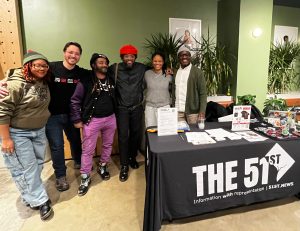
Another really important takeaway is that it’s a myth that people won’t pay for and support news. The growth that we’ve had at the 51st is remarkable for a lot of reasons, among them that we don’t have a paywall. (The outlet has 4,216 paid members across three tiers — $10, $24, and $51 a month — as of this week). The vast majority of our funding comes directly from readers, from DC residents. At the same time, it is very challenging to power a newsroom on small individual donations alone. A thing we caution to other outlets and try to underscore to our supporters is that long term, newsrooms need large dollar support, whether that is philanthropic dollars, or state or government funding from digital ad taxes or other avenues.
We’re so proud of and humbled by how much individual DC residents have stepped up to make the 51st happen. We are also aware of how much growth we still have to do to build what DC needs and deserves, and that that will require, both for us and the journalism industry more broadly, some large institutions and wealthy people to step up as well.
Maddie Poore: One other thing I’ll add on funding is that given the changes in and realities of the journalism world, we need to start thinking of funding local news specifically as a public good and a public service. There are policy solutions being introduced all around the country to invest tax dollars in funding independent local news, which is a really important piece of the puzzle to make sure we can have a robust local news ecosystem. (DC City Council member and mayoral candidate Janeese Lewis George introduced legislation last year to do just that.) There’s a ton of different interesting approaches to that, whether it be advertising subsidies for local businesses to support local news, or voucher programs for citizens to spend on outlets they want to support.
CMR: It seems like the model of journalism funded by online ad revenue is somewhat defunct. We’ll get to the Post later, but what do you all make of the argument that good journalism takes a lot of money to make and just might not be profitable in and of itself?
AH: I think what Maddie just described is a really important answer to this. We’re hearing very often that journalism is not sustainable anymore, that now with the internet people aren’t willing to pay for journalism. What we all need to agree and commit it to is that journalism is a public good.
Journalism is a thing that we need. Particularly when it comes to local news, when we lose publications, corporate malfeasance increases, people are less likely to vote, to run for office, are less civically engaged. There is a litany of negative effects when we lose news, so there needs to be a commitment to make it happen. And good journalism is expensive. But when you compare it to all the other things that our government and we as a society spend our money on, it’s really not that expensive.
MP: Just check out those daily National Guard fees!
AH: Exactly. The ad model has collapsed, which means we need to replace that funding with something else.
CMR: What gap in coverage did you see the 51st filling when you launched, what were people looking for?
AH: DC is an interesting case. It’s not a news desert as compared to the very real news deserts, particularly in rural areas across the United States, where there are no publications left. But DC shows signs of approaching a news desert, and has experienced a steady and increasingly dramatic erosion of local news. It’s in a unique position because we have a lot of journalists in DC, but most of them are focused on Congress and what Trump said this week. That’s important work, but we also need journalists who are covering DC as a city where hundreds of thousands of people live and work.

With the closure of DCist, where all of us used to work, followed by dramatic reductions at Washington City Paper, and buyouts at the Post that cut deeply into the Metro section, there were so many different gaps that were left in the city. Dedicated education coverage was dramatically lacking, as was dedicated housing coverage.
A thing we heard from a lot of DC residents was a lack of holistic coverage of crime, not in a dramatic or fear-mongering way, but as a societal issue. What services are young people in DC not getting, what ways are neighbors working to keep each other safe etc.
There was also a huge gap in accountability reporting too, the kind of reporting that holds elected officials feet to the fire. That’s something that our full-time reporter, Martin Austermuhle, does by being at the Wilson Building regularly, going to city council hearings and reporting on what is said and passed. There are very, very few journalists that do that dogged local coverage any more.
MP: The other thing we’ve seen people want is stories about local curiosities. The Pho Viet story, about the beautiful abundant garden outside a mainstay Vietnamese restaurant. Or the one about the lifeguard at Banneker Pool that is always playing bops. The sort of things that help you know the fixtures in your community and your neighbors better, things that make you feel really proud to live in DC. There is tendency in national news to talk about DC as just Capitol Hill, it’s important for us to tell stories about why we love this place and why it’s so much more than just a political backdrop or pawn.
AH: Local news is how you know about and get connected to your neighbors. Another thing we heard as we were doing research before launch was that people felt like they didn’t have the information to make weekend plans anymore, didn’t have information about events happening in the city, or restaurants opening, or community events that don’t grab big headlines. That’s what local news is. It’s how people get connected to the other people who call their city home.
CMR: How are you all feeling about the layoffs at the Post? Relatedly, there seems to be significant demand for a “replacement” for the Post’s coverage, what makes the 51st different from other local news offerings in that regard?
AH: I’m still digesting it — I feel so angry and so sad. What happened at the Post did not need to happen. The money to support a publication like the Post and the journalists who work there exists, and, in fact, exists in the pocket of the man who owns the Post. It’s so frustrating how absolutely unnecessary these cuts were. I feel sad about what we’re losing. I feel sad about the journalists losing their jobs, and about what us as citizens of the United States and of the world are losing from all the stories that will no longer be told. And I also feel really scared. What’s happening at the Post is happening in tandem with losing two and half local newspapers every week and massive institutions like CBS and the Post not only being dismantled, but being repurposed for the aims of powerful right wing interests to further consolidate money at the top and remove the remaining checks that we have on their power.
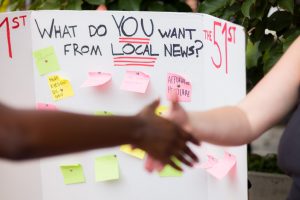
MP: There’s so much to digest, just incredibly heartbreaking and scary and a symptom of the greater collapse we’re seeing across our systems and institutions.
There is a part of me that remains optimistic because of how many people are hungry, eager, and ready to build alternative structures in response to collapse. We are not going to make up this giant void left by this storied institution, but we are taking community feedback really serious and listening to understand what’s needed: an alternative approach to how journalism has traditionally been done, at least institutionalized journalism.
AH: It is really important for us to be clear that we cannot replace the Washington Post. The kind of resources that an institution like that commanded to do vital journalism is irreplaceable. That being said, we are really passionate about the alternative model that we’re building, and really believe in the ability of that model to be part of creating a better local news ecosystem. A local news ecosystem that is not controlled by powerful executives who may or may not have any experience in journalism, one that is directly responsive to the needs of readers and community members.
Local news in particular, but journalism more broadly, does not have a perfect history or present. There are plenty of examples of journalism holding up the interests of the powerful and failing to protect the less powerful. While we contend with what is a catastrophic loss for journalism, it’s also our responsibility to start building better alternatives. We believe that in the community of DC that’s what we’re doing with the 51st.
Thank God we’re not the only local news institution left. DC deserves a vibrant local news community with a bunch of different publications that are well funded and supported to do their journalism. It’s really important to us that we partner with other local institutions — we co-publish with the Spanish language publication El Tiempo Latino and the Amharic language publication Ethiopique. I think that long term it’s better for DC to be a city with many different community-responsive publications than one behemoth like the Washington Post. That’s the vision that we’re building towards.
MP: We have been planning to grow our newsroom and fundraise this month based on the two-year anniversary of the 51st’s launch with a campaign to bring on two full-time employees. After what happened at the Post, we realized the need is so much greater, and also that community support is really there. In the three days after the cuts were announced we saw 700 new paid members join without us even really putting a call out there. (That’s the second biggest growth spurt in the 51st’s history. The first? When Bezos pulled the Post’s endorsement of Kamala Harris) It’s a heartening testament to building something that the community wants. So we’re going to be launching a $375,000 campaign for the next month, and are already in talks with some major local donors and foundations about providing matching funds. We know the need is there for talented reporters in DC.
AH: The support is reflective of the fact that people need this, want this, and, in this economy, are willing to put their dollars behind it. DC has had a rough, rough year. Not only is the National Guard continuing to occupy our streets, but we have seen unprecedented amounts of layoffs in this city both from federal agencies as a result of DOGE and also from nonprofit and think tanks that rely on government funding. A lot of DC residents are worse for wear economically, but are still continuing to show up and commit memberships to the 51st. News and information is something people want, something people deserve, and something that should be free and available to everyone.
Abigail Higgins is the president and managing editor of the 51st.
Maddie Poore is the director of growth and engagement at the 51st.
Chris Mills Rodrigo is the managing editor of Inequality.org.