Arriving at a New Consensus: Immigrants and Asylum Seekers are a Key Driver of Economic Growth
Narratives of immigrants draining resources from the U.S. aren’t just wrong — the opposite is true. Immigration is critical to maintaining a functional economy.
On June 4, 2024, President Joseph Biden signed anExecutive Order allowing border agents to deny entry to humanitarian asylum seekers without an appointment.
The number of asylum seekers had already declined in the months since a bipartisan border deal was agreed proposing a higher cap. Nonetheless, the limit announced by the White House was lower than the number of asylum seekers at the border, so the new rules went into effect quickly. The number of border encounters has kept going down, but policymakers keep trying to limit them even more.
Pervasive misconceptions suggesting that immigration poses a “threat” to the economic stability of the middle class undergird this bipartisan restrictive approach to the border. Despite a generally positive perception of immigrants among U.S. citizens, a significantportion of the country believes that continued immigration at the current rate could weaken the economy.
Immigrants come to work, allowing businesses to hire more workers and grow. Immigrants do not take jobs from others because they create a higher demand for goods and services and thus create more jobs.
Some point to remittances, the funds that immigrants send back to their home countries, as evidence of a financial drain on the U.S. However,a recent report by the Center for Latin America and Latino Studies (CLALS) at American University suggests that remittances are, in fact, a testament to immigrants’ economic contributions to the U.S. economy.
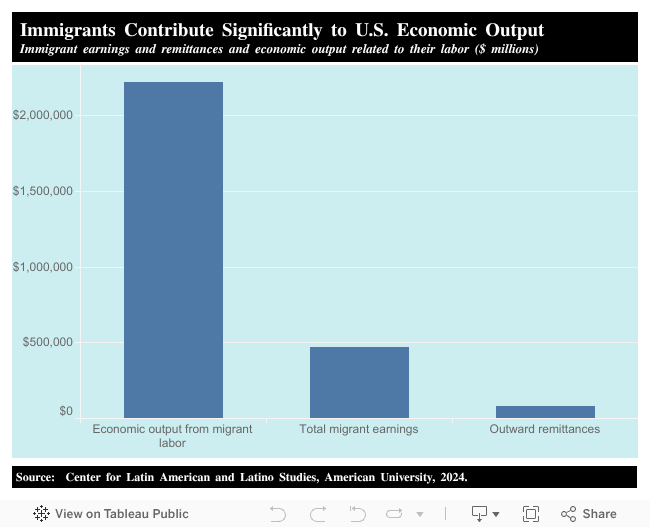
Immigrants who remit contribute approximately $2.2 trillion annually to the U.S. economy, accounting for around 8 percent of the country’s gross domestic product (GDP). That is larger than the whole Canadian economy. In 2022, for reference, remittances amounted to $81.6 billion.
Studies suggest that remittances constitute 17.5 percent of immigrants’ income. Consequently, their combined income would total around $466,491 million annually. There is a gap between what one produces and what one gets paid. Thus, we calculate that this subset of immigrants generated at least $2.2 trillion dollars in economic output.
This estimation reveals two crucial insights that dispel misconceptions about the economic impact of immigration: firstly, remittances constitute a mere 4 percent of the total economic value generated by immigrants. These transnational transfers are important for those who receive them, but do not represent a siphoning of resources from the country because 96 percent of the wealth generated by immigrant labor and expenditures stays within the United States. Secondly, the economic contributions of immigrants are likely to be even more substantial, given that a significant number of immigrants do not remit, or they do so through informal channels that do not show up in official remittance aggregate figures.
These findings underscore the pivotal role of immigrants in bolstering the economy. Remittances allow migrants to help loved ones but come at the cost of long-term family separation across borders, as we document in a newbook.
Moreover, these estimates do not account for the economic growth stimulated by immigrants through their expenditure in the U.S., which creates demand and generates jobs. This is not to mention their human, cultural, culinary, and creative contributions. Immigrants don’t just grow the size of the pie — they make it tastier.
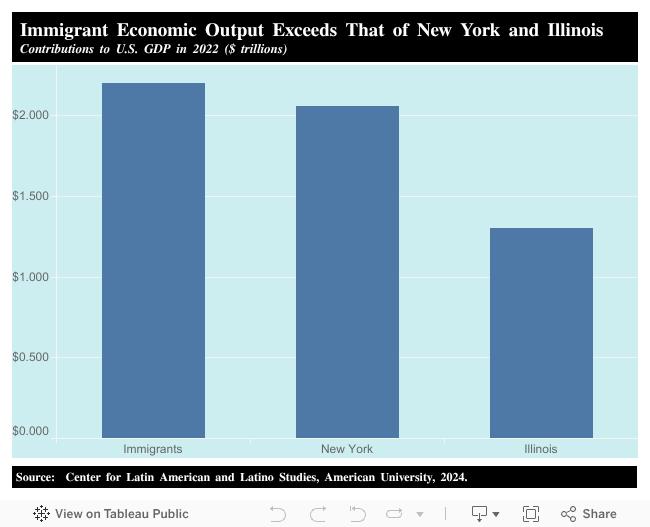
If all immigrants were to constitute a state, their contributions to the nationalGDP in 2022 would surpass that of Illinois and even New York State.
The Rationale Behind the Contributions
In the short term, the influx of immigrants revitalizes the U.S. economy. In the long term, immigrants are instrumental in maintaining a relatively youthful demographic in an aging population. For instance, Hispanics currentlyconstitute 25 percent of children in the United States. Furthermore, immigrants play a crucial role in many economic sectors and are more likely to relocate in response tochanging labor demands.
The Emerging Consensus
There is a growing consensus on the substantial contributions of immigrants to the U.S. economy. The Economic Policy Institutefound that immigration does not lead to high unemployment among U.S.-born workers. The unemployment rate for U.S.-born workers averaged a record low of 3.6 percent in 2023. Immigrants, who make up around 18.6 percent of the U.S. labor force, play pivotal roles acrossvarious industries and occupy a range oflower, middle, and higher-wage jobs.
The Congressional Budget Office recently reported that immigration contributes to robust economic growth, with future immigration expected to boost real gross domestic product by 2 percent over the next decade.
Furthermore, immigrants enhance government revenue and complement U.S.-born workers by contributing to the overall population and workforce growth. The U.S. Census Bureauprojects that lower-than-expected immigration levels would lead to a population decline in 20 years, severely impacting economic growth.
A Washington Post articlestates that around 50 percent of the growth in the labor market in 2023 was from foreign-born workers, echoing trends from the1990s.
Immigrants are integrated into American social, economic, cultural, and political life. In 2021, 45 million immigrants resided in the United States, accounting for 14 percent of the country’s population. The Immigrant Research Initiativecalculates that immigrants account for 17 percent of the U.S. economic output (GDP), which is higher than their share of the population.
Considering that the United States boasts a $19.6 trillion economy, according to theBureau of Economic Analysis 2021 statistics, all immigrants would be responsible for $3.3 trillion of economic output using that estimate. This seems compatible with our calculation of around $2.2 trillion derived solely from immigrants who send money abroad, as many immigrants (such as those highly paid immigrants who come with their families or those who are able to reunite in the United States) do not send as much in remittances.
In conclusion, there would be no year-to-year economic growth in the United States without recent immigrant arrivals. If immigration decreases in the following years, economic growth will likelyplummet, and inflation will rise further. This applies not only to the United States but toother countries as well.
The data is clear: immigration is not just a humanitarian issue but an economic necessity for large economies. Immigrants, refugees, and asylum seekers contribute more than resilience. They bring talent and create jobs, growth, and a stronger future for the U.S. economy.
Ernesto Castañeda is Professor at the College of Arts and Sciences and the School of International Service and Director of the Center for Latin American and Latino Studies, the Immigration Lab at American University in Washington, D.C.
Edgar Aguilar is an International Economics Master’s student at American University, a research assistant at the Center for Latin America and Latino Studies, and a consultant for the World Bank. He specializes in migration, human security, sustainable energy, finance, and environmental policy.
Narratives of immigrants draining resources from the U.S. aren’t just wrong — the opposite is true. Immigration is critical to maintaining a functional economy.