
Taking Aim at Overpaid CEOs
Landmark San Francisco and Los Angeles ballot initiatives aim to hike taxes on corporations with huge gaps between CEO and worker pay.
A recent poll found that nearly half of people in the world’s richest country are having difficulty affording basic necessities like groceries, utility bills, health care, housing, and transportation.
A new Institute for Policy Studies report shines a spotlight on the role leading corporations are playing in this affordability crisis. The report analyzes the 20 largest employers of low-wage U.S. workers, a group we’ve dubbed the “Low-Wage 20.”
Our analysis finds that at half of these firms, median worker pay actually declined in real terms between 2019 and 2024. For the group as a whole, average median pay dropped 4.6 percent to just $29,087.

Not one single company in the Low-Wage 20 had median pay in 2024 that met the $59,600 income level needed to afford the U.S. average rent for a two-bedroom apartment.
At seven Low-Wage 20 firms, annual pay for a typical worker fell below $25,533, the average price of a used car. Without reliable transportation, workers can’t get to their jobs – not to mention grocery stores and doctors’ offices.
Poverty wages also make it extremely challenging for low-income families to afford to send their kids to college. At 16 of the Low-Wage 20 firms, the typical worker makes less in an entire year than the $44,961 average annual cost for tuition and fees at a private college. Seven of the companies have median income lower than the $25,415 average cost of out-of-state tuition and fees at public universities.
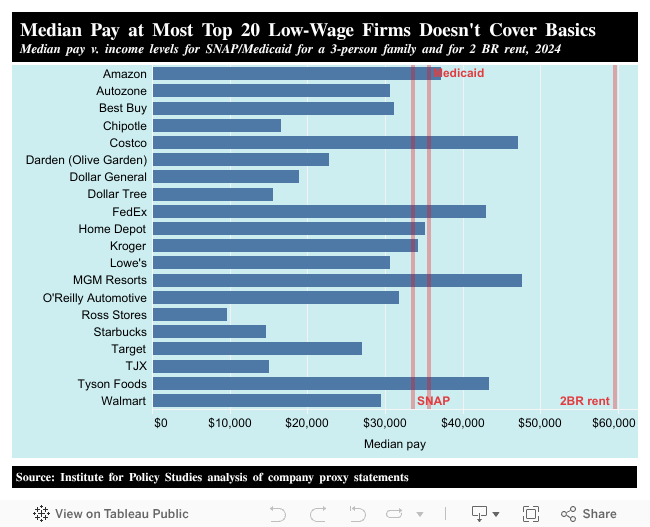
These companies’ low-wage business models have left many of their workers with no choice but to rely on public assistance.
Fifteen of the Low-Wage 20 reported median pay in 2024 below the $35,631 income limit for a family of three to be eligible for Medicaid. At 13 of the firms, median pay fell below the $33,576 family threshold for SNAP food aid.
On the opposite end of the income scale, the CEOs of Low-Wage 20 companies earned average compensation of $18.6 million in 2024. Starbucks CEO Brian Niccol landed the biggest payout, with $95.8 million in his first year on the job. Amazon CEO Andrew Jassy received only a modest $1.6 million in 2024. But thanks to previous massive multi-year pay packages, he’s sitting on Amazon stock valued at about $467 million.

Sarah Anderson directs the Global Economy Project and co-edits Inequality.org at the Institute for Policy Studies.

Reyanna James is an inequality research associate and co-edits Inequality.org at the Institute for Policy Studies.