
Income Inequality
In the United States, the income gap between the rich and everyone else has been growing markedly, by every major statistical measure, for more than 30 years.
Income Inequality
Wage Inequality
Racial Income Inequality
CEO-Worker Pay Gaps
Income Inequality
Income includes the revenue streams from wages, salaries, interest on a savings account, dividends from shares of stock, rent, and profits from selling something for more than you paid for it. Unlike wealth statistics, income figures do not include the value of homes, stock, or other possessions. Income inequality refers to the extent to which income is distributed in an uneven manner among a population.

Over the past four decades, the very richest Americans have enjoyed by far the fastest income growth. Between 1979 and 2022, the average income of the richest 0.01 percent of households, a group that today represents just over 13,000 households, grew over 12 times as fast as the income of the bottom 20 percent of earners. Although a sharp decline in the stock market brought down incomes at the top somewhat in 2022, the gaps are still extremely wide. These Congressional Budget Office figures include income from labor and investments, and do not account for taxes or means-tested public assistance, such as food stamps or Medicaid.

Income disparities are now so pronounced that America’s richest 1 percent of households averaged 103 times as much income as the bottom 20 percent in 2022, according to the Congressional Budget Office.
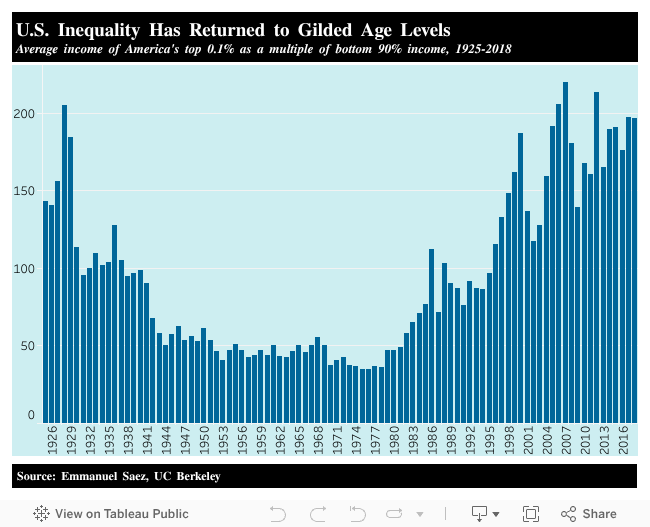
The U.S. income divide has not always been as vast as it is today. In response to the staggering inequality of the Gilded Age in the early 1900s, social movements and progressive policymakers fought successfully to level down the top through fair taxation and level up the bottom through increased unionization and other reforms. But beginning in the 1970s, these levelers started to erode and the country returned to extreme levels of inequality. According to data analyzed by UC Berkeley economist Emmanuel Saez, the ratio between the average income of the top 0.1 percent and the bottom 90 percent reached Gilded Age levels in the years preceding the 2008 financial crisis.

Since 1970, the top 1 percent of American earners have enjoyed a 10 percentage point increase in their share of national income, according to figures in the World Inequality Database. Meanwhile, the Census Bureau’s “official” poverty rate for all U.S. families has declined by merely 2.6 points. In 2011, the Census Bureau began publishing a “supplemental” poverty measure that is more accurate but still likely understates the number of people in the world’s richest country who have to struggle to make ends meet.
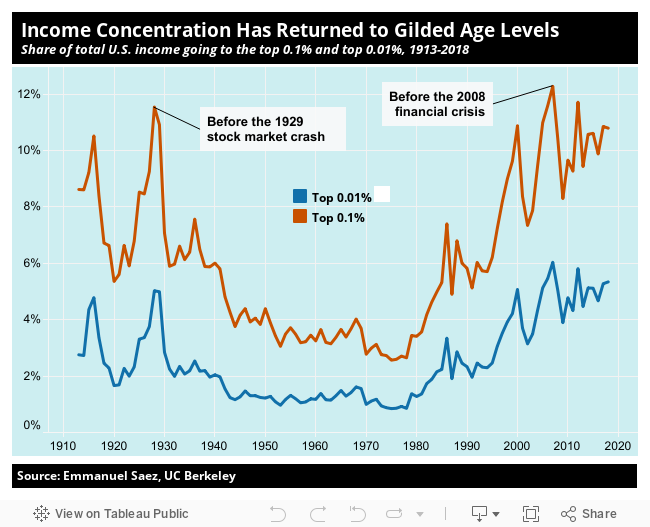
The nation’s highest 0.01 percent and 0.1 percent of income-earners have seen their incomes rise much faster than the rest of the top 1 percent in recent decades. Both of these ultra-rich groups saw their incomes drop immediately after the financial crashes of 1929 and 2008, but they had a much swifter recovery after the more recent crisis. Income concentration today is as extreme as it was during the “Roaring Twenties.”
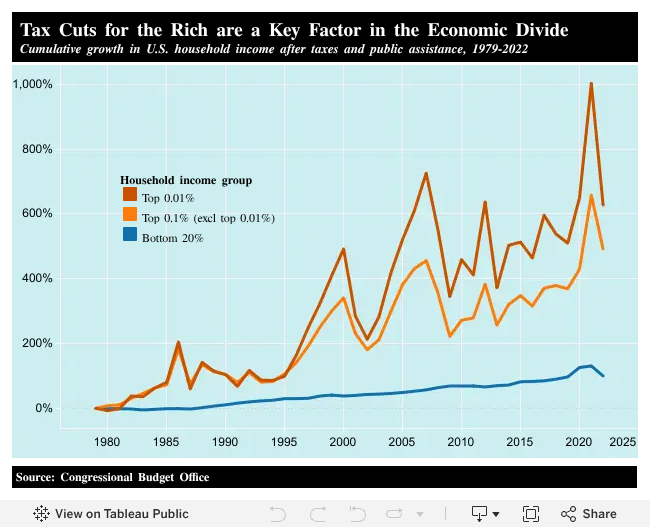
Congressional Budget Office data show that taxes and means-tested public assistance narrow the income divide somewhat, but the gaps remain staggering. Between 1979 and 2022, the richest 0.01 percent of households had a cumulative income growth rate of 628 percent after accounting for taxes and aid transfers. That’s over 6 times the 100 percent growth rate for the bottom 20 percent. Tax cuts for the rich are a key driver of this rising inequality. The top U.S. marginal tax rate in 1979 was 70 percent, compared to just 37 percent in 2022. In 2022, a stock market decline reduced top-end income while poorer families lost ground due to the expiration of pandemic support programs.
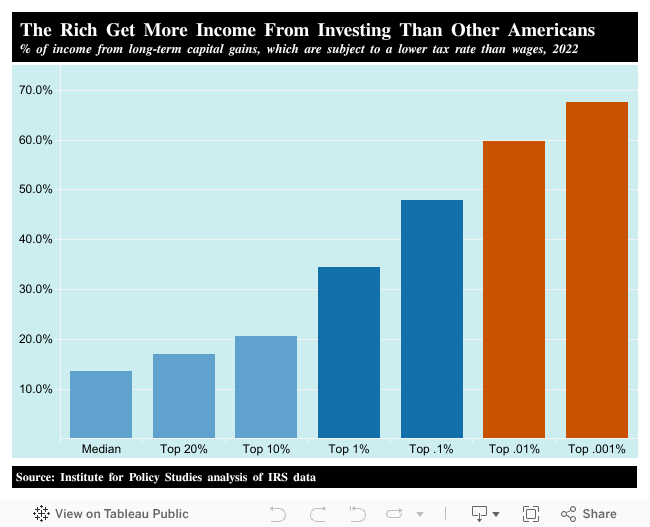
The rich also benefit immensely from the tax code’s preferential treatment of income from investments. Americans who are not among the ultra-rich get the vast majority of their income from wages and salaries. But the higher the U.S. income group, IRS data show, the larger the share of income derived from investment profits. The top tax rate for long-term capital gains is just 20 percent, compared to the top marginal tax rate on ordinary income of 37 percent.

U.S. economic growth is increasingly dependent on the wealthiest tier of consumers. The top 10 percent of income earners now account for nearly half (49.2 percent) of all U.S. consumer spending, up from 43.2 percent in 2020, according to Moody’s Analytics.
Wage Inequality

Low- and middle-wage workers have suffered from decades of slow wage growth. In 2025, the 10th-percentile wage — the hourly wage at which 10 percent of workers are paid less and 90 percent of workers are paid more — sat at $14.56, up 28.6 percent from 1979. By contrast, the wage for earners at the top 90th percentile grew 64.1 percent over this same period, according to Economic Policy Institute analysis of Current Population Survey data. EPI researchers note that the even faster wage growth of those in the top 1 percent of earners cannot be captured from this data source.
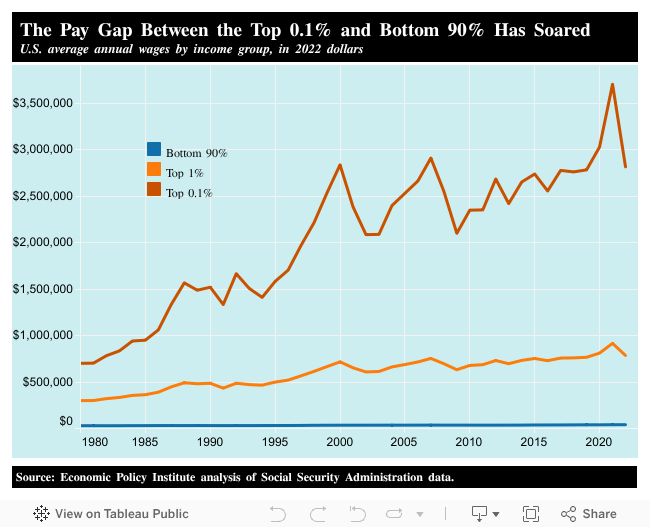
Between 1980 and 2022, the bottom 90 percent of U.S. earners had wage growth of just 36 percent, compared to 162 percent for the richest 1 percent and 301 percent for the top 0.1 percent, according to Economic Policy Institute analysis of Social Security Administration data. Those in the top income groups did experience a decline in 2022. This reflects that year’s weak stock market, since this wage data includes income from stock options, a common form of compensation for corporate elites. But with the market surges in 2023 and 2024, this was no doubt a short-term dip for the richest Americans.

During the decades after World War II, worker productivity and wages rose at approximately the same consistent rate. But since the 1970s, workers have no longer reaped the same rewards from productivity gains. From 1979 to 2025, average hourly compensation increased just 33.6 percent (after adjusting for inflation) while worker productivity increased 92.4 percent, according to the Economic Policy Institute. In other words, productivity grew at a rate 2.7 times as fast as worker pay.

The share of U.S. national income going to corporate profits has grown while the share going to workers has declined. In the second quarter of 2026, U.S. pre-tax corporate profits reached an annualized $4.8 trillion, equal to 18 percent of national income, according to Institute for Policy Studies analysis of Bureau of Economic Analysis data. At the same time, employee compensation — wages and benefits — accounted for 60 percent of national income, its lowest share since the 1950s.
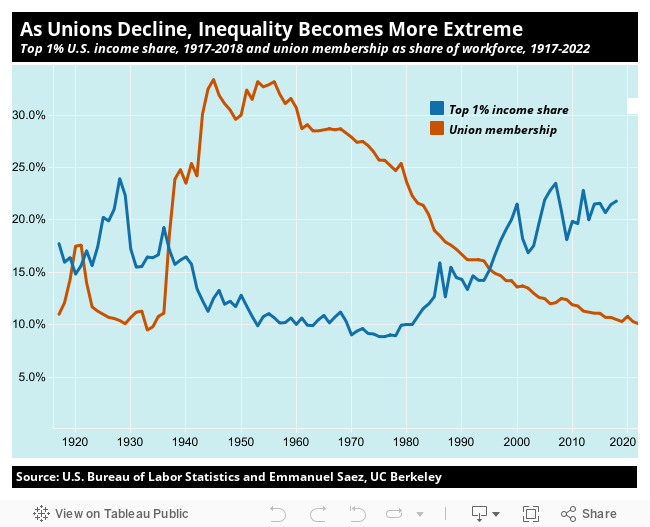
One factor in the widening income divide is the decline of U.S. labor unions. The share of the workforce represented by a union has declined to just 10.1 percent in 2022, down from over 30 percent in the 1940s and 1950s. Meanwhile, those at the top of the income scale have increased their power to rig economic rules in their favor, further increasing income inequality. In 2018, the richest 1% earned over 20 percent of all national income.

U.S. workers who are unionized continue to earn significantly higher wages than their non-unionized counterparts, according to Bureau of Labor Statistics data. The gap is particularly wide among women. In 2025, median weekly wages for full-time unionized women amounted to $1,270 — $214 more than non-unionized women’s earnings.
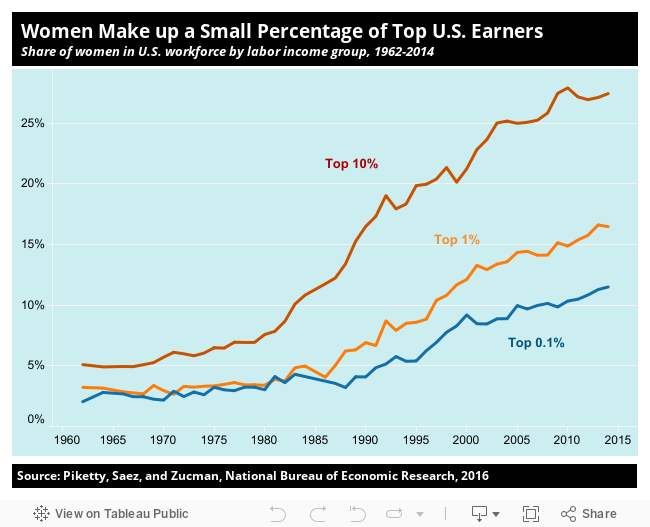
Men make up an overwhelming majority of top earners across the U.S. economy, even though women now represent almost half of the country’s workforce. According to analysis by Thomas Piketty, Emmanuel Saez, and Gabriel Zucman, women comprise just 27 percent of the top 10 percent, and their share of higher income groups runs even smaller. Among the top 1 percent, women make up slightly less than 17 percent of workers, while at the top 0.1 percent level, they make up only 11 percent.

Since 1995, the average Wall Street bonus has increased 491 percent, from $41,400 to $244,700 in 2024 (not adjusted for inflation). If the minimum wage had increased at that same rate, it would be worth $20.87 today, instead of $7.25. The total 2024 bonus pool for 201,500 New York City-based Wall Street employees was $47.5 billion — a record high, and enough to pay for more than 1 million jobs paying $15 per hour for a year. Because the very rich can squirrel away much of their income, huge Wall Street bonuses don’t have nearly the stimulus effect as raising pay for low-wage workers who have to spend nearly every dollar they make. The sharp rise in Wall Street bonuses has also contributed to race and gender inequality.

Hedge fund managers rake in the largest Wall Street paychecks. According to Bloomberg estimates, the 10 highest-earning hedge fund managers collectively brought in about $22 billion in 2025. New York Mets owner Steve Cohen topped the annual ranking, with $3.4 billion in compensation.
Racial Income Inequality

In 2024, Fortune 500 CEOs, who earned $18.9 million on average, included just eight Black people — less than 2 percent of the total. By contrast, Black Americans made up 19 percent of the U.S. workers who would directly benefit from a raise in the federal minimum wage to $17 per hour by 2030, according to Institute for Policy Studies analysis of Economic Policy Institute data. Black people comprise 13 percent of the entire U.S. labor force.
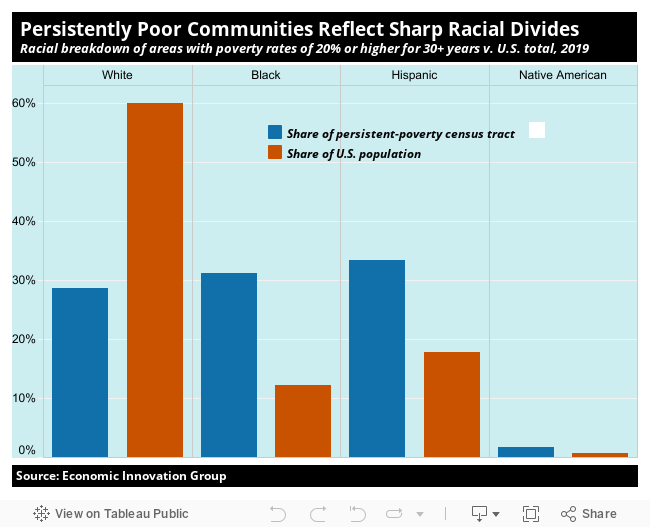
The world’s wealthiest country is home to numerous communities that have been poor for generations: think parts of Appalachia, the Mississippi Delta, the southern border, and Chicago’s South Side. An Economic Innovation Group report finds that people of color are far more likely to live in “persistently poor” communities – defined as those with poverty rates of 20 percent or higher for at least 30 years – than white Americans.

Racial discrimination in many forms, including in education, hiring, and pay practices, contributes to persistent earnings gaps. As of the second quarter of 2025, the median white worker made 24 percent more than the typical Black worker and around 29 percent more than the median Latino worker, according to BLS data.

The Black unemployment rate has persistently run about twice as high as for white workers. These rates only count those who are actively seeking work, leaving out those who have given up finding a job. While racial gaps have narrowed somewhat in recent years, the divides remain wide. In July 2025, Black unemployment stood at 7.2 percent, compared to 3.7 percent for white workers, according to BLS data.
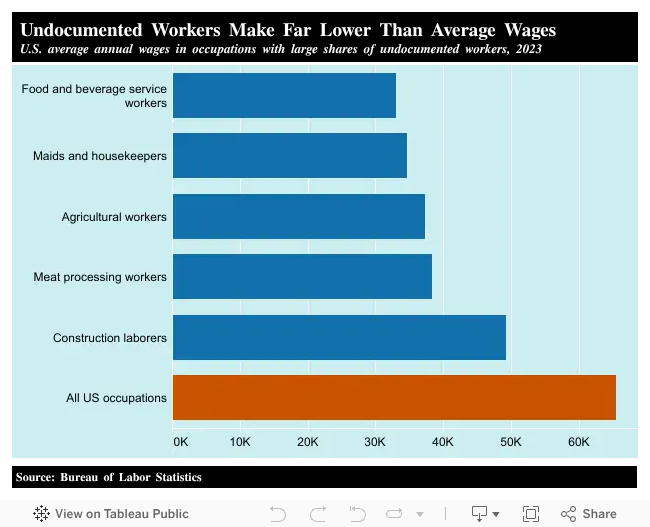
Undocumented immigrants make up an estimated 4.9 percent of the U.S. workforce, with Mexicans making up by far the largest share. Institute for Policy Studies analysis of BLS data illustrates that occupations with large undocumented workforces pay far less than the average annual wage. For example, agricultural workers, an estimated 15.1 percent of whom are undocumented, make an average of $37,370 annually, considerably less than the $65,470 average for all U.S. occupations. And because so many undocumented workers live in the shadows, even these figures likely overestimate their actual wages.
CEO-Worker Pay Gaps
CEO pay has been a key driver of rising U.S. income inequality for decades, and the gap between CEO and worker pay only widened during the pandemic.
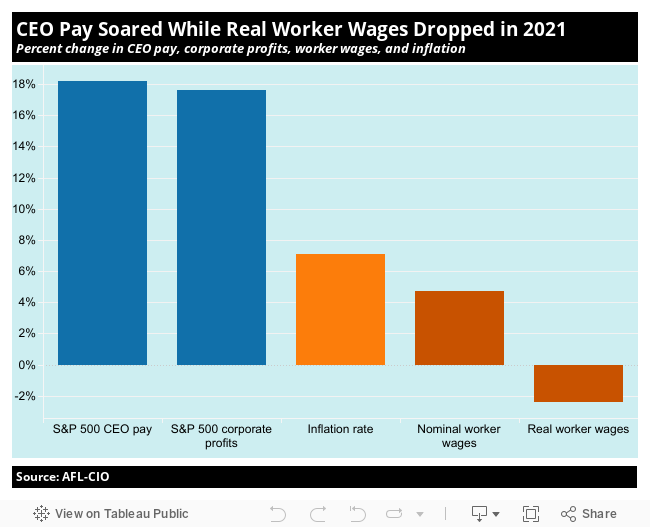
In 2021, corporate CEOs were quick to blame worker wages for causing inflation. But an AFL-CIO analysis reveals that workers’ real wages actually fell 2.4 percent in 2021 after adjusting for inflation. Meanwhile, S&P 500 companies increased their CEO pay by an average of 18.2 percent while enjoying record profits and spending a record $882 billion on stock buybacks.
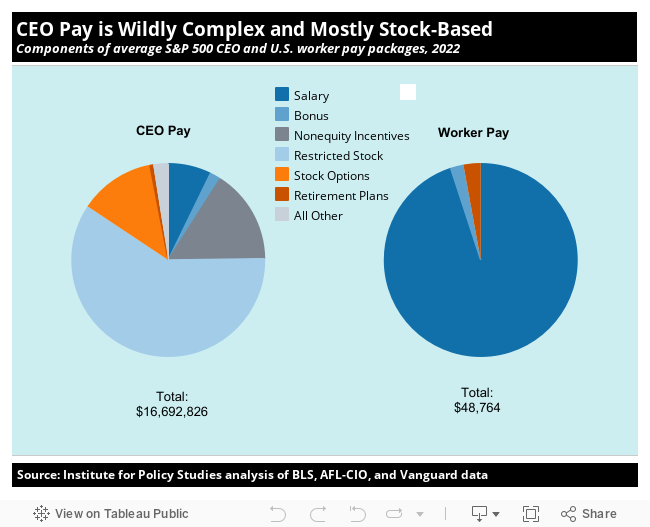
Corporate boards lavish wildly complex compensation packages on their top executives, mostly in various forms of stock-based pay. The objective? To give the impression of a “pay for performance” system that aligns the interests of CEOs and shareholders. By contrast, ordinary American workers receive nearly all of their compensation in the form of cash salary or wages. In the chart above, we’ve added to the BLS median annual wage a bonus worth 2.3 percent and an employer 401(k) contribution worth 3 percent of base pay.
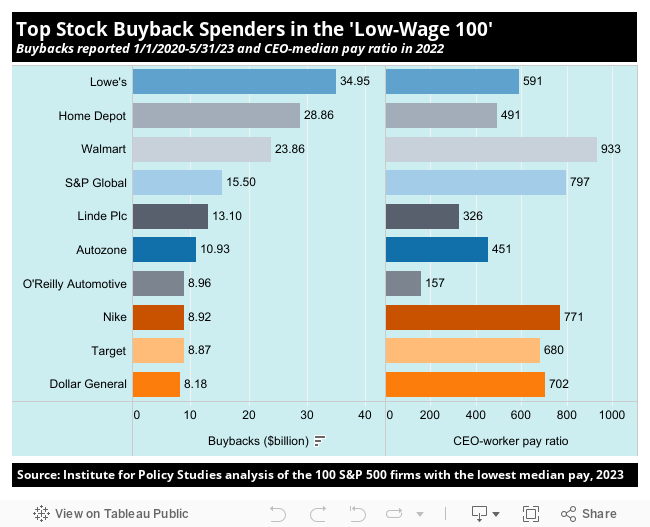
In reality, the notion that Corporate America has a CEO “pay for performance” system is a myth. One common ploy for inflating CEO pay? Stock buybacks. This financial maneuver siphons funds from worker wages while artificially pumping up the value of CEO stock-based pay. The Institute for Policy Studies Executive Excess 2023 report examines buyback activity among the 100 S&P 500 corporations with the lowest median wages. Between January 1, 2020, and May 31, 2023, fully 90 percent of these firms spent company resources on buybacks, for a total expenditure of $341 billion. During their stock buyback spree, the value of CEOs’ personal stock holdings at these “Low-Wage 100” firms increased more than three times as fast as their median worker pay.
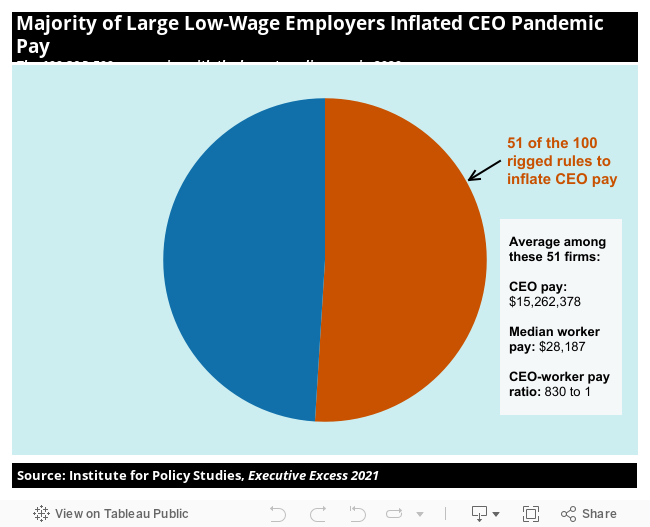
During the pandemic, corporate boards took explicit actions to shield their CEOs’ massive paychecks while workers were suffering. An Institute for Policy Studies analysis found that more than half of the 100 S&P 500 companies with the lowest median worker pay moved bonus goalposts or otherwise rigged rules to inflate CEO pay in 2020. Among these rule-rigging corporations, CEO compensation averaged $15.3 million, up 29 percent from 2019. Median worker pay ran $28,187 on average, 2 percent lower than the 2019 worker pay rate. The ratio between CEO and median worker pay at these 51 firms averaged 830 to 1.

With U.S. unions playing a smaller economic role, the gap between worker and CEO pay has exploded since the early 1990s. In 1980, the average big company CEO earned just 42 times as much as the average U.S. worker. In 2025, the CEO-worker pay gap was over seven times larger than in 1980. According to the AFL-CIO, S&P 500 firm CEOs were paid 312 times as much as average U.S. workers in 2025. This figure excludes Tesla CEO Elon Musk’s $158 billion pay package. Including Tesla, the CEO-worker pay gap was 5,387-to-1 in 2025.
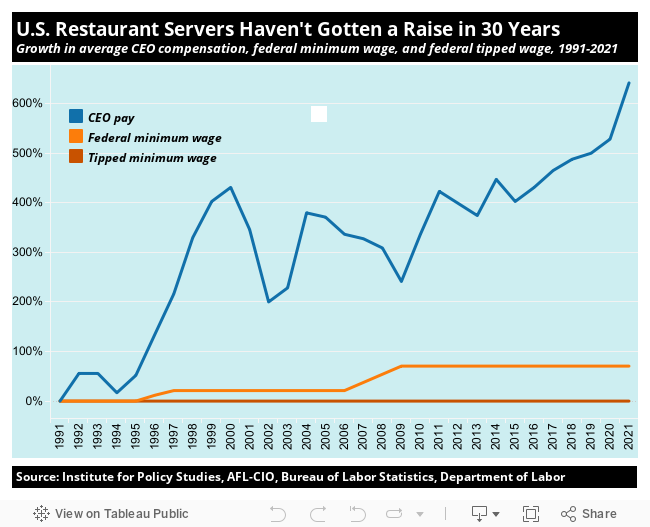
The CEO pay explosion, as shown in AFL-CIO analysis, contrasts sharply with trends at the bottom end of the U.S. wage scale. Average CEO pay at S&P 500 corporations is up 642 percent since 1991, while Congress has not passed a minimum wage increase for more than a decade. The federal minimum wage for restaurant servers and other tipped workers has been frozen at just $2.13 per hour since 1991. According to the Labor Department, 27 states have raised their tipped minimum, while retaining this two-tier system. Seven states and the District of Columbia have eliminated or are phasing out the subminimum tipped wage altogether, while in Michigan the issue was tied up in the courts as of December 2022. In six states, the tipped minimum is still $2.13. While employers are technically supposed to make up the difference if workers don’t earn enough in tips to reach the $7.25 federal minimum, this rule is largely unenforced.