A weekly newsletter from the Institute for Policy Studies |
|
|
CEO pay gaps, a co-op bookstore,
and controlling credit card fees
|
|
|
|
Happy back-to-school season! For me, it’s eye-twitch season. Every year around this time, I nearly go blind crunching the numbers for our annual Institute for Policy Studies Executive Excess report. This year’s 32nd annual edition comes out tomorrow, packed with jaw-dropping data on the 100 S&P 500 firms with the lowest median wages. We’ve dubbed this rather greedy group the “Low-Wage 100.”
A sneak preview: The CEOs of these 100 firms have over 1,280 lobbyists on their payrolls. And, guess what, these CEOs aren’t deploying that army to protect their employees against ICE attacks or the biggest cuts ever to Medicaid and SNAP. Their actual priorities? Check Inequality.org tomorrow for the vexing answer.
In today’s newsletter, we’re highlighting numbers our friends on the AFL-CIO’s Paywatch team have been crunching. They’ve been going after overpaid CEOs as long as we have. And if you’ve never checked out their database with CEO and worker pay at more than 3,800 corporations, I highly recommend it. Sarah Anderson
for the Institute for Policy Studies Inequality.org team |
|
|
|
INEQUALITY BY THE NUMBERS |
A New Model for Selling Books and Educating Communities This week’s frontline faces: The staff of Bol Bookstore, the first cooperatively owned bookstore in Washington, D.C. What they’re doing to help create a more equal world: More than this store’s worker-ownership structure makes it unique. The space plays a dual role as a store and as a community space, offering up public education opportunities.
Amid rising pressures on independent booksellers from Amazon and digital readers, the cooperative model presents a new way to weather the economic difficulties of operating a bookstore. What makes this fight so important: “The difference between a bookstore and, say, a grocery cooperative,” co-founder Arjun Shankar tells Inequality.org, “is that a bookstore cooperative is about political education — it’s an educational model.”
“A grocery cooperative has a goal of making sure people get fed,” adds Shanker. “Our goal is to make sure people know their history, know their rights, and know how people before us have struggled and resisted.” Photo credit: Timmy Clay |
A Promising New Step To Stop Credit Card Profit Skimming
The financial giants that run the credit card industry have an ingenious way of making money: Every time a consumer taps to pay at a business, nearly 3 percent of the purchase goes straight to payment providers — think Visa and Mastercard — and banks. These 3 percent fees added up to a whopping $198.25 billion for debit and credit in 2025. And these fees also amount to a particularly heavy drag on small businesses that already operate on slim margins.
Thankfully, a bipartisan coalition of lawmakers is working to take on this financial scheming. Their Credit Card Competition Act would, if enacted, break the Visa and Mastercard duopoly by letting merchants pick how to complete transactions. This simple fix, Carter Dougherty of Demand Progress points out, could be the first step toward stopping big banks from exorbitantly profiting off us all. |
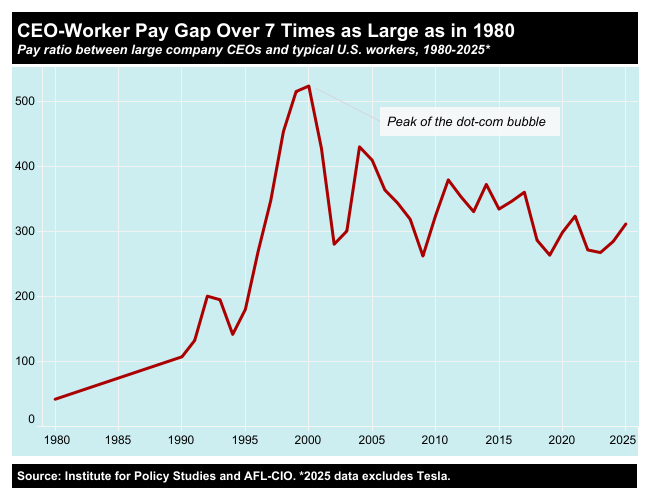
In 1980, the average major corporate CEO earned just 42 times as much as the average U.S. worker. In 2025, according to new AFL-CIO Paywatch data, S&P 500 firm CEOs pocketed 312 times as much as average workers. To see how these S&P 500-wide figures compare with the 100 companies that pay their workers the least, stay tuned for the upcoming release of our Institute for Policy Studies Executive Excess report.
For an interactive version of this chart and more on income inequality, click the link to our Inequality.org Facts section below. |
This week’s overpaid CEO: Elon Musk, the chief executive at Tesla.
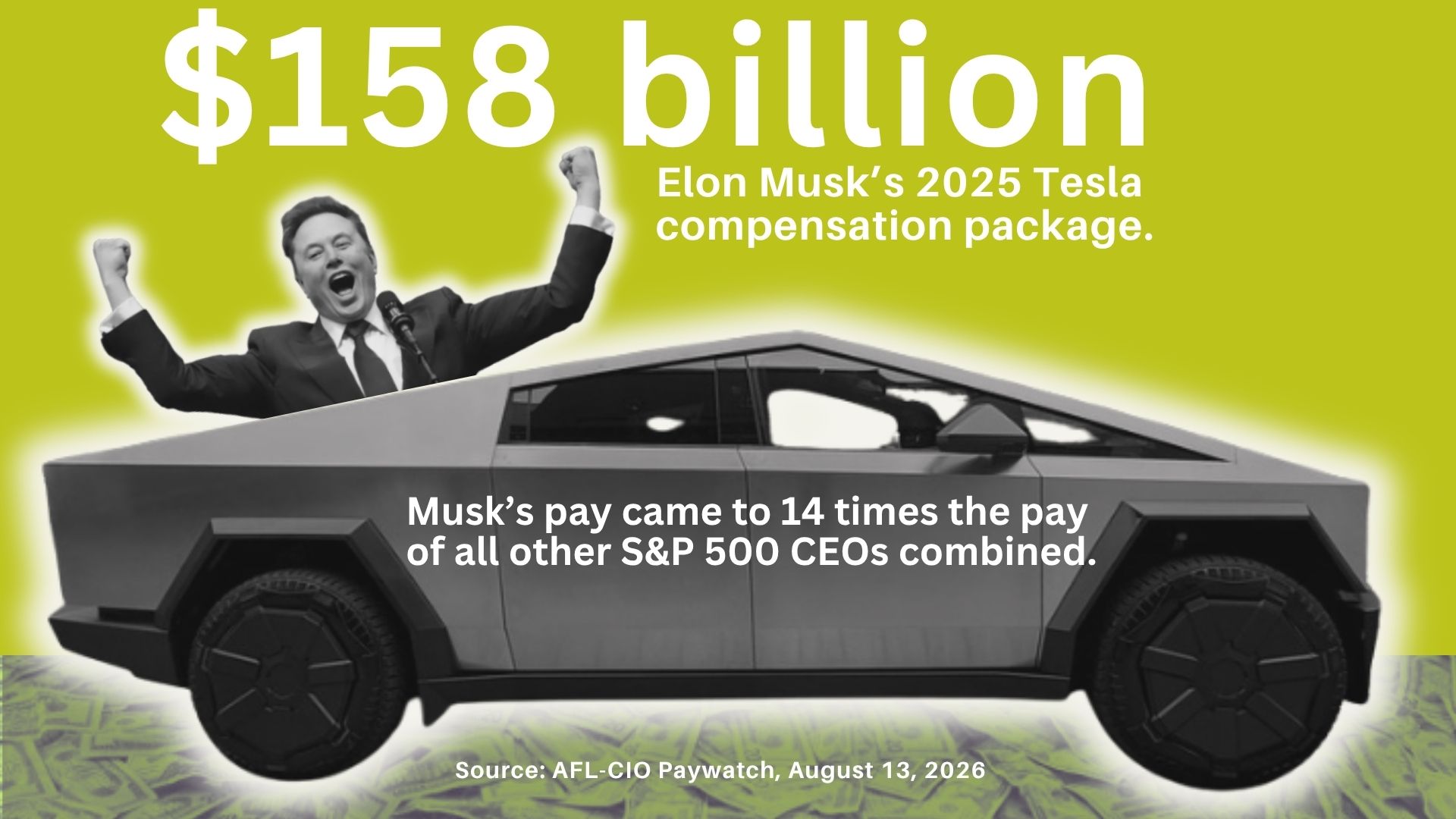
How Musk is driving inequality: To avoid a massive statistical distortion, the AFL-CIO had to remove Musk’s Tesla pay package from their annual calculation of the S&P 500’s average CEO-worker gap. Without Elon Musk, the world’s richest man, that gap stands at an already obscene 312 to 1. With Musk’s $158 billion payday, the gap rises to 5,387 to 1. To help us better grasp the enormity of Musk’s compensation, the labor federation offers a variety of mind-boggling comparisons. Musk’s $158 billion totals, for instance, more than the GDPs of two-thirds of the world's countries and over 41 times Tesla’s 2025 net income.
The last word: “One CEO does not make a company successful, and workers should share in the value they help create,” the AFL-CIO’s compensation experts write in this year’s Paywatch report. Among the solutions the AFL-CIO is proposing: How about requiring all companies with pay gaps of more than 100 to 1 to negotiate a union contract with their employees?
|
|
|
|
What's new on Inequality.org
Ellaine Manyere, Zimbabwe’s Economy Must Serve Citizens, Not Just Ruling Elites. The country’s dramatic inequality requires real interventions.
Blake Burdge, Rubio Promises Cuba a Better Future — in a Cardboard Box. America’s proposed new aid program for the island pales in comparison to the economic damage the U.S. blockade of Cuba has inflicted. Carson Kindred, How to Bridge the ‘Diploma Divide’ in the Progressive Movement. College graduates need to build mutual respect with the entire U.S. working class. Elsewhere on the web
Matt Lewis, Baseball and America’s Summer of Socialism, NOTUS. Baseball today neatly mirrors modern American life: The rich get to take big swings. If they strike out, no worry. They have safety nets. If they hit a home run, they can say they did it all on their own.
Douglas Pasternak, Trump’s Billionaire Boys Club: How Donald Trump has stacked his administration with investment bankers and billionaire businessmen and women, Public Citizen. Forty of the 57 ultra-rich officially inside the Trump administration are now directing government offices. This unprecedented plutocrat presence is paving the way for a classic oligarchy.
Brian Merchant, Charting the rise of tech fascism, Blood in the Machine. One reason Facebook and Meta have operated with such impunity: Billionaire Peter Thiel helped billionaire Mark Zuckerberg structure his corporate empire in a way that keeps Zuckerberg unaccountable to both boardroom dissent and activist shareholders. Anthropic CEO Dario Amodei is now following suit.
Michael Hiltzik, Ordinary Americans struggle to fund their 401(k) plans while plutocrats fill theirs with tax-free millions, Las Vegas Sun. Tax-preferred retirement accounts have become a loophole that lets the ultra-rich shelter grand fortunes.
Michael Madowitz, Saving Democracy Requires Taxing Extreme Wealth, Project Syndicate. Even if Elon Musk never earned another cent, an American household earning the median U.S. income would have to labor over 11 million years to match his personal wealth.
Arthur MacEwan, Taxing the Rich Is Not Enough, Dollars & Sense. We have let the rich and powerful structure markets in a manner that generates extreme inequality. We need to undo that structuring — and reduce our heavy reliance on markets as the foundation of all economic relations.
Matthew Kavanagh, Joseph Stiglitz, Monica Geingos, Winnie Byanyima, and Michael Marmot, The Inequality–Pandemic Cycle — Rethinking Preparedness, New England Journal of Medicine. Inequality makes outbreaks of disease more likely to become pandemics. Pandemics, in turn, deepen inequality, making future outbreaks harder to control and fueling the next outbreak cycle.
Todd Tucker, How Bernie’s AI tax idea came to be, Fireside Stacks. Donald Trump is proposing a plan that would have the federal government pay AI billionaires for shares in companies already living off of public subsidies. One much better alternative: an AI tax paid in stock. The public gets shares without giving billionaires a single penny.
Robert Reich, Who’s Raking it in as the National Debt Explodes? Substack. If the wealthy paid their fair share of taxes, we wouldn’t have such a huge federal debt. And we wouldn’t be paying our rich massive amounts of interest on that debt.
Javier López, Europe’s Cities Were Designed For A Climate That No Longer Exists, Social Europe. Heat comes hardest for people who work outdoors. To adapt cities for climate change, that makes shade a question of social justice as much as of urban planning and its absence a quiet form of inequality.
|
|
|
|
Monthly Donors Make This Read Possible! |
Inequality.org, an Institute for Policy Studies nonprofit project, depends on donations to keep this newsletter free and available to all readers. Your monthly gifts make all the difference in the world, whether you can donate $3 or $300 a month. Ready to give a few bucks a month? Sign up today. |
|
|
|
Inequality.org | www.inequality.org | inequality@ips-dc.org Institute for Policy Studies
1301 Connecticut Avenue Ste 600
Washington, DC 20036
United States
Managing Editor: Chris Mills Rodrigo
Co-Editors: Sarah Anderson, Chuck Collins, Bella DeVaan, Reyanna James, and Sam Pizzigati |
|
|
|
|