A weekly newsletter from the Institute for Policy Studies |
|
|
The voting wealth gap, penalizing overpaid CEOs, and the ‘Prince of Plunder’ |
|
|
|
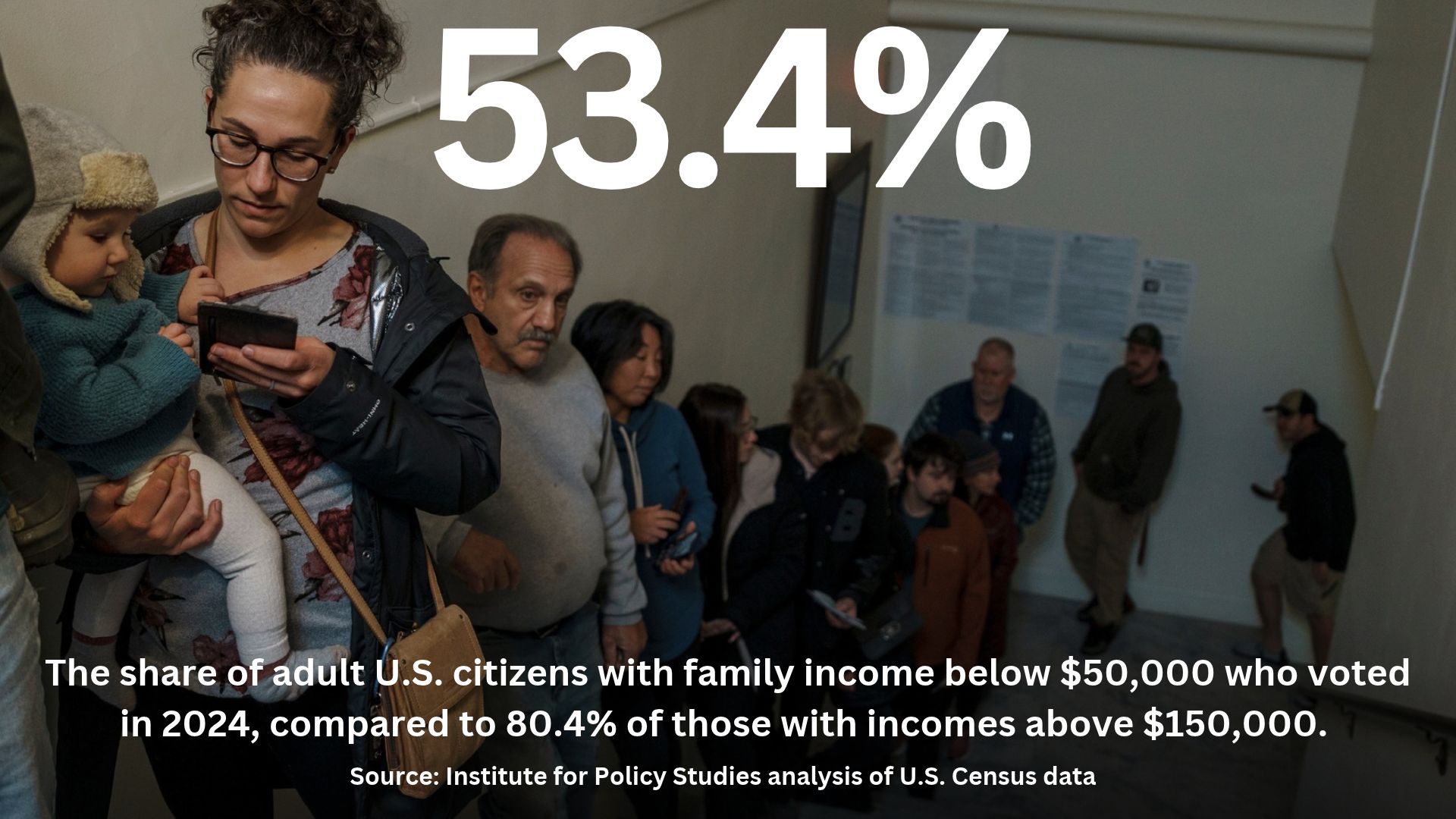
Thirteen more days. One thing keeping me sane: the ambitious efforts around the country to narrow the voting gap between rich and poor. This gap has grown so large that if poor and low-income Americans voted at the same rate as higher-income citizens, they could sway elections in every state.
A team of us from the Institute for Policy Studies provides research support for one of the great champions in the struggle to narrow this gap: Bishop William Barber II. His organization, Repairers of the Breach, is right now mobilizing poor and low-income people to cast their ballots early through 1,000 nonpartisan marches to the polls. Check out their march map here.
But good organizing makes for only part of the solution. “Politicians need to give people a vision that’s greater than their pain,” Barber noted in a recent MSNOW interview. “Vision draws people out.”
Building the power to achieve a vision of eliminating poverty and reversing extreme inequality remains, of course, a year-round challenge that will only need to intensify starting November 4. Sarah Anderson
for the Institute for Policy Studies Inequality.org team |
|
|
|
INEQUALITY BY THE NUMBERS |
Dignity for Domestic Workers Who Make the World Go Around
This week’s frontline face: Ai-jen Poo, president of the National Domestic Workers Alliance. What she’s doing to help create a more equal world: Organizing to improve labor conditions for workers around the world who provide essential caregiving services in people’s homes.
In the United States, the coalition Poo leads has now won Domestic Workers Bills of Rights in 13 states, two cities, and Washington, D.C. These laws typically guarantee domestic workers basic rights that range from decent minimum wages and overtime pay to rest breaks and safe working conditions. Some also include paid leave and anti-discrimination protections.
At the global level, Poo and allies in the International Domestic Workers Federation are struggling for dignity and improved working conditions for all. With the United States hosting a G20 summit this December, they’ll be demanding that world leaders strengthen international labor standards, invest more in better care systems, and ensure domestic workers a voice in shaping care policies.
What makes this fight so important: “Domestic workers often enter our lives amidst life’s major transitions: a newborn, a new home, an accident, or a diagnosis,” Poo writes in a new commentary for Inequality.org. “They are trusted with the people we love most and our very homes. Yet despite this deep-rooted care, the people doing this work remain among the least protected and least valued workers in our global economy.” |
Building on the World’s First Tax Penalty on Firms with Wide Pay Gaps
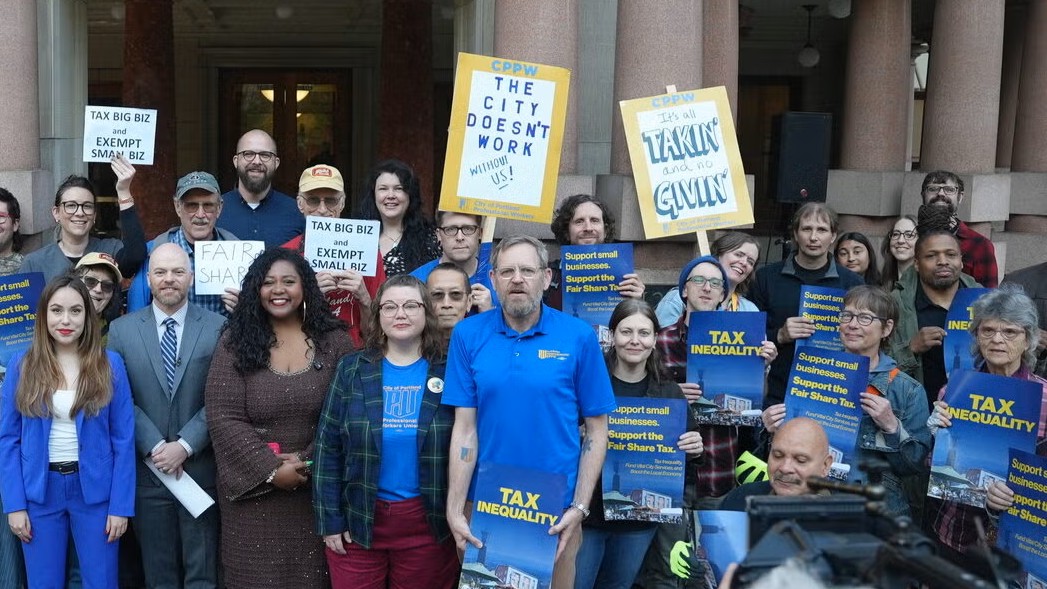
Ten years ago, in Oregon, the city of Portland adopted the world’s first tax penalty on corporations that pay their CEO over 100 times their median worker pay. Our veteran CEO pay expert, Sarah Anderson, met with Portland city councilors back then to help advance that path-breaking measure. Council members recently invited her back to testify about a proposed increase in that landmark levy.
The current moment, Anderson testified, could hardly be riper for building on the past decade of success with Portland’s pay gap surtax. Like many cities facing major federal aid cuts, Portland needs more revenue. Large corporations, flush with record profits and overpaid execs, sit well-positioned to pay more. Anderson also reminded the council that its surtax has always been voluntary.
“Companies can avoid it altogether,” she explained, “by narrowing their pay gaps to below 50 to 1 — either by lifting up worker pay or reining in their CEO pay.” A stronger Portland pay gap tax would give a boost to similar efforts to incentivize corporations to narrow their CEO-worker pay gaps. Lawmakers in Congress and at least 10 U.S. states have already introduced pay ratio tax proposals. Read or watch Sarah’s full testimony at the link below. |
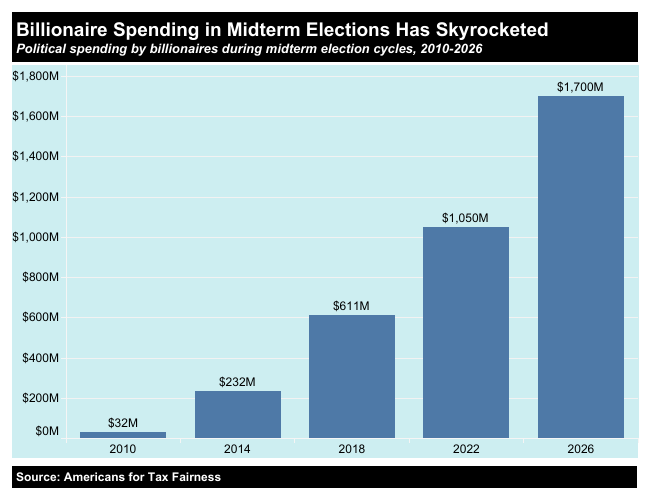
Billionaire influence over U.S. elections continues to grow. As of August 28, 170 billionaire families had spent more than $1.7 billion to influence the outcome of the 2026 federal midterms. This huge outlay represents a 53-fold increase in billionaire political spending since the Supreme Court’s 2010 Citizens United decision opened the door to unlimited super-rich campaign contributions.
That court decision has created a political system where a tiny number of wealthy can dump enormous sums on the elections that determine our collective future. For an interactive version of this chart, click the link below. |
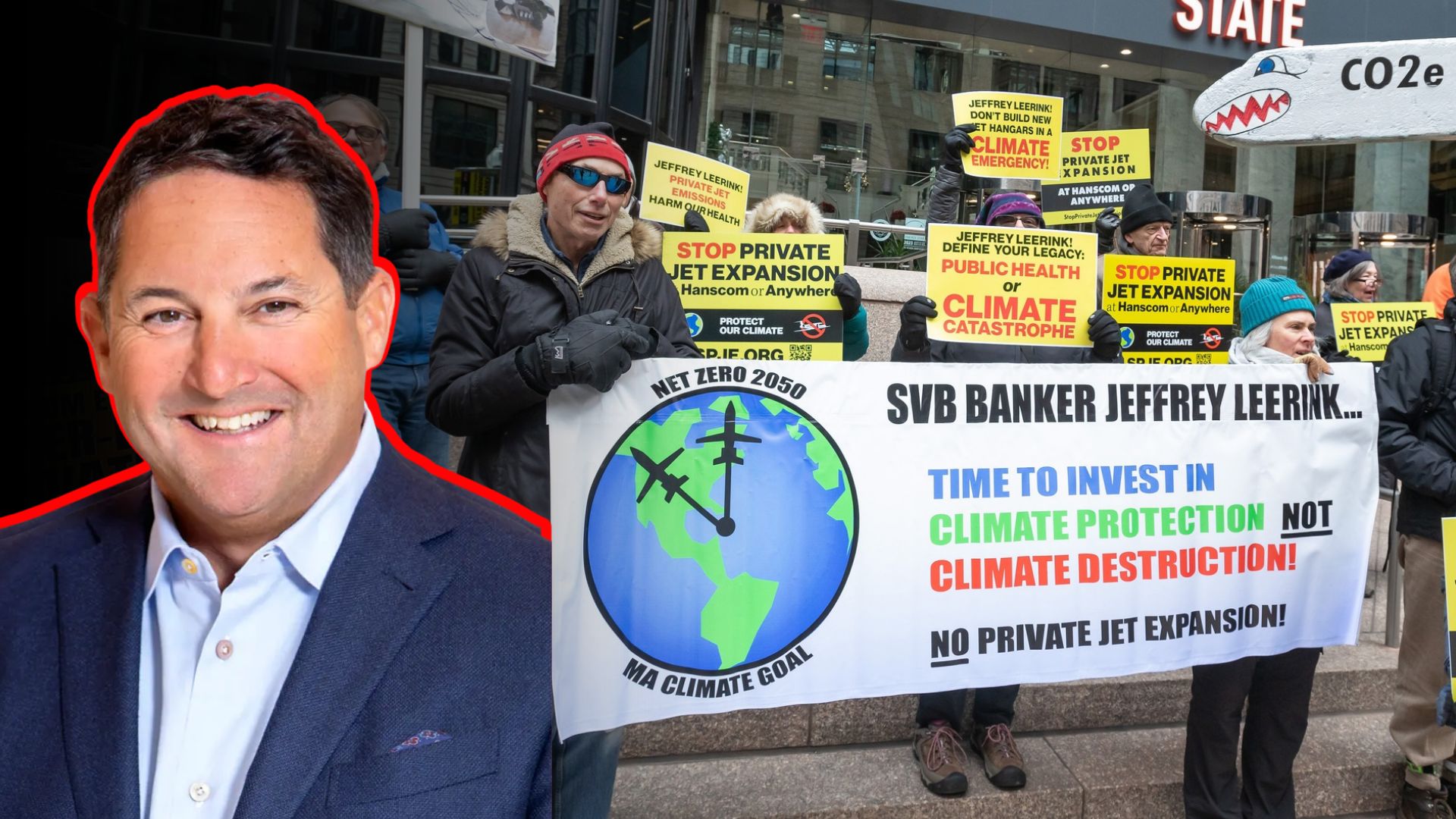
This week’s overpaid CEO: Jeffrey Leerink, the top executive at Leerink Partners, a private-equity firm.
How Leerink is driving inequality: In a recent Nation analysis, our Inequality.org co-editor Chuck Collins described Leerink as the “Prince of Plunder.” Among his exploits: handling the financing that turned Steward Health Care into one of the largest for-profit hospital networks in the country. Like other private-equity ventures in health care, Steward squeezed patients, workers, and communities, endangering health care quality and ultimately leading to bankruptcy.
Now Leerink is spearheading an effort to expand private jet hangers at Hanscom Field, New England’s largest private-jet airport. An Institute for Policy Studies report has revealed that Hanscom primarily serves ultra-wealthy travelers who make short hops to luxury destinations, emitting tons of carbon in the process. Leerink and his team are claiming their expansion plans will increase efficiency.
The last word: “Please don’t erect these bogus environmental rationales for something that has nothing whatsoever to do with relieving the crisis that faces us in terms of climate,” Massachusetts state senator Michael Barrett told a recent public hearing. “Just be honest about it. This is all about becoming a little richer yourselves by helping people even richer than you.” |
|
|
|
What's new on Inequality.org
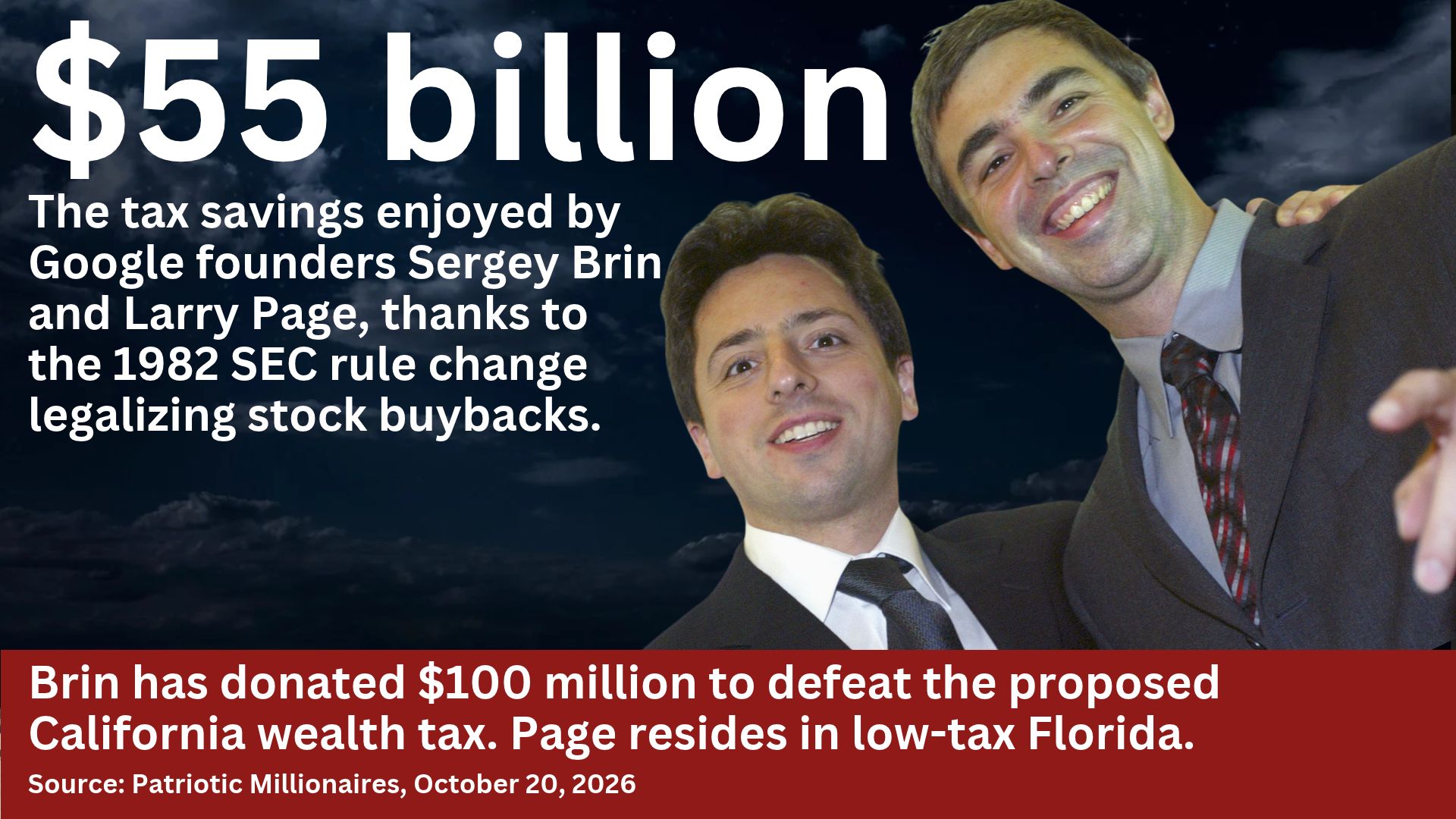
Bob Lord and Morris Pearl, $55 Billion in Stock Buyback Wealth for Google Oligarchs. A 1982 SEC rule change has turbocharged America’s extreme wealth concentration, adding $55 billion to the wealth piles of Larry Page and Sergey Brin alone. Rand Wilson, Micron’s Plan to Spend $35 Billion on Stock Buybacks Is a Slap in the Face to Its Employees. After pocketing billions in U.S. taxpayer support, the semiconductor giant is planning to spend AI windfalls to enrich shareholders and executives. Julian Villa, New York Is Getting Richer. Most New Yorkers Aren’t. Data shows that New York City has grown richer since the pandemic, but the gains have flowed overwhelmingly to the top. Elsewhere on the web
Nancy Folbre, Tax the rich and save the world, Resilience. The growing visibility of wealth concentration is rousing a coalition of economists, unions, and the worried rich. They’re pushing back against four decades of trickle-down orthodoxy, and their message is gaining traction.
Robert Kuttner, What Will Everyone Do for a Living? The American Prospect. To avoid a future AI jobs disaster, we need first to tax the living daylights out of concentrated wealth and income.
Juliana Menasce Horowitz and Richard Fry, Americans’ Views of Economic Inequality, Its Causes and Who Should Fix It, Pew Research Center. Since 2019, a growing share among those who say we have too much inequality think the economic system needs to be completely rebuilt to address it.
Michael Hiltzik, The billionaires’ campaign against the California billionaire tax rests on conjecture and fear-mongering, Los Angeles Times. Google’s Sergey Brin has contributed $102 million to the group bankrolling two ballot countermeasures that would nullify Prop 40 even if it garners a majority of votes.
Francisco de Zárate, Thomas Piketty: ‘The future billionaires are preparing for us is dystopian,’ El País. A world in conflict over resources, with growing inequality within and between countries, leads to the collapse of democratic institutions.
Rebecca Crosby and Noel Sims, Beware of AI billionaires bearing gifts, Popular Information. Elon Musk says he’s going to give every kid in America a share of his SpaceX stock. As the SpaceX founder, Musk paid essentially nothing for the stock. Giving the shares away will boost his fortune — the world’s largest — at U.S. taxpayer expense.
Sam Wollaston, Excessive wealth, extreme emissions – and ecocide: what I learned at Europe’s big superyacht show, Guardian. Nixie, the mega-yacht owned by the CEO of Revolut, stretches longer than a football field, sports a glass-bottomed infinity pool, and can be yours to rent for $3.2 million a week.
Josh Sims, Is Society’s Obsession With Wealth Making Us Sick? Esquire. People who regularly watch TV shows that glamourize wealth turn out to be less sympathetic to social causes that help the low-income. |
|
|
|
Monthly Donors Make This Read Possible! |
Inequality.org, an Institute for Policy Studies nonprofit project, depends on donations to keep this newsletter free and available to all readers. Your monthly gifts make all the difference in the world, whether you can donate $3 or $300 a month. Ready to give a few bucks a month? Sign up today. |
|
|
|
Inequality.org | www.inequality.org | inequality@ips-dc.org Institute for Policy Studies
1301 Connecticut Avenue Ste 600
Washington, DC 20036
United States
Managing Editor: Chris Mills Rodrigo
Co-Editors: Sarah Anderson, Chuck Collins, Bella DeVaan, Reyanna James, and Sam Pizzigati |
|
|
|
|