A weekly newsletter from the Institute for Policy Studies |
|
|
Cowardly CEOs, tackling pay gaps,
and Target’s overpaid boss
|
|
|
|
With Labor Day approaching, I’ve been thinking about what a terrible, horrible, no good, very bad year it’s been for our country’s frontline low-wage workers.
ICE agents have terrorized and detained employees of Walmart, Amazon, Target, and a host of other low-wage corporations. They’ve even shot at two DoorDash drivers, killing one and wounding another.
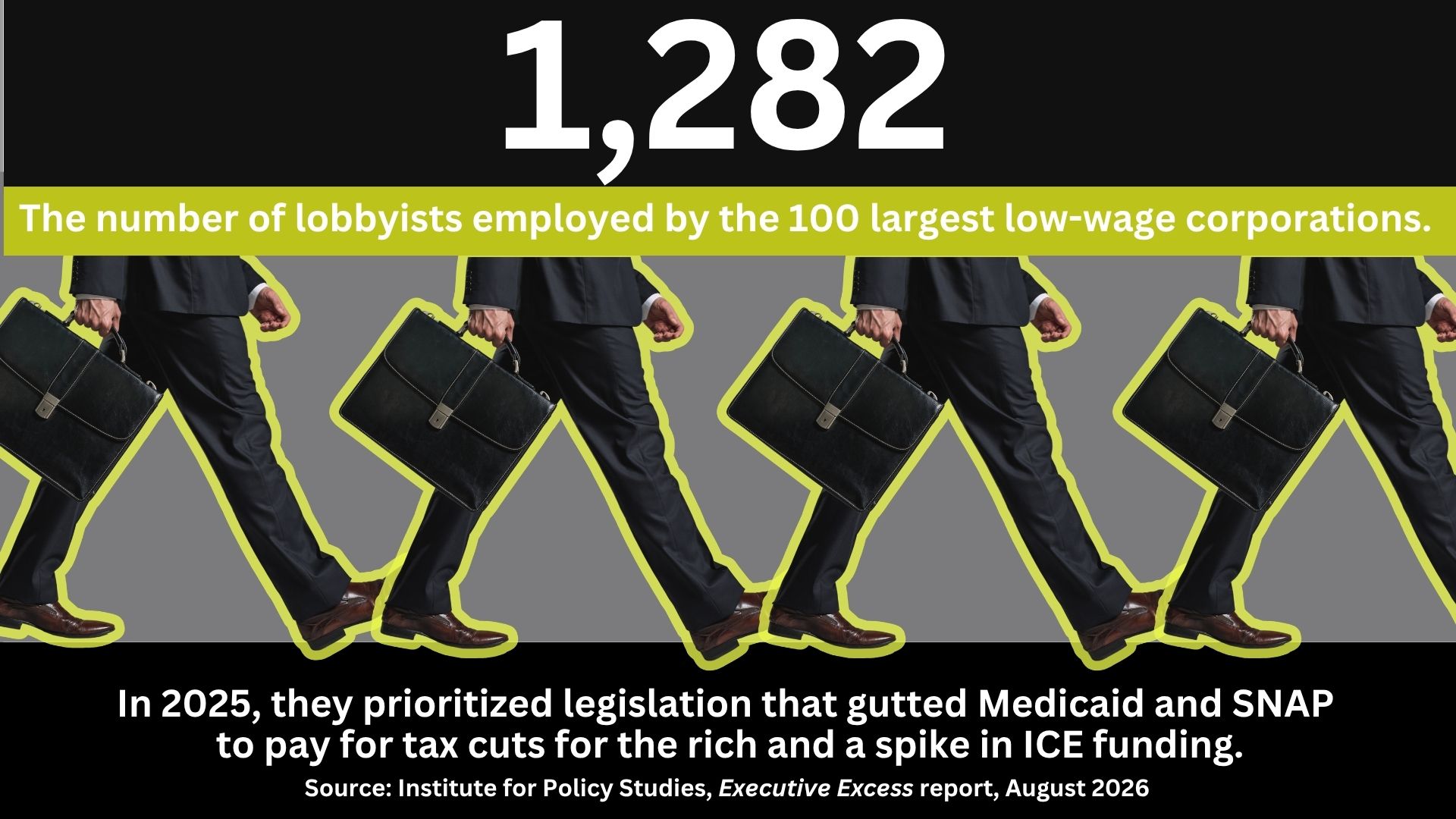
How have CEOs responded to these threats against their employees? By looking the other away. Instead of defending their workers, they’ve used their vast political power to win more tax cuts for themselves — tax cuts paid for by slashing the public assistance programs many of their workers rely on to get by.
In the remote economic galaxy these CEOs inhabit, fathoming the fear of not being able to feed your family — or even come home to your family after a day’s work — must be next to impossible. Our new Executive Excess report on our nation’s 100 largest low-wage corporations reveals that the average CEO-worker pay gap at these firms now stands at a stunning 614 to 1.
Read on below for ideas on how we can narrow gaps like that as a key part of our broader, ongoing struggle to defend human rights and democracy. Sarah Anderson
for the Institute for Policy Studies Inequality.org team |
|
|
|
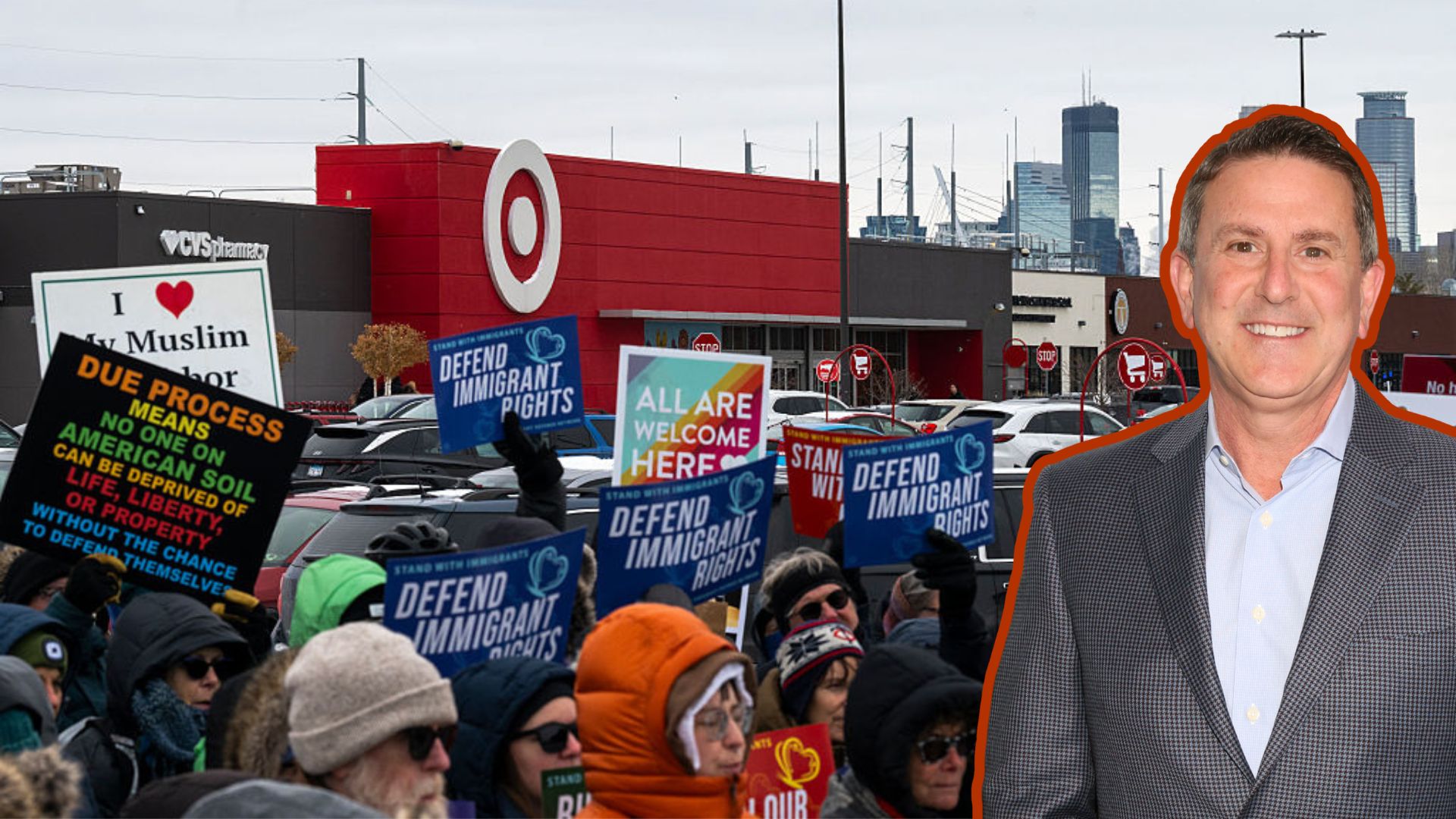
This week’s overpaid CEO: Brian Cornell, the former longtime Target CEO.
How Cornell is driving inequality: As CEO, Cornell pocketed $21.8 million in 2025 compensation, 794 times as much as the company’s $27,506 median pay. With wages that low, it’s no surprise that a GAO report has found that thousands of Target employees need Medicaid and SNAP food assistance to get by.
Target employees face challenges that go beyond poverty wages. During the ICE surge in the company's hometown of Minneapolis, agents targeted the chain and used Target parking lots for staging operations and intimidating employees. At one suburban Target, they nabbed two Latino employees — both U.S. citizens. Hours later, they dumped the men out in a parking lot in another town.
Target officials have declined to comment on ICE harassment of their employees. Cornell transitioned from Target CEO to executive chairman last February. At the time, he held Target stock worth about $40 million.
The last word: Community, faith, labor, and healthcare leaders recently rallied outside Target headquarters to call on the company to speak out about ongoing violations of basic rights. You can sign their petition here.
The American Federation of Teachers, meanwhile, is urging consumers to shop elsewhere for their school supplies to protest Target’s refusal to condemn ongoing unlawful ICE activity. Check out the campaign website at ShopSmart.AFT.org. |
Tackling Huge CEO-Worker Pay Gaps Should Not Be Partisan
At a time of intense political divisions, Americans across the political spectrum share enormous common ground on at least one problem facing our nation: the extreme CEO-worker pay gaps at our country’s largest corporations. What gets people particularly riled? Watching major companies hand out massive CEO paychecks while their lower-level employees are struggling to get by.
Everyday Americans, notes one Harvard Business School study, believe that CEO-worker pay ratios should run no higher than 7 to 1. The average pay gap at the 100 large low-wage corporations we analyzed in our just-released latest annual Executive Excess report: 614 to 1.
Policy makers can tackle this outrageous gap — at the city, state, and federal levels — through tax and government contracting policies. Moving in that direction would likely draw considerable bipartisan public support.
One survey, for instance, has found that 89 percent of Democratic and 71 percent of Republican likely voters support a tax hike on corporations that pay their CEO over 50 or more times what they pay their median employees.
And, amazingly, U.S. senators from both sides of the aisle have actually come together to insert a provision in the pending Senate defense authorization bill that would bar stock buybacks at military contractors. CEOs of these firms, with this provision in effect, would no longer be able to artificially inflate the value of their stock-based pay through this once-illegal financial maneuver.
For more solutions, check out the options our new Executive Excess lays out. |
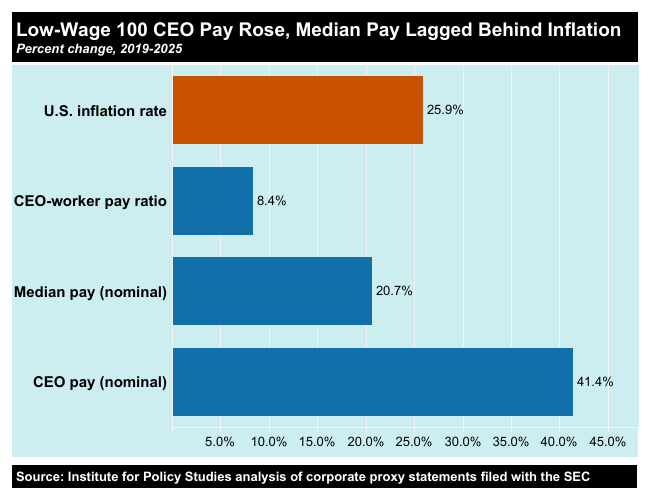
At the 100 lowest-wage major U.S. companies, CEO pay has soared while median worker pay has lagged behind inflation. Between 2019 and 2025, average CEO pay at these companies rose 41.4 percent in nominal — unadjusted for inflation — terms, double the 20.7 percent increase in these firms’ average median worker pay. The U.S. inflation rate over this same period: 25.9 percent.
For an interactive version of this chart and to read our full Executive Excess report, click the link below. |
|
|
|
The Latest Indigenous Resistance to Extractivism in New Mexico
This week’s frontline face: Cheyenne Antonio, a member of the Navajo Nation and an energy organizer with Diné Citizens Against Ruining Our Environment, Diné C.A.R.E. Antonio’s family hails from Pueblo Pintado, New Mexico, about a dozen miles east of the Chaco Culture National Historical Park, a region that locals have described as a “sacrifice zone” for oil and gas extraction.
The Trump administration is now seeking to revoke federal protections that have limited new oil and gas development around the park.
What she’s doing to help create a more equal world: Antonio is working to mobilize opposition to the proposed revocation of the public land order that protects more than 336,000 acres around Chaco from new mineral leasing. She’s helped organize a community cookout and comment drive that drew hundreds of people and also helped get the federal assessment translated into Navajo.
What makes this fight so important to her: Antonio grew up immersed in the Chaco landscape, learning from elders like her grandfather, an herbalist who has gathered traditional medicinal plants for decades. But expanded drilling in the area has left places where he once gathered plants both inaccessible and unsafe.
The fight over Chaco, Antonio believes, comes down to whether future generations will still have access to the land or if the deeply unequal “sacrifice zone” pattern of oil and gas development will continue on. |
INEQUALITY BY THE NUMBERS |
|
|
|
What's new on Inequality.org
Layla Sayed and Logan Decker, Congress Finally Passed a Housing Bill. It Isn’t Enough. The ROAD to Housing Act fails to address the commodification of housing driving our affordability crisis.
Julian Villa, Co-op Bookstores Advance Economic Democracy in the Literary Space. A visit to Bol, the first worked-owned bookstore in Washington, DC.
Elsewhere on the web
Sarah Anderson, CEOs Get Rich Underpaying Their Workers and Then Don’t Stand Up for Them, Common Dreams. The nation’s top 100 low-wage firms have spent over $718 billion repurchasing their own stock over the past seven years. The Lowe’s $46.8 billion expenditures on buybacks could have covered a $24,235 bonus for all the firm’s 276,000 employees every year during that period.
Michael Sainato, CEOs earn 614 times more than workers at US’s 100 lowest-paying corporations, The Guardian. Between 2019 and 2025, instead of paying decent wages, America’s biggest low-wage 100 firms spent $718 billion on stock buybacks.
Kristin Toussaint, CEOs at these ‘low wage’ S&P 500 companies enjoy lavish salaries while their workers struggle: report, Fast Company. CEOS making mega-millions off low-wage labor, notes Institute for Policy Studies analyst Sarah Anderson, find it “really hard to fathom what it’s like for people who have to worry about feeding their families.”
Caleb Ecarma, Musk’s wild new plan to save the world — and make himself even richer, Oligarch Watch. Elon Musk has suddenly returned to warning that climate change poses a pressing existential threat. His “solution” — while not endorsed by climate scientists — neatly aligns with his plan to make SpaceX more valuable “than the rest of Earth.”
Paul Krugman, From Kakistocracy to Cheatistocracy, Substack. Between 2011 and 2019, the share of incomes over $1 million that the IRS audited plummeted from 7.2 to 0.7 percent.
James Rodriguez, NYC's millionaires vs. the pied-à-terre tax, Business Insider. The super rich trying to dodge New York mayor Zohran Mamdani's new tax on second homes are slamming into a harsh reality.
David Conrad-Pérez, The 1915 TNR Debate That Predicted the Ills of the Billionaire Class, The New Republic. The problem — for democracy — that concentrated wealth poses: not whether a rich person could use that wealth for the public good, but whether the public good has become dependent upon what that person decides to do.
Joe Hughes, The Trump Administration Slashed Taxes for H&R Block and Raised Costs for Tax Filers, Institute on Taxation and Economic Policy. By ending the Direct File program that allowed millions of Americans to file their taxes with the IRS for free, Team Trump has set the stage for windfall corporate earnings.
Matteo Frascadore, In Miami, the Super-Rich Escape Traffic by Helicopter and Yacht, La Voce di New York. Miami ranks as the fifth most congested U.S. city. For those with the means, the answer: fly private copters or go by yacht. The new Villa Miami luxury tower has a helipad on its roof and a dock at its base.
|
|
|
|
Monthly Donors Make This Read Possible! |
Inequality.org, an Institute for Policy Studies nonprofit project, depends on donations to keep this newsletter free and available to all readers. Your monthly gifts make all the difference in the world, whether you can donate $3 or $300 a month. Ready to give a few bucks a month? Sign up today. |
|
|
|
Inequality.org | www.inequality.org | inequality@ips-dc.org Institute for Policy Studies
1301 Connecticut Avenue Ste 600
Washington, DC 20036
United States
Managing Editor: Chris Mills Rodrigo
Co-Editors: Sarah Anderson, Chuck Collins, Bella DeVaan, Reyanna James, and Sam Pizzigati |
|
|
|
|