A weekly newsletter from the Institute for Policy Studies |
|
|
Presidential hopefuls Kamala Harris and Donald Trump participated in what could be the first and last debate of this election cycle last night. From our Inequality.org perspective, we found some aspects of the debate encouraging. Tax cuts for the wealthy came under fire three times and the poverty-reducing child tax credit got a welcome prime-time mention.
But much of the debate focused on immigration, with both candidates pledging hard-line approaches to border security unlikely to do anything about the root causes driving millions to leave their homes in search of a better life.
And both Harris and Trump left an important undercurrent to the immigration debate unsaid: Millions of Americans are worrying about immigrants because they’ve been convinced that our economy is a zero-sum game where they lose if immigrants get jobs.
The reality? We have more than enough resources to go around in this country. Our main problem: The ultra-wealthy are hoarding those resources. As AFL-CIO President Liz Shuler put it last night: “An immigrant doesn’t stand between you and a good job. A billionaire does.” Chris Mills Rodrigo
for the Institute for Policy Studies’ Inequality.org team |
|
|
INEQUALITY BY THE NUMBERS |
|
|
The Ongoing Battle To Narrow America’s Daunting Racial Wealth Divide
This week’s frontline face: Dedrick Asante-Muhammad, the new president of the Washington, D.C.-based Joint Center for Political and Economic Studies.
What he’s doing to help create a more equal world: Asante-Muhammad has since earlier this year been leading the think tank dedicated to providing solutions to barriers to full freedom for America’s Black people. A longtime contributor to the Institute for Policy Studies and Inequality.org, his research on the racial wealth divide has laid bare just how much needs to be done to reach economic equality.
Investments in everything from quality education and affordable housing to new publicly financed asset building opportunities like “Baby Bonds” remain “essential,” Asante-Muhammad noted recently in a piece co-written with the Center for Economic and Policy Research’s Algernon Austin.
What makes this fight so important: “In this 21st century, the problem of the color line is still at the center of inequality and division in the United States,” Asante-Muhammad points out, “and it is my goal to position the Joint Center to lead the nation beyond its historical divisions and injustice.” |
|
|
The Ever More Important Case for a National ‘Robin Hood Tax’
No matter how difficult making ends meet has become for average Americans, those atop one sector of our economy always seem to be able live luxuriously. That sector: Wall Street. By gambling on our markets, traders manage to end up holding prodigious amounts of wealth despite producing nothing of tangible value. So why not tax the stock, bond, and other financial trades that are making Wall Streeters so phenomenally wealthy? A group of over 100 organizations earlier this summer made just that case. These groups called on Congress to adopt a 0.1 percent financial transaction tax, or FTT. That minuscule tax rate would generate an estimated $752 billion over 10 years, as Public Citizen's Susan Harley has just noted on Inequality.org.
Those billions would be enough to cover free universal preschool, free community college, and national paid family and medical leave — all combined. That sure sounds better for society than a Wall Street exec getting a second yacht.
Similar “Robin Hood” taxes enacted abroad have both generated significant revenues and disincentivized the high-frequency trades that firms use to make tiny profits over millions of moves. Read more below from Harley on how taxing trades could rein in Wall Street and leave our society significantly more equal. |
|
|
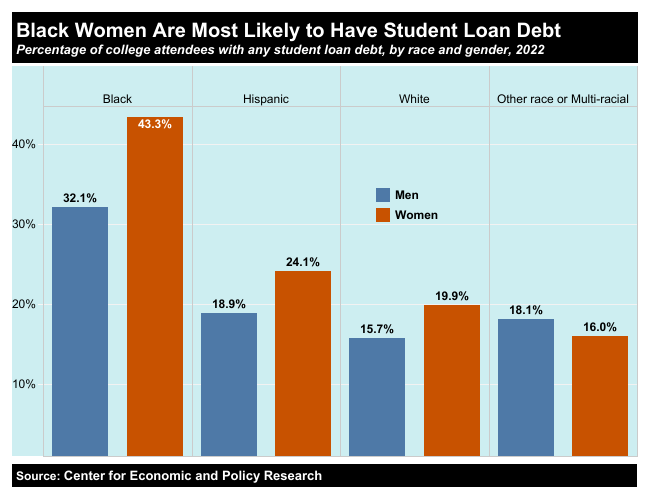
Our back-to-school season is now running in full swing, and so is the inequality that comes along with student loan debt. According to a Center for Economic and Policy Research analysis of Americans who have attended college, 43.3 percent of Black women are shouldering these financial burdens, compared to just 15.7 percent of white men. For an interactive version of this chart and more on racial inequality, just click the link to our Inequality.org Facts section below. |
|
|
Are You Ready for Some (Private Equity Kingpin) Football! The billionaires who run the world’s most profitable sport have just decided to “share the wealth” — with the greediest of their fellow rich. By a 31-1 margin, the owners of the 32 pro football franchises that make up the NFL have just voted to crack open their money-making machine to the investment fund kingpins of private equity.
The downside of letting private equity in? NFL owners don’t see one. After all, every other major pro sport — from baseball and basketball to hockey and soccer — is already sporting a private equity presence. But fans and their communities have little cause to share that welcoming spirit of pro sports franchise owners. Inequality.org co-editor Sam Pizzigati has more. |
PETULANT PLUTOCRAT OF THE WEEK |
Flimflamming Fans: A New Ally for Not Taxing the Rich
This week’s dour deep pocket: Bill Belichick, the long-time mega-millionaire coach of the New England Patriots football team and current extravagantly compensated ESPN network sports analyst.
What has Belichick sour: the 4 percent surtax on household income over $1 million that Massachusetts voters approved in 2022. Late last month, on the nation’s top sports talk show, Belichick claimed that the new “Taxachusetts” levy on millionaires would leave the state’s pro teams unable to re-sign their biggest stars. Player agents, Belichick charged, will “sledgehammer” Boston teams on the new state taxes their clients would have to be paying.
Massachusetts expects to raise some $1.3 billion from the millionaire surtax in the current budget year. Those dollars will enable the state, among other outlays, to make school meals free for all K-12 students.
The last word: “Multimillionaire athletes and CEOs can easily afford” the new Massachusetts millionaire’s tax, says Andrew Farnitano of Raise Up Massachusetts — and the state’s sports fans don’t have to worry about any massive player exodus. The tax, he notes, certainly didn’t prevent the Boston Celtics “from putting together the best team in the NBA last year and re-signing nearly the entire roster.”
|
|
|
What's new on Inequality.org
Sarah Anderson, Hotel CEOs Prioritize Their Own Paychecks, Not Improvements for Their Companies or Workers. The three hotel chains hit with Labor Day strikes have all been spending more on stock buybacks than long-term investments or worker retirement security.
Natalia Renta, Corporate Greed Doesn’t Need a Boost From ‘Anti-ESG’ Politicians. House Republicans are fixated on blocking corporate progress on clean energy, racial justice, and labor protections.
Farrah Hassen, Workers Need Protection From Record-Breaking Heat. Some 2,000 workers die from extreme heat every year. As temperatures rise, we need federal standards for water breaks, shade, and other basic protections. Elsewhere on the web
Bob Lord and Morris Pearl, Project 2025: Will the rich ever pay tax again? Fortune. The tax proposals in Project 2025, if ever enacted, would practically guarantee an even greater concentration of our country’s wealth in the hands of our super rich.
Les Leopold, Everyone Talks About the Economy, But No One Does Anything About It! Wall Street’s War on Workers. Meta, Alphabet, and Microsoft laid off over 40,000 workers in 2022-23 despite booking hundreds of billions in profits. These tech giants value higher share prices above all else because those prices translate into enormous windfalls for investors and top execs alike.
David Kass and Portia Allen-Kyle, How Tax Fairness Can Promote Racial Equity, Americans for Tax Fairness. A new report details how our tax system has perpetuated white privilege and hindered upward mobility for people of color.
Robert Reich, Six ways to rein in Musk, Substack. Elon Musk is rapidly transforming his enormous wealth — as the richest person in the world — into a huge source of unaccountable political power.
Joshua Yaffa, How to Give Away a Fortune, New Yorker. An Austrian heiress — inspired by the egalitarian work of the philosopher Ingrid Robeyns — recruited 50 people from all walks of life to redistribute her own huge personal fortune.
Annie Massa, Ultra-Rich Families Set to Control $9.5 Trillion by 2030, Deloitte Says, Bloomberg. The wealth of ultra-rich families will likely swell to $9.5 trillion by 2030 as “family offices” grow and morph to rival hedge funds in size.
Andrew Perez and Asawin Suebsaeng, Trump Is Banking on Billionaires to Put Him Back in the White House, Rolling Stone. The former president is increasingly relying on the wealthiest of donors — and offering them the world.
David Moscrop, The Rich Want You to Fear Tax Fairness: An interview with Jim Stanford, Jacobin. A Canadian look at the broader implications of privileging capital gains over ordinary income.
Parthiv Parekh, Greed Is Good, Bad or Ugly: Which Political Party Is Better for the American Economy? American Kahani. Bottom 99 percents, not top 1 percents, determine the vitality of consumer demand. |
|
|
ON BILLIONAIRES AND THE REST OF US |
This newsletter and the whole Inequality.org project are powered by donations. We’re not raking in cash from the billionaire class, though. We’re counting on people to see why this reporting, research, and advocacy matters, and then to become paid subscribers, by making a recurring monthly donation of any amount. Make a monthly gift as a paid subscriber. Start your paid subscription today. |
|
|
Inequality.org | www.inequality.org | inequality@ips-dc.org Institute for Policy Studies
1301 Connecticut Avenue Ste 600
Washington, DC 20036
United States
Managing Editor: Chris Mills Rodrigo
Co-Editors: Sarah Anderson, Chuck Collins, Bella DeVaan, and Sam Pizzigati |
|
|
|