A weekly newsletter from the Institute for Policy Studies |
|
|
California's crybaby billionaires, boycotting Starbucks, and Bezos's jewels
|
|
|
|
Some of the nation’s most sensitive and fragile billionaires seem to be living out on the left coast these days. This fall, facing a popular Prop 40 ballot initiative that would place a one-time 5 percent tax on the wealth of California’s 200-plus billionaires, these sensitive souls are ponying up tens of millions to kill the levy.
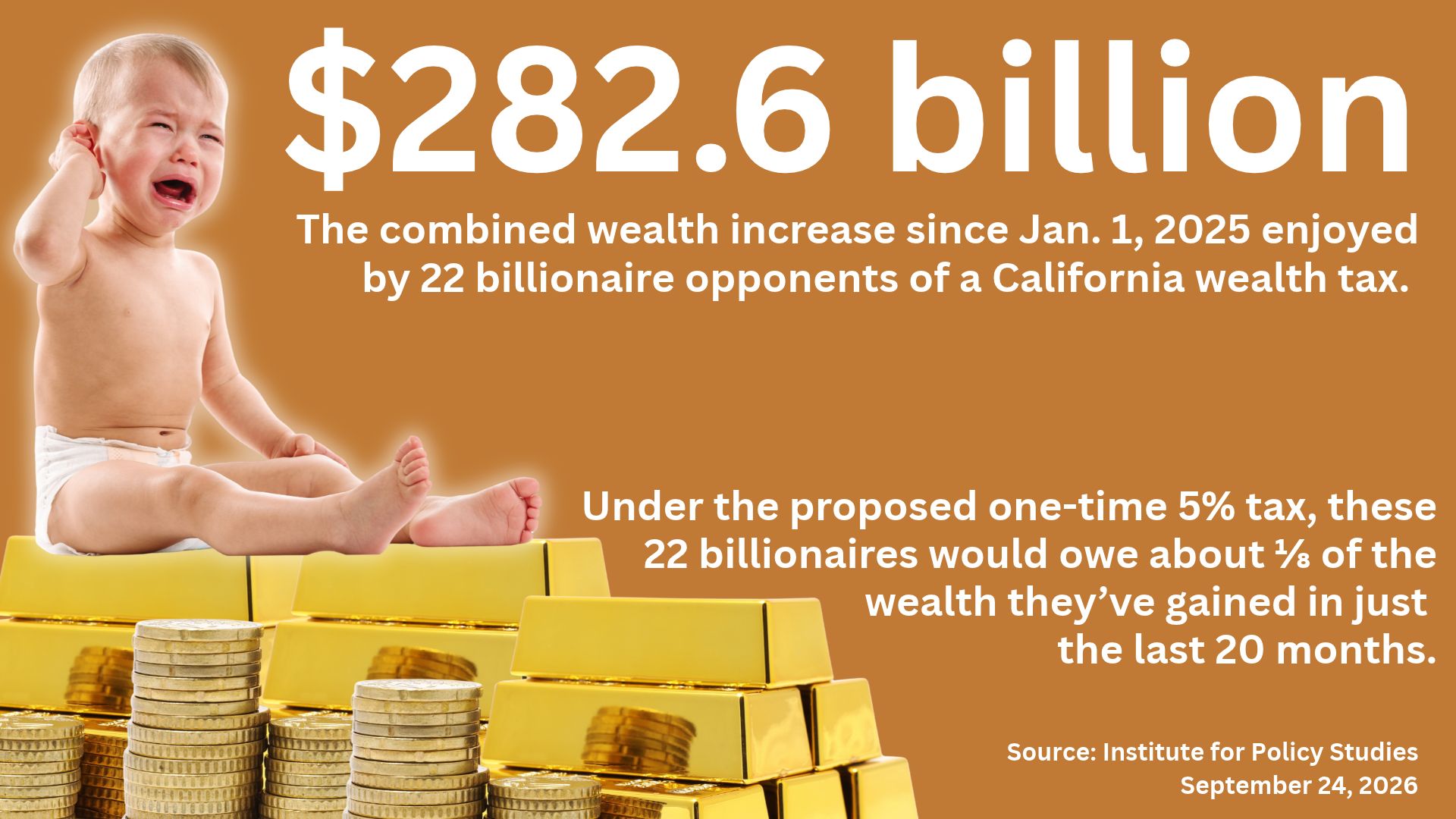
In an analysis for the folks at Tax the Ultra Rich Now, our Inequality.org crew has identified 22 Golden State billionaires who’ve contributed massively to the “No On 40” drive or spoken out aggressively against it. These 22, turns out, have seen their combined wealth increase 64 percent over the last 20 months. Yet you’d think that Prop 40 would leave them destitute from the way they’re acting.
One example: Venture capitalist John Doerr has given $10 million to “No On 40.” Over the past 20 months, Doerr’s personal wealth has jumped nearly 48 percent, from $14.8 billion to $21.9 billion. His fortune is now running 7,227 times the $303,000 wealth of California’s median households.
Listening to the baleful cries of billionaires like Doerr, you almost feel a need to take their hand and share some reassuring words. You’re going to be OK. If Prop 40 passes, you’ll still have 95 percent of your billions and tens of thousands of your neighbors will have health care thanks to the 5 percent you’ll be missing. California voters will decide Prop 40’s fate on Election Day this November.
One other quick note: Don’t miss Mike Scutari’s Inside Philanthropy article on our new Institute for Policy Studies report, Philanthropy Under Oligarchy. The report, Mike writes, “proves you can be excited about something while simultaneously dreading it.” That’s our inequality research team in a nutshell! Chuck Collins
for the Institute for Policy Studies Inequality.org team |
|
|
|
INEQUALITY BY THE NUMBERS |
Why You Should Join the New Boycott Against Starbucks This week’s frontline face: Lisa Watson, a three-year Starbucks barista from North Carolina and an active member of Starbucks Workers United.
What she’s doing to help create a more equal world: Watson and thousands of other Starbucks workers nationwide are calling on the public not to spend any dollars at the coffee chain until Starbucks finally agrees to a contract.
Starbucks Workers United has been negotiating with the coffee giant for over five years now, ever since Starbucks workers in Buffalo, New York, became the first in the chain’s history to unionize. Starbucks workers nationwide are demanding fair compensation, access to health insurance, and more humane shift scheduling.
What makes this fight so important: As Starbucks baristas struggle to make ends meet, company CEO Brian Niccol is raking in tens of millions and commuting to work in a private jet. Notes Watson on Inequality.org: "Our CEO-to-worker pay ratio in 2025 was a staggering 1,794 to 1." |
Want To Help America’s Families? Help Pass Universal Child Care
Vice President J.D. Vance has recently been trying to polish his 2028 election resume by focusing on the plights of parents struggling financially to raise their children. His proposal for “helping” families: divert resources from the federal Child Care and Development Fund to a new program that would give $9,000 a year to married couples with kids if one parent rates as a stay-at-home spouse.
Instead of punishing single parents, as this proposal would do, journalist Sonali Kolhatkar is proposing a much better way to help struggling families: universal child care. Both New Mexico and New York have recently made moves toward developing child care projects that would greatly reduce the financial strain on working families. To read more about where Vance goes wrong, click below. |
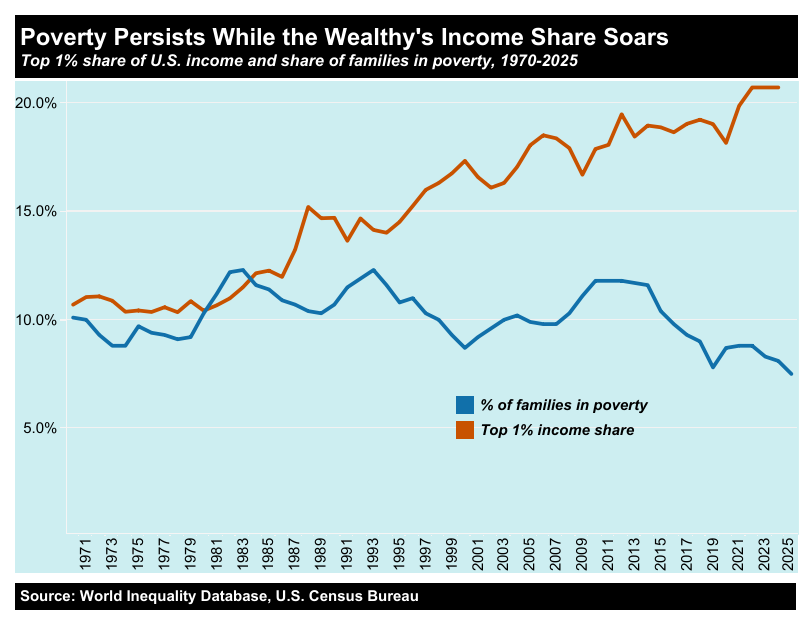
Since 1970, the top 1 percent of American earners have increased their share of national income by 10 percentage points. Over the same stretch, the Census Bureau’s “official” poverty rate for U.S. families has fallen by just 2.6 percentage points. This contrast highlights the growing divide between the immense gains going to the top and the limited progress made in reducing poverty at the bottom.
For an interactive version of this chart and more on income inequality, click the link to our Inequality.org Facts section below. |
OVERPAID EXECUTIVE OF THE WEEK |
This week’s overpaid executive: Jeff Bezos, founder and the current executive chairman of Amazon.
How Bezos is driving inequality: Among the top 10 U.S. gazillionaires, Bezos happens to be the only chief exec whose company sits on our IPS Low-Wage 100 list of large corporations with the lowest median worker pay.
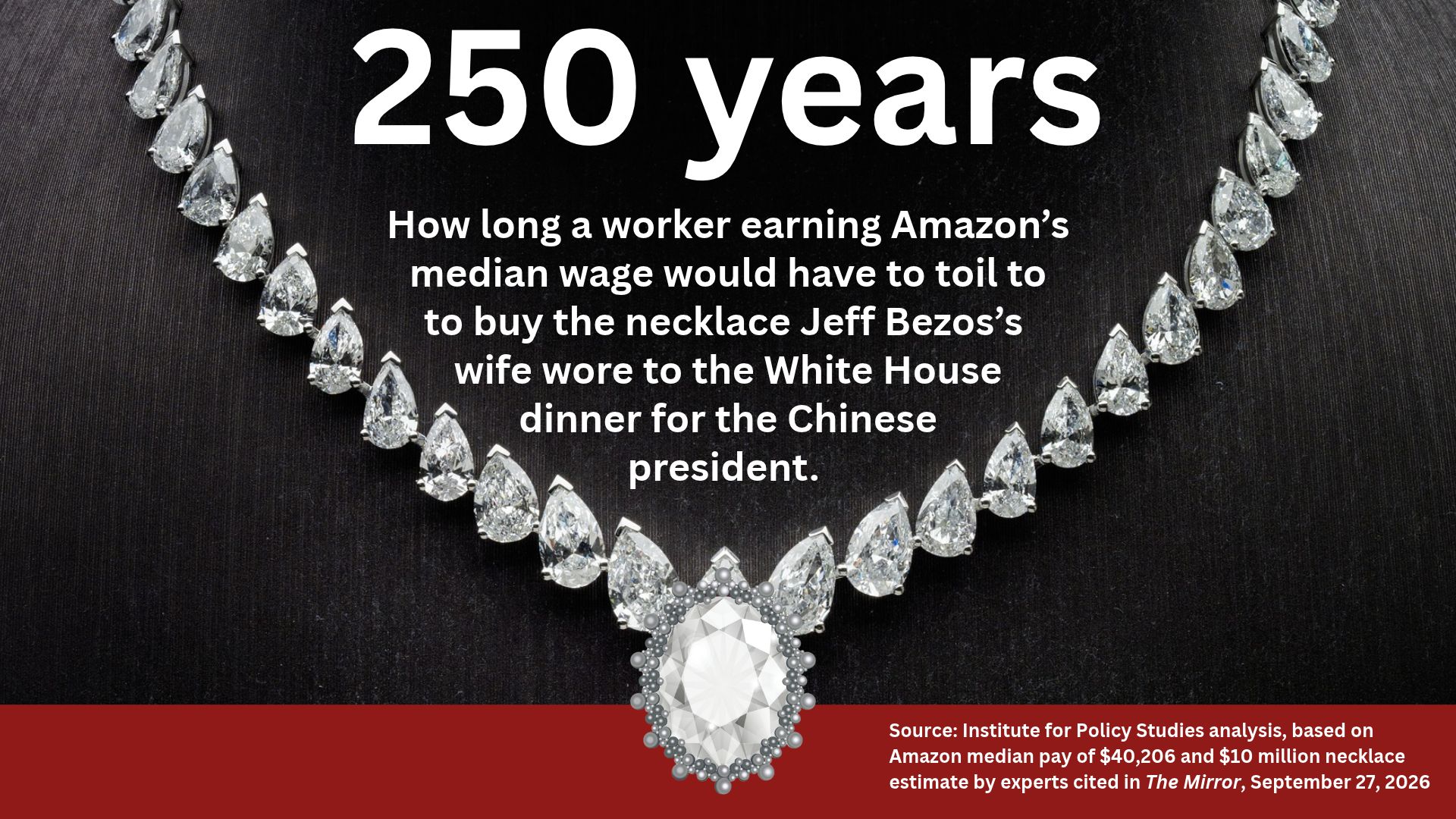
Last year, Amazon’s median wage stood at just $40,206. At that rate, a worker would have to toil for well over two centuries to earn enough to buy the $10 million diamond necklace Bezos’s wife, Lauren Sanchez, flaunted at last week’s Donald Trump state dinner with the Chinese president.
Bezos and Sanchez nibbled on squash velouté and wild mushroom fricassee at that opulent White House soirée. Thousands of Amazon employees, meanwhile, spent the evening scrambling to feed their families. A Government Accountability Office analysis has found that 12,346 Amazon workers in nine states are making so little that they qualify for SNAP benefits. The last word: Bezos’s plutocratic behavior and Amazon’s powerful grip on our society and economy have provoked innovative resistance, including the founding of the broad-based Athena Coalition, an alliance of worker, antitrust, small business, and racial, economic, and environmental justice organizations.
Athena director Ryan Gerety says shifts in how the public perceives mega-corporations have buoyed their group’s efforts to rein in Amazon’s power. “Everyday people are like, ‘These companies are not good and shouldn’t have this much power, and why aren’t we breaking them up?’” Gerety recently noted.
|
|
|
|
What's new on Inequality.org
Anthony Pahnke, Global Summit Gives Wisconsin Workers and Farmers a Platform to Demand Fair Trade. As G20 trade ministers meet in Milwaukee, labor advocates are pushing for a trade agenda that delivers for working people. Elsewhere on the web
Bob Lord, The Tax Avoidance Two-Step of the Ultrarich, Substack. Rightwing Tax Strategy: First understate the income and overstate the tax rates of the ultrarich, then claim the revenue from taxing them more wouldn’t amount to much.
Patrick Freyne, Naomi Klein: The super rich need to be abolished and ‘prescribed a middle-class life,’ Irish Times. Says Klein: “We’re not calling for the guillotine. All we want for these billionaires is to just have to live in the same world as us. It’s not so bad down here.”
Les Leopold, Wanted: An Organized Political Movement to Counter the AI Oligarchs, Common Dreams. AI firms and their execs have rapidly accumulated political influence in both parties. Where will pressure for real AI regulation — and serious protections against growing economic inequality — come from?
Brent Griffiths, The 25 billionaires and millionaires who have already spent roughly $850 million ahead of the midterms, Business Insider. The $850 million total does not include money from billionaire-bankrolled “dark money” groups not legally required to disclose their donors.
Shane Dixon Kavanaugh, Portland councilors seek major expansion of city’s CEO pay-gap tax, Oregonian. Lawmakers in Portland, the first U.S. city to up taxes on corporations with CEOs making over 100 times their worker pay, are pushing to raise their tax penalty’s tax rate.
Antony Adshead, AI promises a productivity windfall – who will reap the benefits? Computer Weekly. Will AI make our world more unequal? Absolutely — if we allow the pattern of previous industrial revolutions to repeat. But that repetition need not be automatic.
Tracy Weber, Why ProPublica Is Leaning Into Sports Investigations, ProPublica. Big Money’s tentacles are squeezing every aspect of the sports industry. Just one example: Have a gleaming new stadium in your town? Your tax dollars likely paid for much or all of it, despite the billions that belong to your team’s owners
|
|
|
|
Monthly Donors Make This Read Possible! |
Inequality.org, an Institute for Policy Studies nonprofit project, depends on donations to keep this newsletter free and available to all readers. Your monthly gifts make all the difference in the world, whether you can donate $3 or $300 a month. Ready to give a few bucks a month? Sign up today. |
|
|
|
Inequality.org | www.inequality.org | inequality@ips-dc.org Institute for Policy Studies
1301 Connecticut Avenue Ste 600
Washington, DC 20036
United States
Managing Editor: Chris Mills Rodrigo
Co-Editors: Sarah Anderson, Chuck Collins, Bella DeVaan, Reyanna James, and Sam Pizzigati |
|
|
|
|