A weekly newsletter from the Institute for Policy Studies |
|
|
Algorithmic ripoffs, restricting pesticide profits, and a greedy gamer
|
|
|
|
Corporate America is crushing it. Analysts are expecting S&P 500 profits to be up by over 47 percent in the second quarter, compared to a year ago. Meanwhile, working families are struggling to get by, and real wages have barely budged. At a recent Institute for Policy Studies symposium, Lindsay Owens of Groundwork Collaborative shed some revealing light on one key factor driving those corporate profits: the reinvention of the ripoff.
“We now have algorithmic price fixing, where landlords across the country can use an app to align on pricing for rents,” Owens explained. “Even things like groceries are changing price more frequently than they used to. We also have surveillance pricing. Companies are spying on you in order to overcharge you, trying to use data to better ascertain your individual willingness and ability to pay.”
Creepy, right? You can now find online videos and transcripts of all that symposium’s speakers, including yours truly. I presented a new IPS blueprint for countering the power of billionaires, corporations, and the Pentagon. A quick note on scheduling: Inequality.org will be taking a summer hiatus August 12 and 19. We’ll be back in your inbox August 26. Sarah Anderson
for the Institute for Policy Studies Inequality.org team |
|
|
|
INEQUALITY BY THE NUMBERS |
Fighting to Keep Disability Communities Together This week’s frontline face: Janiah Miller, the senior campaigns organizer at Black Feminist Future, a political hub that focuses on building the power needed for real liberation.
What she’s doing to help create a more equal world: Drawing attention to a huge hole in the housing debate. Nearly all the current focus centers on supply and affordability. For those in the disability community, an extra wrinkle comes in: relationships.
Neighbors and peer networks rate as especially important for people with disabilities. But affordability discussions often don’t factor in the cost of losing access to those supports. A new apartment might cost less in rent, but that apartment, without helpful people surrounding it, can be inaccessible.
What makes this fight so important: “Accessibility isn’t just about ramps, elevators, or widened doorways but whether disabled people can afford to remain in the communities that enable us to thrive,” Miler notes in a new analysis for Inequality.org.
"A housing bill that ignores these realities actively deepens inequality," she adds. "Accessibility is a policy choice. And right now, policymakers are choosing to leave disabled people behind." |
States Need to Lead the Way on Restricting Corporate Pesticide Windfalls
The Supreme Court ruled in Monsanto v. Durnell earlier this summer that states can no longer hold the manufacturer accountable for skipping warning labels unless required to do so by the federal EPA.
That decision hits hard at the ability of states to restrict dangerous chemicals that the Trump administration’s currently lax federal enforcement efforts have invited. But states can still proactively protect their residents from non-Hodgkin lymphoma and other cancers.
States still can, notes Emma Newton from the State Innovation Exchange, directly ban the sale of pesticides, establish buffer zones for use, and pressure Congress. For more on the role states have to play after the Supreme Court’s decision, click below. |
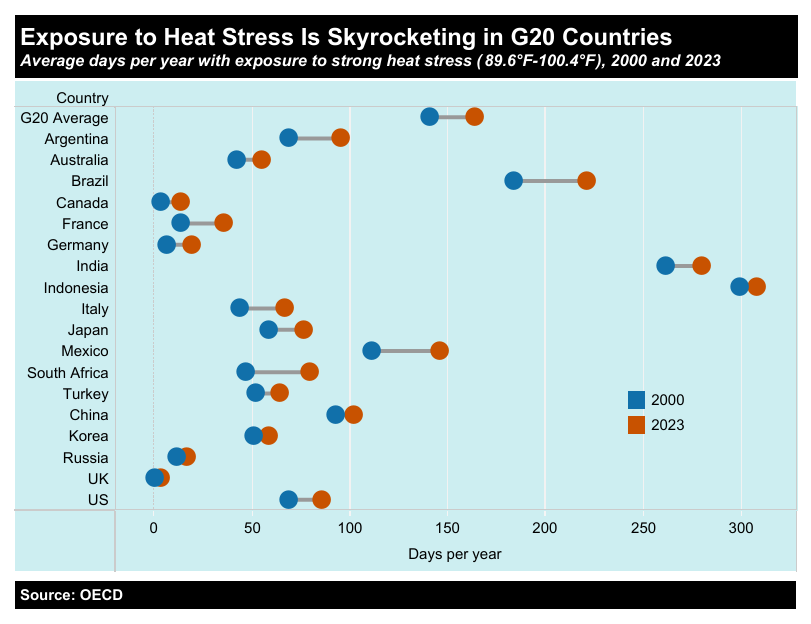
Heat stress is an urgent threat for workers around the world. Between 2000 and 2023, the number of days people experienced temperatures between 89.6°F and 100.4°F increased in every G20 country, rising by an average of 16.5 percent. With the United States chairing this year's G20 — a forum for the world's largest economies to discuss global economic issues — international trade unions are urging leaders to make worker heat protections a priority. Instead, the Trump administration is rolling back Biden-era federal heat safety rules while promoting corporate-friendly deregulation on the global stage. For an interactive version of this chart, click the link below.
|
PETULANT PLUTOCRAT OF THE WEEK |
This Gaming CEO Works Magic: He Makes Game Creators Disappear
This week’s dour deep pocket: Andrew Wilson, the 51-year-old CEO of Electronic Arts, one of the world’s largest computer gaming giants.
What has Wilson sour: that he didn’t figure out a way to wheel and deal his way to a private-equity buyout sooner. Electronic Arts became a privately held company earlier this week, just days after EA — as a publicly traded company — had to reveal Wilson’s take-home for EA’s fiscal 2026.
Wilson collected $38.6 million for the year, 305 times the pay of EA’s most typical staffers. The enormity of Wilson’s compensation has sparked outrage throughout the gaming community. The key reason: Wilson has been laying off, by the hundreds, the EA staffers who programmed Battlefield 6, a game that last fall sold 7 million copies in its first three days, one of gaming’s best launches ever.
Privately held corporations have no obligation to reveal their top executive pay.
The Saudi-led grouping that took EA private paid $55 billion for the privilege, the largest-ever leveraged buyout outlay. That grouping includes Affinity Partners, the investment firm Trump son-in-law Jared Kushner co-founded.
The last word: “We live in a parasitocracy,” one gamer posted online after news of Wilson’s $38.7 million 2026 compensation surfaced. Added another: “Here to remind everyone that the .7 in $38.7M is the price of a house.” |
|
|
|
Danny Dorling, Take a Moment to Feel the Pain of the Rich, Jacobin. The idea that extraordinary talent deserves extraordinary compensation has become our modern-day justification for record inequality. Robert Reich, A Realist’s Guide to the American System, Substack. In the system we now have, power and wealth have become inseparable. Great wealth flows from great power. Great power depends on great wealth.
Elizabeth Wilkins and Todd Tucker, How Public Equity Can Promote a Revived American Democracy, The Nation. Bernie Sanders has proposed that any AI company earning more than $200 million make a one-time deposit of 50 percent of its shares in a publicly owned sovereign wealth fund.
Daniel Drezner, The Perils of the Billionaire Bubble, Drezner’s World. If you think speaking truth to power can be hard, this political scientist advises, try speaking truth to money. David Runciman, The Cult of Longevity, London Review of Books. The solution to the problem of gerontocracy in America: the expropriation of the assets of wealthy older citizens who have far more than they need.
Plutocratifornia, Excessive Wealth Disorder Blog. The challenge to the rich that California’s billionaire wealth tax initiative poses has brought plutocracy out in the open. Can billionaire money convince voters to vote against their self-interest and the interests of California? We’ll see.
This 4,000-year-old city defied the rules of history, University of York. The ancient Mohenjo-daro civilization in modern-day Pakistan and India, a new study shows, demonstrates that a technologically advanced society can distribute prosperity broadly. The more equal Mohenjo-daro became, the more advanced the civilization grew.
László Andor, Burnham’s Break with Thatcherism Matters for All Europe, Social Europe. Might the UK Labour Party finally, after decades of being, as Labour insider Peter Mandelson infamously put it, “intensely relaxed about people getting filthy rich,” finally be ready to take on gross economic inequality?
Joseph Wilkins, Why America's super rich have embraced the appeal of British soccer teams, CBNC. English soccer clubs, or football clubs, per the sport’s more common global name, have become hot commodities for the U.S. ultra-rich, who now control over half the teams in the UK’s most prestigious soccer circuit.
|
|
|
|
Monthly Donors Make This Read Possible! |
Inequality.org, an Institute for Policy Studies nonprofit project, depends on donations to keep this newsletter free and available to all readers. Your monthly gifts make all the difference in the world, whether you can donate $3 or $300 a month. Ready to give a few bucks a month? Sign up today. |
|
|
|
Inequality.org | www.inequality.org | inequality@ips-dc.org Institute for Policy Studies
1301 Connecticut Avenue Ste 600
Washington, DC 20036
United States
Managing Editor: Chris Mills Rodrigo
Co-Editors: Sarah Anderson, Chuck Collins, Bella DeVaan, Reyanna James, and Sam Pizzigati |
|
|
|
|