A weekly newsletter from the Institute for Policy Studies |
|
|
Putting a smile on Abe Lincoln’s face and
a look at the rich who still love New York |
|
|
|
Poor Lincoln. From his perch on Mount Rushmore, he’s had to listen to his latest successor rant about the “communist menace.” From his big chair in D.C., he's had to watch people get arrested for dipping their hands in his reflecting pool. But one recent event must have boosted Lincoln’s spirits. Late last week, the world’s largest private equity firm abandoned efforts to build the world’s largest AI data center. Blackstone’s proposed colossus would have loomed over the site in the Virginia city of Manassas where soldiers clashed in the Civil War’s first major battle.
Blackstone CEO Stephen Schwarzman, a Republican mega-donor worth more than $40 billion, seldom suffers defeat. But local residents and preservationists beat him this time. Determined to stop the desecration of hallowed ground to pump up private equity and Big Tech profits, they dragged out one zoning hearing for 27 hours! Now, after a five-year battle, these activists have prevailed.
Lincoln urged Americans to honor the Civil War’s dead by striving to create a government of the people, by the people, and for the people. He would have cheered on the mighty data center fighters of Manassas.
p.s. Please join us – in person in DC or virtually – on July 23 for our Forging a Democracy that Works for All symposium. Speakers will include Rep. Jamie Raskin and inequality fighters from People’s Action, Jobs with Justice, CWA union, and more. Sarah Anderson
for the Institute for Policy Studies Inequality.org team |
|
|
|
Bringing the Fight Against Developing Nation Debt Into Our Backyard
The ongoing Middle East war is wreaking havoc on economies around the world, forcing dozens of developing nations to spend more on debt payments than on health care or education. But that debt burden, Jubilee USA’s Aldo Caliari explains in an exclusive new Inequality.org analysis, isn’t just crippling the Global South. That debt has ordinary Americans suffering as well.
U.S. workers who depend on trade-dependent businesses suffer. Consumers pay more for groceries and other everyday goods. Pension holders face financial instability. And taxpayers often wind up bailing out the private creditors — known as “vulture funds” — who buy up heavily discounted debt and then sue governments to collect in full, scuttling international debt relief negotiations.
Can we stop those private vultures? Activists and lawmakers in New York, the state where these private debt contracts abound, think we can. Over the past year, their proposed legislation that would crack down on predatory private creditors has gained real traction. Read more from Caliari about this innovative, state-based solution to a global crisis. |
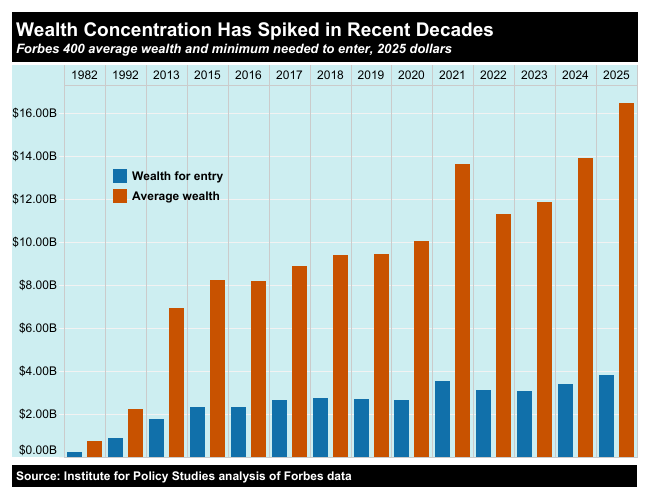
The bar for joining the ranks of America’s richest has never been higher.
Back in 1982, the year Forbes published its first annual list of America’s 400 richest, the nation’s deepest pockets averaged about $750 million, in today’s dollars, with the “poorest” among them worth $250 million.
Fast forward to our time. In 2025, just making the top 400 cut took a personal fortune worth at least $3.8 billion. The average Forbes 400 fortune has soared to more than $16 billion, over 21 times the 1982 average after adjusting for inflation. And these figures don’t even include Elon Musk’s recent rise to trillionaire status, meaning next year’s numbers will likely be even more staggering.
For an interactive version of this chart and more on wealth inequality, click the link to our Inequality.org Facts section below. |
PETULANT PLUTOCRAT OF THE WEEK |
This CEO Can’t Believe It: The Rich Still Love New York
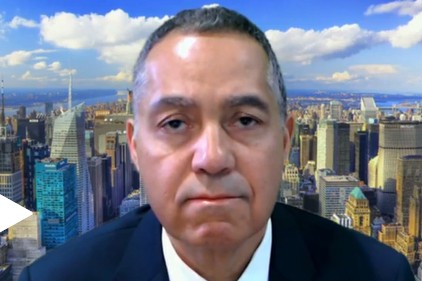
This week’s dour deep pocket: Don Peebles, the CEO and chair of the Peebles Corporation, a privately held national real estate giant that boasts developments worth over $8 billion. What has Peebles sour: Zohran Mamdani’s victory in last year’s New York City mayoral election. “I am shocked that the epicenter of capitalism,” Peebles declared after Mamdani’s triumph, “has elected a socialist.” This past spring, Peebles focused his fire on Mamdani’s push for a special “pied-à-terre” tax on New York City second-home apartments valued at over $1 million. State lawmakers okayed that tax in May.
“New York City is not going to be able to tax its way out of its problems,” Peebles at that time predicted. “The more they tax people, the more high net worth individuals keep leaving.”
But the new tax has inspired no such exodus. In fact, notes CNBC’s Robert Frank, the high end of Manhattan’s real estate market — the end the new tax impacts the “most” — “remains the strongest.” Manhattan condo sales between $10 million and $20 million “surged” an amazing 55 percent last month.
The last word: “The amount of money out there,” gushes New York realtor Lauren Muss, “is insane.” |
|
|
|
INEQUALITY BY THE NUMBERS |
|
|
|
New on Inequality.org
Kennith RaShaun Woods II, DC Council Punts Wealth Tax Debate to the Fall. The DC Council plans to consider a wealth proceeds tax in September, rather than this summer.
Elsewhere on the web
Matt Simonton, Oligarchy’s Ancient Origins, Project Syndicate. In ancient Greece, oligarchs relied on cleverly designed political institutions to shore up unpopular regimes. With concerns rising over the “rule of the few” in today’s U.S., Americans should consider how their own institutions are doing oligarchs’ work for them.
Noa Rosinplotz, One Year Later: How OBBBA’s Tax Cuts for the Rich Have Weakened Democracy, Roosevelt Institute. A year ago, America’a richest president ever signed the “One Big Beautiful Bill Act.” For top 1 percenters, the bill did indeed rate as beautiful, with annual tax savings averaging $66,000.
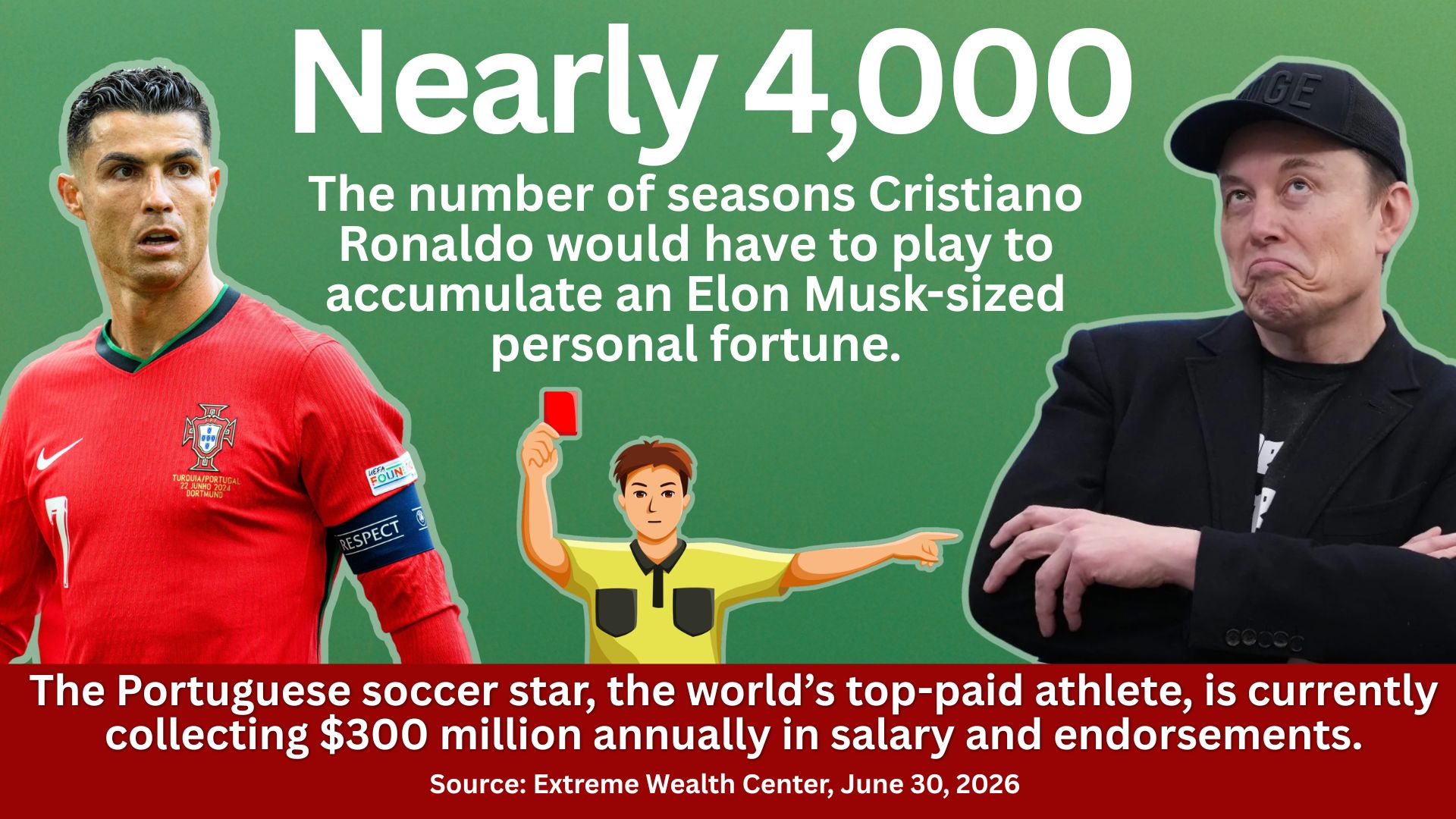
Arwa Mahdawi, Doubt that Elon Musk ‘earned’ his trillion? Rightwing media says you’re in an ‘impotent envy cult,’ The Guardian. Musk fanboys say their hero’s global contributions to society make his grand fortune merited. The 700,000 people worldwide who’ve died because Musk took a chainsaw to USAID might have begged to differ.
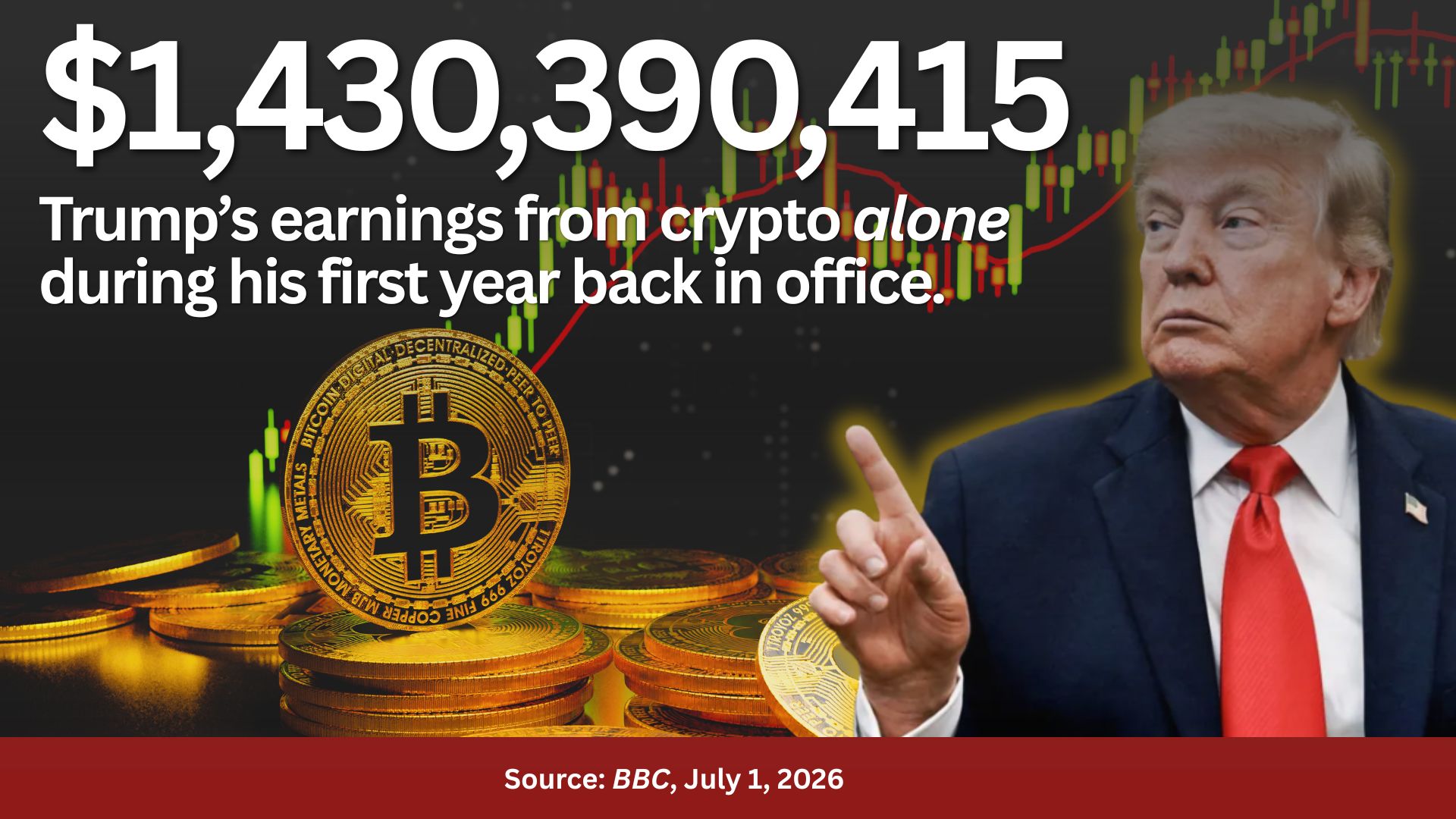
Clara Ence Morse and Dan Diamond, Trump’s wealth grew on a scale without modern presidential precedent, The Washington Post. In Donald Trump’s first term, most of his annual income came from real estate. Most of his income now comes from cryptocurrency and related ventures his administration is either refusing or failing to regulate.
Ro Khanna, Are We Willing to Actually Tax Billionaires or Only Willing to Talk About It? Common Dreams. The billionaire wealth tax that Rep. Khanna and Senator Bernie Sanders are proposing would raise enough tax dollars to set a $60,000 salary floor for public school teachers, cap child care at 7 percent of family income, and restore $1 trillion cut from federal health care, with a $3,000 check left over for every household making under $150,000.
Harold Meyerson, Benjamin Franklin, Champion of the Wealth Tax, The American Prospect. Franklin pitched taxes on grand fortune as both proper and necessary.
Snigdha Gairola, Anthony Scaramucci Warns Wealth Inequality Could End With ‘Pitchforks,’ Urges Rich to ‘Spread the Wealth,’ Yahoo.com. A former Trump White House communications director says he’s really worried.
Philip Broadbent, New obesity figures highlight the income divide, The Conversation. The cheapest calories just happen to be the unhealthiest ones, and these calories surround people with the least money. “Willpower” only gets you so far in an environment stacked against you. Must watch
Sean Morrow, We Uncovered The Master Plan That Peter Thiel Doesn't Want You To See, More Perfect Union. Billionaire Peter Thiel is funding plans for privatized city-states everywhere from Gaza to California. The goal: to replace governments with for-profit companies. |
|
|
|
Monthly Donors Make This Read Possible! |
Inequality.org, an Institute for Policy Studies nonprofit project, depends on donations to keep this newsletter free and available to all readers. Your monthly gifts make all the difference in the world, whether you can donate $3 or $300 a month. Ready to give a few bucks a month? Sign up today. |
|
|
|
Inequality.org | www.inequality.org | inequality@ips-dc.org
Institute for Policy Studies
1301 Connecticut Avenue Ste 600
Washington, DC 20036
United States
Managing Editor: Chris Mills Rodrigo
Co-Editors: Sarah Anderson, Chuck Collins, Bella DeVaan, Reyanna James, and Sam Pizzigati
|
|
|
|
|