A weekly newsletter from the Institute for Policy Studies |
|
|
Grounding private jets, the big money
against SF’s proposed new CEO tax,
and ‘nonprofit’ hospital greed |
|
|
|
The late and luminous Barbara Ehrenreich, the author of the famed anti-poverty bestseller Nickel and Dimed and a trustee here at the Institute for Policy Studies, suggested 20 years ago that our inequality program do more to document how extreme wealth inequality touches our daily lives. “Take private jets,” she said. “Don’t the rest of us subsidize these huge polluters?”
We took her advice. In 2007, we published our first High Flyers report, a close-up look at how average taxpayers and air travelers subsidize this most polluting form of transportation. You can read now our most recent version of that report, and a new one will be coming out later this year.
We’ve also been working to stop private jet expansion at Hanscom Field, New England’s largest luxury jet hub. On top of that, we’re launching a new Private Jet Accountability Project to help communities resist private jet expansions.
Earlier this month, we worked with Rep. Eugene Vindman and other members of Congress to introduce the Stop Subsidizing Private Jets Act, a bill to roll back tax loopholes for private jet owners. With costs spiraling up for energy and everything else, after all, should we really be picking up the tab for luxury jet owners? Thanks to all of you who’ve already joined this private jet struggle. Inequality.org readers have so far sent over 14,000 letters urging members of Congress to cosponsor Vindman’s new legislation. Help us get to 25,000 by signing here. Chuck Collins
for the Institute for Policy Studies Inequality.org team |
|
|
|
INEQUALITY BY THE NUMBERS |
Yes, We Can Eliminate Enormous Subsidies for Billionaire Private Jets As we noted in this week’s intro, our Inequality.org team has long been battling the spread of private jets, a method of transport open only to our ultra-rich. Our drive against this excess took a serious hit in 2017 when lawmakers slipped a 100 percent bonus depreciation for private jet assets into that year’s Trump tax cut. Last year’s Trump One Big Beautiful Bill Act renewed that depreciation bonus.
But tireless organizing is changing the political climate on Capitol Hill. Members of Congress have introduced legislation, the Stop Subsidizing Private Jets Act, to stop billionaires from claiming enormous write-offs when they purchase luxury vehicles like private jets. Read more about this legislation — and just how much the wealthy are sabotaging our climate — right below. |
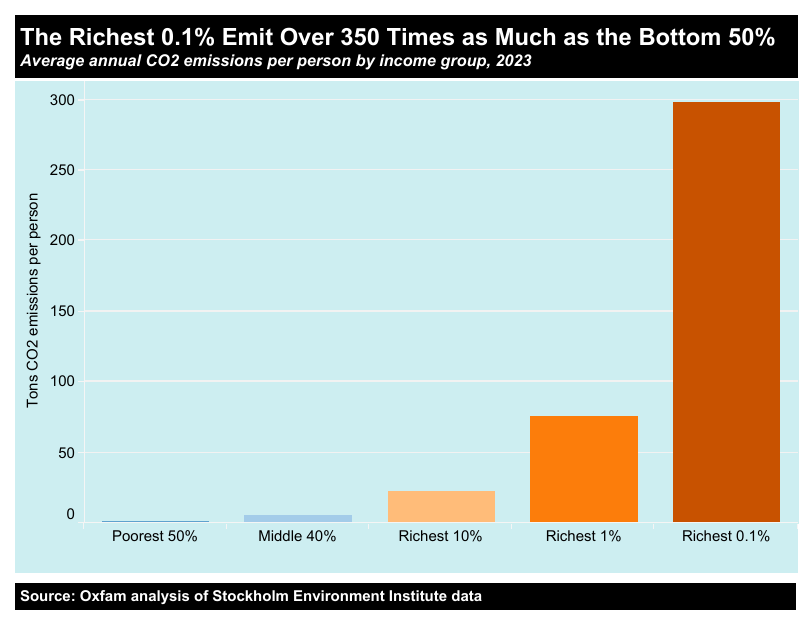
Private jet trips make up just one part of the ultra-wealthy’s enormous environmental footprint. On average, a person in the global top 0.1 percent is now emitting 298 tons of carbon dioxide per year, compared with just 0.8 tons for someone in the bottom half of the global income distribution.
If everyone contributed to climate change at the same rate as our world’s richest 1 percent, the planet would hit the catastrophic 1.5°C warming threshold within three months. For an interactive version of this chart and more on global inequality, click the link to our Inequality.org Facts section below. |
|
|
|
PETULANT PLUTOCRAT OF THE WEEK |
If Your CEO Grabbed Over $25 Million, You’d Be Feeling Proud, Too
This week’s dour deep pocket: Gene Woods, the CEO of Advocate Health, the nonprofit hospital giant that rewarded him with $25.8 million in 2024 compensation. The top exec at the nation’s largest for-profit hospital system, HCA Healthcare, that same year only collected $23.8 million.
What has Woods sour: the growing support in North Carolina — the state where the Advocate Health headquarters sits — for capping nonprofit hospital CEO pay. At a certain point, says state senator Jim Burgin, “people need to say, ‘Wait a minute, you’re not-for-profit.’”
Last week, six of the nine commissioners on the influential Mecklenburg county board indicated they would support state legislative action that limits how giant nonprofits can operate.
Woods has left the defense of his paycheck to his media team. His “performance-based” pay, that team maintains, “reflects the scale and complexity of guiding one of the nation’s largest health systems.” In a Harvard Business Review article, meanwhile, Woods is celebrating “internal surveys” showing that 85 percent of his firm’s 170,000 employees “feel proud to be part of Advocate Health.”
The last word: Do the ranks of prideful Advocate Health employees include those workers who labor at the company’s lowest hourly wage? In 2024, the latest year with figures available, these workers took home over 650 times less than what their proud CEO pocketed. |
|
|
|
What's new on Inequality.org
Omar Ocampo, The U.S. Military is Intensifying Hawai’i’s Housing Affordability Crisis. Military demand for housing caused rents to increase an estimated 7.1 percent in 2024 alone, causing Hawai’i’s residents to spend an extra $234.8 million on rent.
Chuck Collins and Emily Wagner, Lawmakers Press to Eliminate Private Jet Travel Subsidies. The Stop Subsidizing Private Jets Act of 2026 would close loopholes in Trump's tax codes that allow billionaires to write off planes as business expenses.
Elsewhere on the web
Katrina vanden Heuvel, Aren’t Billionaires People, Too? Yes, but…, The Nation. With ordinary Americans skipping meals to afford health care, the Democratic Party needs to resist retreating from small “d” populist policies.
Mark Glick, Gabriel Lozada, and Darren Bush, Why Public Policy’s Core Value Should Be Equality, Institute for New Economic Thinking. Equality runs deeper than economics textbooks suggest. Evidence increasingly links more equal societies to stronger well-being, greater social trust, and healthier democracies.
Teresa Ghilarducci, The Myth of the Deserving Billionaire, Project Syndicate. Our wealthy, claim their fanboys, create jobs and benefit everyone. But the best predictor of how wealthy a particular person becomes, studies have shown, remains how wealthy that person’s parents happened to be.
Gabriel Zucman, Why do billionaires pay much less tax than the average American? Substack. Our ultra-wealthy can easily structure their wealth so that this wealth will generate little — sometimes even not any — taxable income. Hence no income tax owed.
Dean Baker, Charles (a.k.a. “the Leaker”) Littlejohn: American Hero, Beat the Press. The man who exposed the latest games the super rich play to avoid paying taxes is now serving a longer prison sentence than many people routinely get for committing manslaughter.
Igor Volsky, I Fled the USSR. That’s Why I Support Taxing Billionaires, OtherWords. Taxing extreme wealth to reduce the influence of a tiny, ultra-rich elite doesn’t make democracies fall. Taxing the rich helps democracies survive.
Jeffrey Winters, How oligarchs dominate our democracies and preserve inequality, London School of Economics. Why haven’t two centuries of increasingly free and equal voting prevented the United States from becoming more unequal? This political scientist’s conclusion: The inability of modern democracy to address wealth inequality comes by design.
Paul Krugman, Bezos, Backlash and Zombies, Substack. Jeff Bezos has come down with a severe case of billionaire brain, a special blend of ignorance and arrogance that occurs regularly in men who believe their success in accumulating personal wealth means they understand everything.
Chris Brooks, The Real Cost of Union Busting Is Much Higher Than You Think, Jacobin. America’s top corporate execs are paying enormous sums to maintain internal anti-union operations designed to suppress organizing before it spreads — and then intervene once workers start in motion.
Brian Merchant, They just formed the biggest tech worker union in the US. They plan to rein in AI and curb layoffs, Blood in the Machine. Tech workers across the University of California system have voted to unionize. Their victory could help showcase how to equitably introduce and implement new AI technology.
Samantha Martin, Study reveals one of world’s first cities prospered as wealth-gap shrank, University of York. Historians have generally argued that the progress of ancient small villages as they evolved into cities came at the price of widening inequality. But a new study delves into the Indus civilization’s largest city in present-day South Asia and finds exactly the opposite.
|
|
|
|
Monthly Donors Make This Read Possible! |
Inequality.org, an Institute for Policy Studies nonprofit project, depends on donations to keep this newsletter free and available to all readers. Your monthly gifts make all the difference in the world, whether you can donate $3 or $300 a month. Ready to give a few bucks a month? Sign up today. |
|
|
|
Inequality.org | www.inequality.org | inequality@ips-dc.org Institute for Policy Studies
1301 Connecticut Avenue Ste 600
Washington, DC 20036
United States
Managing Editor: Chris Mills Rodrigo
Co-Editors: Sarah Anderson, Chuck Collins, Bella DeVaan, Reyanna James, and Sam Pizzigati |
|
|
|
|