A weekly newsletter from the Institute for Policy Studies |
|
|
Trump's attack on mail voting, new wealth tax proposals, war profiteering, and a leading defender of oppressed CEOs
|
|
|
Donald Trump has just put out an executive order that restricts mail-in voting. Trump loathes mail ballots — except, of course, when he votes by mail himself, as he just did in a recent Florida special election.
Low-wage workers of all political stripes have a big stake in the battle to block this latest anti-democratic Trump order. One reason why: Research from Colorado and Utah shows significant increases in poor and working class voting after these states adopted all-mail elections, as I note in a new Inequality.org column.
That research finding should come as no surprise. When you can fill out a ballot at your kitchen table, you don’t have to worry about ticking off your boss by asking for paid time off to vote. Nor do you have to worry about other possible costs of getting to the polls, like arranging for child care or transportation.
Our election system already does far too much to favor wealthy Americans. Our richest can spend unlimited sums to buy political influence. Instead of restricting mail-in voting, we should be making mail ballots universal in every state. A move like that wouldn’t fix all the problems with our lopsided political system, but it would be one powerful step toward creating a democracy that works for us all. Sarah Anderson
for the Institute for Policy Studies Inequality.org team |
|
|
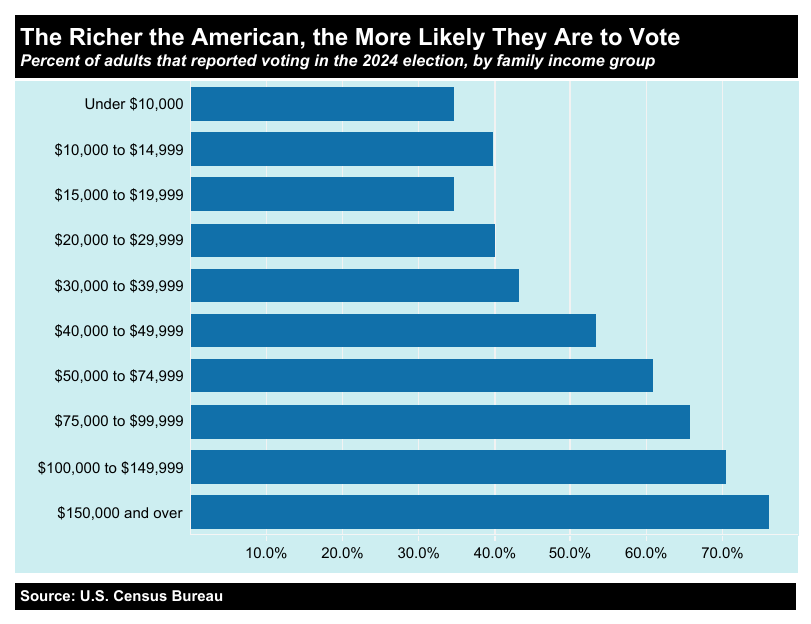
The absence of universal mail-in voting rights in the United States helps explain the huge voter participation gap between rich and poor Americans. According to Census data, 76 percent of voters with household income over $150,000 voted in the 2024 presidential election, compared to just 34.7 percent of those making between $15,000 and $20,000. |
Now Before Congress: Two New Proposals to Tax Concentrated Wealth
In the United States today, polls consistently show, we have a broad consensus — across race, gender, and political lines — that taxing democracy-distorting concentrations of wealth and power needs to become a top national priority. In a new analysis, Inequality.org co-editor Chuck Collins breaks down two of the most encouraging new proposals to tax wealth now pending at the federal level.
The first comes from Senator Bernie Sanders and Rep. Ro Khanna. Their “Make Billionaires Pay Their Fair Share Act” would levy an annual 5 percent wealth tax on households worth over $1 billion. Such a levy, experts estimate, could raise as much as $4.4 trillion over ten years. The bill includes measures that would prevent and penalize moves to avoid the new tax.
The second comes from Senator Elizabeth Warren and Rep. Pramila Jayapal. Their "Ultra-Millionaire Tax” casts a wider net, levying a 2 percent annual wealth tax on households and trusts valued at over $50 million, with an additional 1 percent surtax on wealth and trusts over $1 billion. This proposal could bring in $6.2 trillion over ten years.
Revenue collected from the ultra-rich — under both these measures — would help reverse Trump’s tax cuts, fully fund federal social service programs, and start the long task of building the truly egalitarian society that we all deserve. |
|
|
PETULANT PLUTOCRAT OF THE WEEK |
A Resolute Defender Finally Emerges for America’s Oppressed CEOs
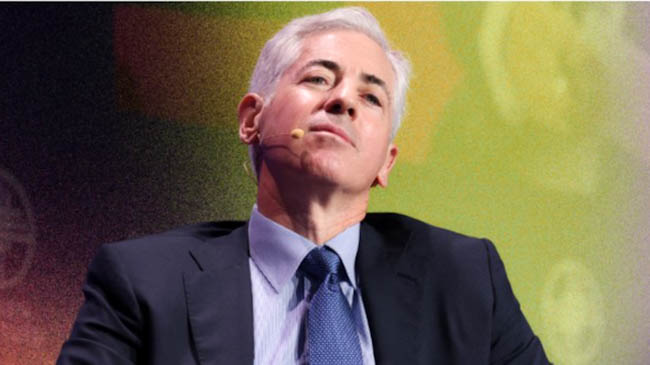
This week’s dour deep pocket: The billionaire Bill Ackman, the 59-year-old chief exec of the New York-based Pershing Square Capital Management hedge fund.
What has Ackman sour: a gender discrimination lawsuit that a laid-off attorney at his family’s investment office has filed against him. Over recent years, Ackman has emerged as one of America’s loudest critics of the drive to bring more diversity, equity, and inclusion to the nation’s workplaces.
“I am going to fight this nonsense to the end of the earth in the hope that it inspires other CEOs to do the same,” Ackman declared after the lawsuit’s filing.
The last word: Last July, the International Tennis Hall of Fame granted Ackman and his doubles partner a wild-card entry into the annual pro tour competition the organization hosts in Newport, Rhode Island. The Ackman doubles pairing went on to perform so appallingly that tennis great Andy Roddick would dub the match “the biggest joke I’ve ever watched in professional tennis.”
An embarrassed Tennis Hall of Fame subsequently turned down Ackman’s offer of a $10 million donation. Ackman, meanwhile, has challenged Roddick to a match. |
INEQUALITY BY THE NUMBERS |
|
|
Take a break from reading to watch a new video on California wealth tax plans from our friends at More Perfect Union that cites research from the Institute for Policy Studies analyst Omar Ocampo.
Sarah Anderson, Multimillion-dollar CEO pay at these 20 low-wage companies is costing you. This is the only fix, MarketWatch. At America’s 20 largest low-wage corporations, the paychecks typical workers receive won’t pay the rent for a decent two-bedroom apartment. But those same bargain-basement worker wages do wonders for the mega-million paychecks their CEOs annually pocket.
Caleb Ecarma, Are Musk and Bezos turning the sky into a landfill? Oligarch Watch. Back in 2018, Elon Musk called for “a new space race” defined not by nations but by rival billionaires scrambling to commercialize the final frontier. That new race is having devastating environmental consequences.
Josh Scheer, Trillions Hidden, Humanity Starving: The Super-Rich vs. the Rest of Us, ScheerPost. A new analysis from Oxfam reveals a staggering truth: The untaxed wealth hidden offshore by the richest 0.1 percent now exceeds the combined wealth of the poorest 4.1 billion people on Earth.
Melissa Jacobs, Can Congress stop the ‘straight greed’ of US sports teams leaving their cities? The Guardian. Sports in America, says a sponsor of new legislation before the U.S. Senate, should be about more than just making billionaire owners even richer.
Stephen Prager, ‘Let Me Clear Things Up’: Bernie Sanders Explains Wealth Tax to Wall Street Overlord Jamie Dimon, Common Dreams. If the national wealth tax Bernie Sanders is now co-sponsoring ever becomes law, JPMorgan CEO Dimon would owe $135 million a year more in taxes.
Michael Massing, Lust for Luxury, The Nation. If voters okay California’s proposed 5 percent tax on wealth over $1 billion, how will our richest ever afford the $80-million Gulfstream private jet that seats 19, with a luxury bedroom and shower and a range of 7,750 nautical miles.
Timothy Rooks, Wealth tax: Why are countries afraid to tax the ultrarich? DW. What makes the proposed California wealth tax ballot initiative so important? Only the United States as a whole, China, and Germany have larger economies than California.
Cassidy Sheppard, Low Tax for Whom? California vs Texas, Institute on Taxation and Economic Policy. Sixteen states — Texas and Florida among them — tax their poorest at rates higher than California taxes its richest. Florida is taxing its wealthiest at a rate just one-fifth of what its poorest households pay.
Ranked: How Many Lifetimes to Earn a CEO’s Annual Pay, Visual Capitalist. The typical worker at Marriott would have to work 12 lifetimes to earn what Marriott’s CEO makes in a single year. McDonald’s workers would have to labor 25 lifetimes to match what their chief exec pockets in 12 months. |
|
|
ON BILLIONAIRES AND THE REST OF US |
This newsletter and the whole Inequality.org project are powered by donations. We’re not raking in cash from the billionaire class, though. We’re counting on people to see why this reporting, research, and advocacy matters, and then to become paid subscribers, by making a recurring monthly donation of any amount. Make a monthly gift as a paid subscriber. Start your paid subscription today. |
|
|
Inequality.org | www.inequality.org | inequality@ips-dc.org Institute for Policy Studies
1301 Connecticut Avenue Ste 600
Washington, DC 20036
United States
Managing Editor: Chris Mills Rodrigo
Co-Editors: Sarah Anderson, Chuck Collins, Bella DeVaan, Reyanna James, and Sam Pizzigati |
|
|
|