March 4, 2026                                                         Home   Subscribe  Open in Browser


A weekly newsletter from the Institute for Policy Studies


THIS WEEK

American families are struggling to pay their bills. Iranian families are living in terror for their lives. What connects these two groups ever so directly? 

Last year’s Republican “One Big Beautiful Bill” gutted America’s social safety net to pay for tax cuts for the rich and create a $156 billion slush fund for the Pentagon. That extra military money boosted the annual budget of the Trump “War Department” to more than $1 trillion, easing the way for Team Trump to launch a war on Iran without any congressional approval. 

Working people in the United States are bearing the domestic costs of this latest global conflict while our wealthiest are profiting lavishly — through military contracts and “the spoils of war,” everything from expanded access to natural resources to new real estate investment opportunities. 

Our military budget expert colleagues at the Institute for Policy Studies have just released a fact sheet on the costs of the Iran invasion. They estimate the outlay for the war’s daily operations alone at about $60 million, the equivalent of what the federal government lays out daily in SNAP food aid for 9.5 million Americans. 

IPS is also releasing today a report looking at America’s 20 largest low-wage corporations. These “Low-Wage 20” companies are handing out massive CEO paychecks at the same time their workers are struggling with the double whammy of high prices and deep cuts in federal aid programs. 

Those 20 corporations and the Pentagon are both exploiting people who lack decent job opportunities. In fact, many of our lowest-paid troops also have to rely on SNAP. With the United States barreling into what could well become another “forever war,” working class Americans will no doubt wind up on the frontlines.

Sarah Anderson
for the Institute for Policy Studies Inequality.org team


INEQUALITY BY THE NUMBERS

Walmart employee with the text: 15 out of 20, The share of the 20 largest low-wage corporations where median pay falls below the Medicaid income limit for a family of three. With families facing high costs and deep cuts to public aid, all corporations should be paying living wages. Source: Institute for Policy Studies,
 

BOLD SOLUTIONS

A ‘Bad Business Fee’ on Corporations Paying Poverty Wages

Jobs with Justice has developed a novel idea for cracking down on companies that pay wages so low their workers are forced to depend on public assistance. 

Through a “Bad Business Fee,” Jobs with Justice notes, companies forcing taxpayers to subsidize their low-wage business models would have to contribute to a state revenue fund. Elected boards of community stakeholders would then decide how to spend the money in those funds to most effectively support low-wage workers and their communities.

“A proposal like this,” Adam Shah of Jobs with Justice explains, “strengthens democracy on multiple fronts.”

The Jobs with Justice proposal would promote democracy by giving communities direct control over how public money is spent. And it would incentivize companies to directly respond to employee requests for fair wages and adequate benefits.

In short, corporations paying poverty wages would have a choice: either create good jobs and pay living wages or contribute directly to the public systems their workers rely on. More details from Adam Shah below.

BAD BUSINESS FEE
 

CHART OF THE WEEK

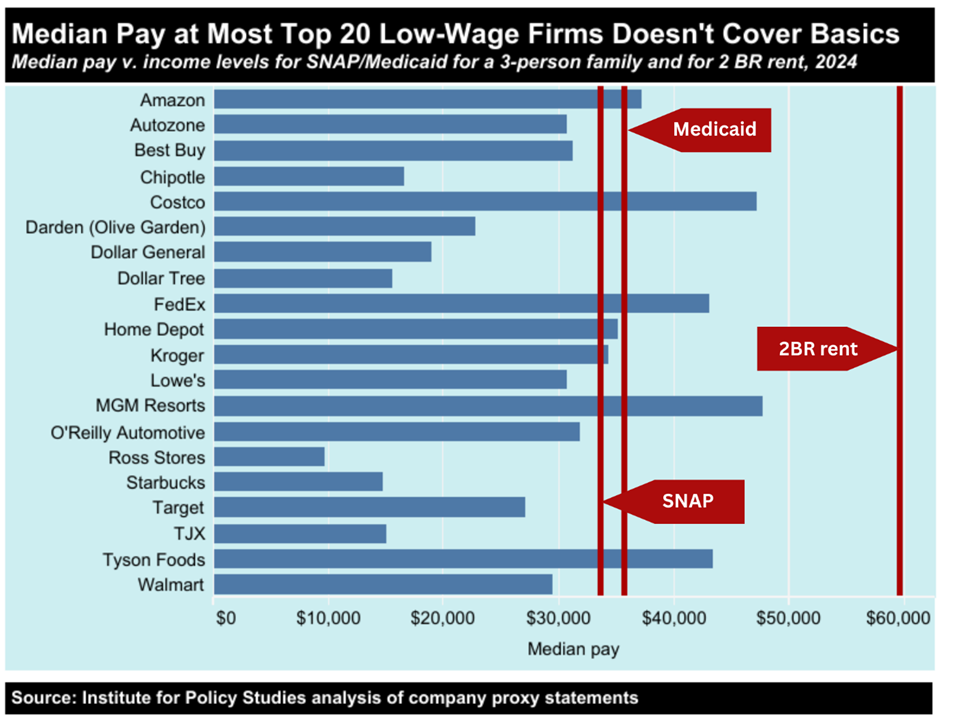
A chart showing how many low-wage firm salaries don't hit the income caps for social services, or rent.

The 20 largest U.S. employers of low-wage workers pay wages so low that many employees have little choice but to turn to public assistance programs to make ends meet. Fifteen of these 20 firms reported median pay in 2024 below the $35,631 income limit that typically makes families of three eligible for Medicaid.

Not a single company in the Low-Wage 20 had 2024 median pay that met the $59,600 income needed to afford the U.S. average two-bedroom apartment rent. For more, including an interactive version of this chart, click the link below.

DIVE DEEPER
 

PETULANT PLUTOCRAT OF THE WEEK

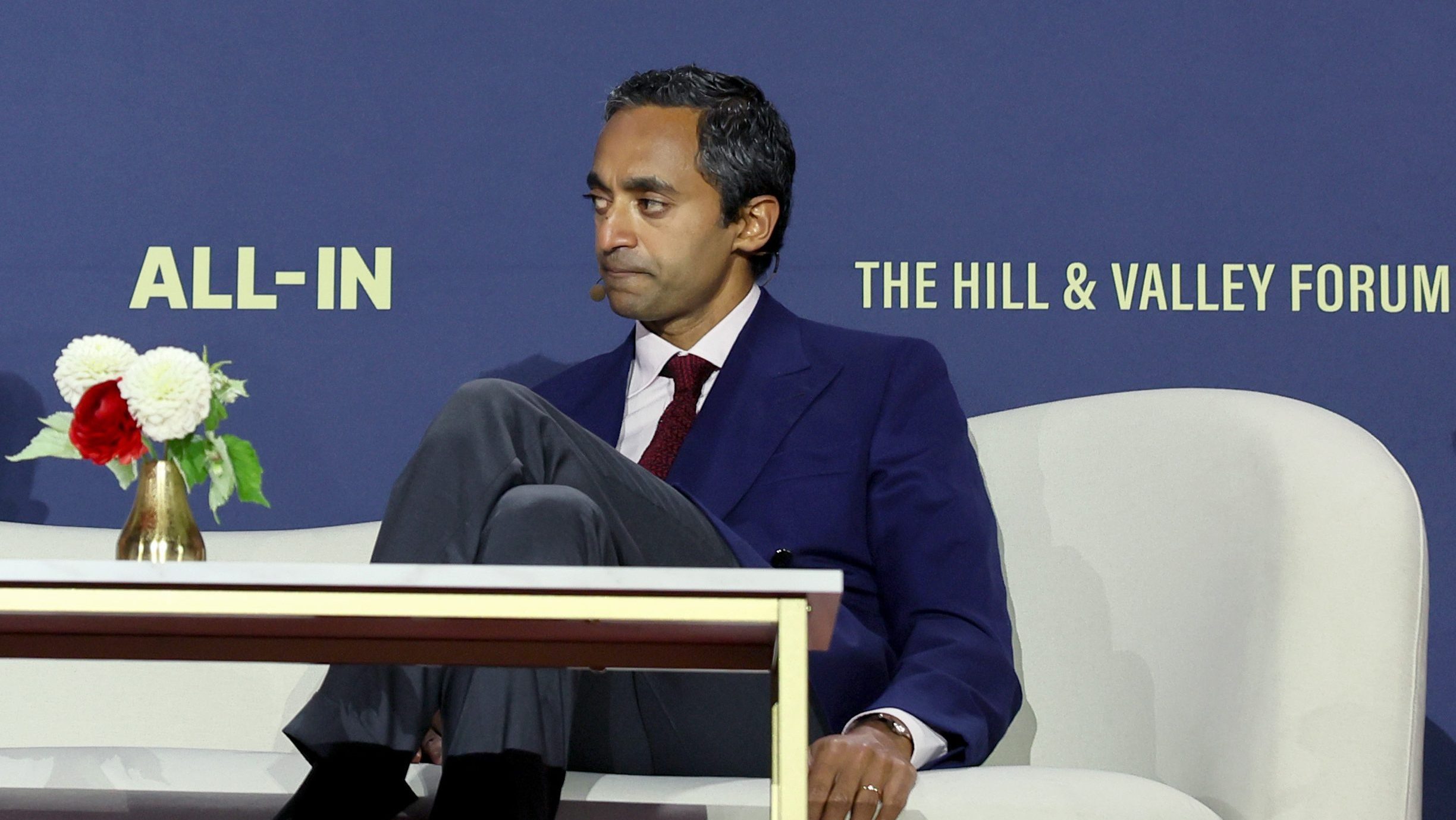
Chamath Palihapitiya

Lazy Young People, Irrelevant Uyghurs, and Ungrateful Democrats   

This week’s dour deep pocket: Chamath Palihapitiya, a 49-year-old venture capitalist and former senior Facebook exec.

What has Palihapitiya sour: those Americans gainfully employed who see more to life than going to work. On his new video, 30 Years of Business Advice in 13 Minutes (from a Billionaire), Palihapitiya blasts the “number of young people I encounter” who “talk about all these idiotic things like work-life balance.”

Palihapitiya would rather, as he puts it on YouTube, “make bets on disruptive ideas, technology, and people.” But he’s not betting on the Uyghurs, an ethnic group Beijing officials consider disruptive.

“Nobody cares about what’s happening to the Uyghurs, okay?” Palihapitiya has told one podcast host. “You bring it up because you really care, and I think it’s nice that you care, the rest of us don’t care.”

The last word: Earlier this year, on a podcast, Palihapitiya explained why he’s gone full-bore MAGA: “l was a megadonor to the Democrats — you know, like, dinner-with-Obama level donor. Okay? I couldn’t get a phone call returned from the White House to save my life. The Trump administration is totally different. There’s not a single person there you can’t get on the phone and talk to.”


GREED AT A GLANCE

Cash changing hands with the text: 16, The number of billionaires who owe their wealth to one of the 20 largest low-wage U.S. corporations. Billionaires associated with each corporation: Walmart (8), Amazon and Tyson Foods (2), Home Depot, Best By, Starbucks, Chipotle (1). Source: Institute for Policy Studies,
 

MUST READS

What's new on Inequality.org


Sarah Anderson and Reyanna James, These 20 Corporations Are Major Culprits in the Affordability Crisis. Typical pay at America’s largest low-wage employers is now running so low that workers can’t cover basic necessities and often have to rely on public assistance.


Alice Li, Cuts to the IRS Workforce Will Delay Refunds Families Desperately Need. Tax refunds have become a critical lifeline for struggling families.


Satra D. Taylor, Trump is Stealing Students’ Dreams to Give Billionaires Tax Breaks. A first-generation college student fears other young people won’t get the financial aid she’s relied on for her education.


Elsewhere on the web


Jeff Stein, Sanders pitches $4.4 trillion tax on billionaires, in 2028 marker, The Washington Post. The new Sanders legislation calls for an annual 5 percent wealth tax on U.S. billionaires. Co-sponsor Ro Khanna is calling the bill “the most ambitious” legislation of our times “to tackle inequality in the New Gilded Age.”


Robert Kuttner, How to Tax Billionaires, The American Prospect. The details are complicated. The politics should be simple.


Judd Legum, The money behind the new Iran War, Popular Information. The Saudi Public Investment Fund pays Trump son-in-law Jared Kushner $25 million annually for handling its $2 billion investment in Kushner’s private equity fund, one of the many conflicts of interest juicing Team Trump’s latest rush to war.


Aida Edemariam, ‘I think we feel stuck’: Kate Pickett on how to build a better, fairer, less stressed society, The Guardian. In her new book, the co-author of The Spirit Level gathers jaw-dropping facts about our contemporary inequality crisis — and explores creative ways to beat that crisis back.


Hamilton Nolan, They Haven’t Even Started Spending Yet, How Things Work. America’s richest haven’t even begun to spend on politics what they have the capacity to spend. The $300 million Elon Musk gave pols in 2024 amounted to less than a mere .04 percent of his net worth.


Kyle Moore, We’ve been here before, and we know what comes next, Economic Policy Institute. White supremacy has always been used to usher in massive economic inequality.


Igor Volsky, Billionaires Shouldn’t Just Pay More. They Should Have Less, Fireside Stacks. What makes concentrated wealth so bad for our economy? The veteran activist leading the Tax the Greedy Billionaires campaign explores the devastating dynamics that grand fortunes unleash.


Christopher Marquis and Nick Romeo, Tax the Rich. They’re Not Going Anywhere, Time. Our nation’s richest residents, the claim goes, will flee any political jurisdiction that dares to raise their taxes. But we see a far different story unfold when we look beyond the anecdotes.


Michelle Martinez and Molly Sweeney, One Solution to Data Centers? Tax the Rich, Convergence. Data centers are offering localities a dream: a flood of dollars for public expenditures. In exchange, these risky investments are potentially running us off the climate cliff.


Robert Reich, Suddenly, a New Pro-Trump Mega Media Monopoly, Substack. The United States now sports a new pro-Trump media empire, with CBS, CNN, HBO, Comedy Central, and TikTok all under the control of Trump mega-billionaire crony Larry Ellison and his son David.


Dean Baker, The Ellisons Taking Over Warner is Pants on Fire Stuff, but Team Progressive Just Whines, Beat the Press. First, Fox News. Right-wing billionaires may soon have the capacity to suppress any news that counters their agenda.


ON BILLIONAIRES AND THE REST OF US

This newsletter and the whole Inequality.org project are powered by donations. We’re not raking in cash from the billionaire class, though. We’re counting on people to see why this reporting, research, and advocacy matters, and then to become paid subscribers, by making a recurring monthly donation of any amount. Make a monthly gift as a paid subscriber. Start your paid subscription today.


Inequality.org | www.inequality.org | inequality@ips-dc.org

Institute for Policy Studies
1301 Connecticut Avenue Ste 600
Washington, DC 20036
United States 

Managing Editor: Chris Mills Rodrigo
Co-Editors: Sarah Anderson, Chuck Collins, Bella DeVaan, Reyanna James, and Sam Pizzigati

Facebook TwitterCustom