A weekly newsletter from the Institute for Policy Studies |
|
|
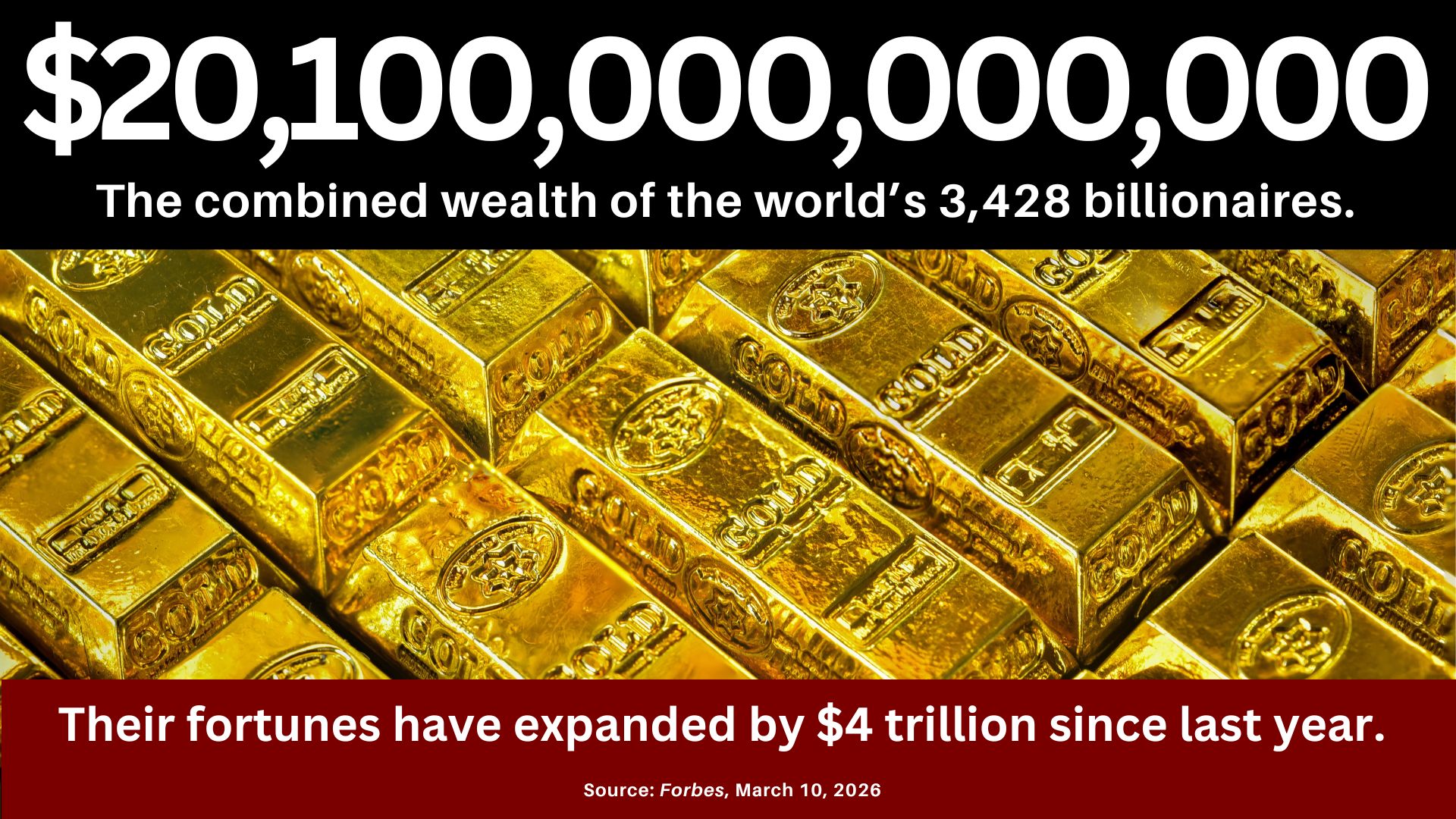
The crisis at the Washington Post doesn’t seem to be cooling down. Weeks after layoffs decimated the Post newsroom, several of the paper’s star journalists have decided to decamp to other outlets. How has Post owner Jeff Bezos reacted? In his infinite billionaire wisdom, he has tried to stem the bleeding by hosting a glitzy lunch at his mansion in D.C.’s posh Kalorama neighborhood.
At this four-hour affair with editors and reporters, Bezos fielded questions on everything ranging from Amazon’s financial backing of the Melania Trump documentary to why he wouldn’t accept offers to sell the Post. But this show of transparency — and, notably, wealth — hasn’t restored his staff’s faith in Bezos’s commitment to run a news outlet that respects its journalistic responsibilities.
And why should we expect Bezos to do that respecting? Over the last few decades, billionaires have come to occupy critical roles in everything from our media to our government. Their wealth has bought them responsibility. Are any of them respecting that responsibility? I sure can’t think of any. Chris Mills Rodrigo
for the Institute for Policy Studies Inequality.org team |
|
|
INEQUALITY BY THE NUMBERS |
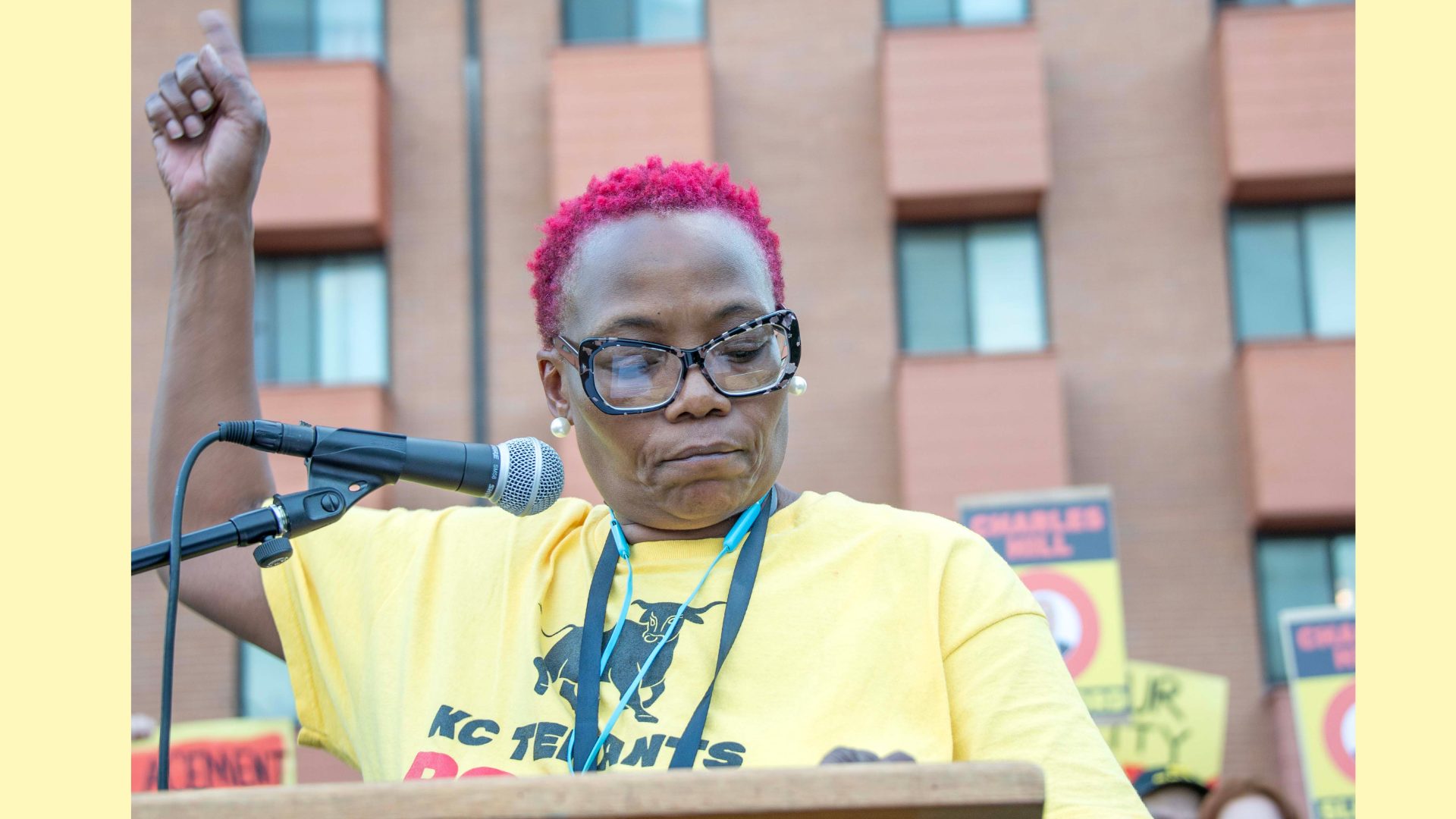
Rewriting the Power Dynamics of Renting in America’s Heartland This week’s frontline face: Cynthia Barlow, a tenant organizer based in Raytown, Missouri.
What she’s doing to help create a more equal world: Barlow and her neighbors at Bowen Tower Apartments did something very special earlier this year: They took on their landlords and won. After years of unanswered building complaints and rising rents, tenants banded together to go on a rent strike.
Four months later, with the help of the activist group KC Tenants, Bowen Tower residents won “good cause” eviction protections, two-year leases, and repair commitments. And, maybe most impressively of all, they'll only have to pay back 35 percent of the rent they withheld.
What makes this fight so important: “It’s time for landlords to take accountability for their actions,” Barlow recently wrote for Inequality.org. “As tenants, the only way we can make sure they do is by forming unions and sticking together, no matter how tough the fight gets.”
|
|
|
Billionaires Are Making Fortunes Off Low-Wage Workers: Let’s Tax the Rich!
Sixteen U.S. billionaires, a new Institute for Policy Studies report details, owe their wealth to America's 20 largest low-wage employers — corporations where a significant share of workers earn so little they have to rely on public assistance. Walmart, Amazon, Tyson Foods, Home Depot, Best Buy, Starbucks, and Chipotle each have representatives in this elite club.
Taxing away excessive wealth could encourage corporations to share profits equitably instead of extracting from those at the bottom to make wealthy executives and shareholders even richer. The proposed Billionaires Income Tax Act, for instance, addresses an existing tax loophole that lets the ultra-rich avoid paying any taxes on the gains from their financial assets while allowing them to borrow against these assets to fund their lavish lifestyles.
Senator Elizabeth Warren and Representative Pramila Jayapal are leading the charge for the Ultra-Millionaire Tax Act, legislation that would apply a 3 percent annual tax to the net worth of billionaire households and a 2 percent tax on those with wealth between $50 million and $1 billion.
Senator Bernie Sanders and Representative Ro Khanna have recently introduced a slightly different tax-the-rich model that would set a 5 percent annual wealth tax on billionaires. Their proposal mirrors a proposed California state ballot initiative that would place a 5 percent one-time wealth tax on billionaire residents of that state. For more, read our co-editor Sarah Anderson’s analysis below. |
|
|
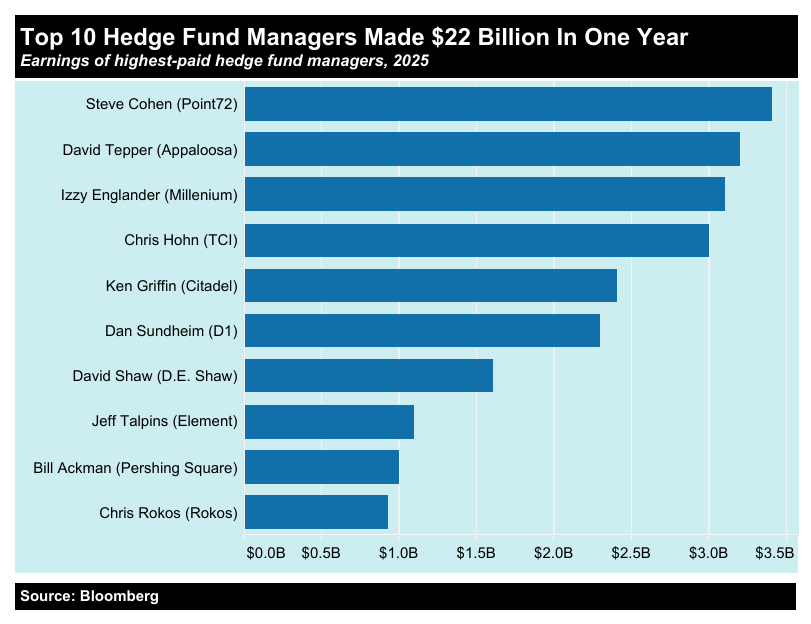
Billionaires abound on Wall Street. According to Bloomberg estimates, the financial world’s 10 highest-earning hedge fund managers alone collectively brought in about $22 billion last year. New York Mets owner Steve Cohen topped this annual ranking, with $3.4 billion in 2025 compensation. For an interactive version of this chart and more on inequality, click the link below. |
|
|
PETULANT PLUTOCRAT OF THE WEEK |
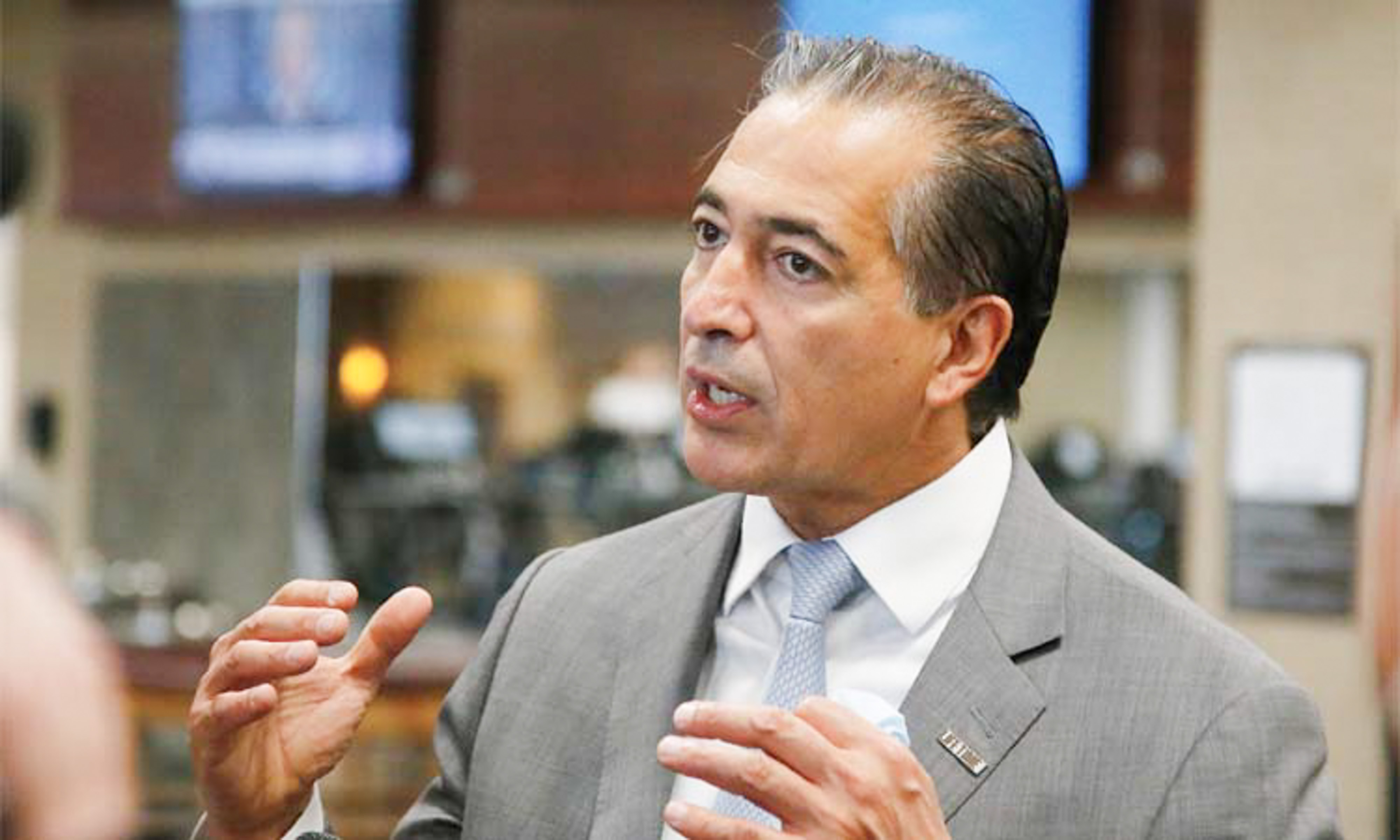
A CEO ‘Athletic Country Club’ King Is Fretting About His Fortune This week’s dour deep pocket: Bahram Akradi, the Iranian-born CEO of Life Time, a Minnesota-based fitness center giant. Public filings last week revealed that Akradi’s annual compensation totaled $218.2 million in 2025, becoming, in the process, Minnesota’s highest-ever corporate executive pay package. What has Akradi sour: The rain that Donald Trump’s tariffs may yet rain on his fitness parade. Tariff, says Akradi, doesn’t rate as “a beautiful word.” One reason Akradi feels that way: His fitness empire depends on a long list of components that need importing, everything from dumbbells to floor mats.
Akradi opened his first fitness center in 1992, 14 years after his worried father — an air force officer under the Shah — sent his 17-year-old son to the United States not long before Iranians ended the Shah’s rule. But Akradi’s fitness empire wouldn’t start truly soaring until Akradi, after Covid, refocused his entire corporate operation on attracting an upscale clientele.
Life Time’s new “athletic country clubs” would feature resort-style pools, fine dining, and wait-lists that gave off an enticing air of exclusivity. The company, at one point, even introduced a luxury duffle bag that sold for a sweet $2,400.
The last word: Life Center’s typical employee, a news report noted last March, makes $8,359 a year. |
|
|
What's new on Inequality.org
Ed Pomfret, The Billionaire Circus Is Back. Forgive Me If I Don’t Clap. The annual rankings of the world’s wealthiest amount to the opposite of light entertainment. Jake Triola, Union Candidates Can Win Back Working-Class Voters. Candidates with union backgrounds can help labor and the Democratic Party, a new report argues, but rarely get recruited to run. Elsewhere on the web
Paul Krugman, The Billionaires’ War, Substack. America’s ultra-rich put Donald Trump in power, but none of them will pay the price his reign is now imposing.
Robert Reich, Who’s Winning from Trump’s War? Follow the Money, Substack. Between 2020 and 2025, America’s top military contractors devoted $110 billion to stock buybacks and dividends that boosted their share prices — and, of course, CEO pay packages.
Anand Giridharadas, Rich Brain, The.Ink. What do super-rich people think about constantly? The Epstein files offer an answer: Our richest spend incredibly huge amounts of their time on the highly boring and tedious work of maintaining and defending their wealth and ensuring that their offspring turn into oligarchs, too.
Kate Pickett, Extreme Inequality Created the World Jeffrey Epstein Exploited, Social Europe. We need to see the Epstein revelations as symptoms of a deeper crisis: a political economy that rewards extraction over creation and concentrates power in ever fewer hands.
Adrian Wooldridge, America’s Plutocrats Are Derailing Democracy, Bloomberg. A global business columnist demolishes the case for billionaires as a force for fiscal common sense and better public policy.
Connie Loizos, The billionaires made a promise — now some want out, Tech Crunch. A look at the failure of the “Giving Pledge,” the effort Warren Buffett and Bill Gates launched in 2010 to get the world’s wealthiest people to pledge that they will give away over half their personal fortunes.
Taylor Giorno, Millionaires Are Overrepresented in the U.S. Senate — By a Lot, NOTUS. At least 73 of the 100 sitting U.S. senators now rate as millionaires. Only about 7 percent of the U.S. population today hold millionaire status.
Richard Rubin and Jeanne Whalen, Red and Blue States Are Growing Further Apart on Income Tax, Wall Street Journal. Since 2021, 21 GOP-led states have lowered the tax rates on their top incomes. Washington State lawmakers, by contrast, have just placed a new 9.9 percent tax on incomes over $1 million.
Chris Blackhurst, These are the richest people in the world — but not all is as it seems, Independent. The Forbes annual list of global billionaire fortunes doesn’t tell the whole wealth story. The reason: Many super rich choose not to disclose their actual full net worth. |
|
|
ON BILLIONAIRES AND THE REST OF US |
This newsletter and the whole Inequality.org project are powered by donations. We’re not raking in cash from the billionaire class, though. We’re counting on people to see why this reporting, research, and advocacy matters, and then to become paid subscribers, by making a recurring monthly donation of any amount. Make a monthly gift as a paid subscriber. Start your paid subscription today. |
|
|
Inequality.org | www.inequality.org | inequality@ips-dc.org Institute for Policy Studies
1301 Connecticut Avenue Ste 600
Washington, DC 20036
United States
Managing Editor: Chris Mills Rodrigo
Co-Editors: Sarah Anderson, Chuck Collins, Bella DeVaan, Reyanna James, and Sam Pizzigati |
|
|
|