A weekly newsletter from the Institute for Policy Studies |
|
|
During the White House’s initial wave of federal worker firings, Inequality.org published a piece by Paul Osadebe, a fair-housing lawyer at the Department of Housing and Urban Development. That article urged federal workers to fight for their jobs out of a duty to the millions of Americans they were helping daily.
Now Osadebe and his HUD colleague Palmer Heenan have been fired by the Trump administration for signing onto a whistleblower letter charging that cuts to the agency have made enforcing housing fairness impossible.
Repression has become the widespread norm at all levels of our society. Federal workers wanting the government to do good have felt that repression. So have folks ranging from protesting students to immigrants just trying to protect their children, like this issue's featured face on the frontlines. Meanwhile, our nation’s richest continue to get even richer, as we highlight below with the latest Federal Reserve statistics on who holds America’s wealth.
Chris Mills Rodrigo
for the Institute for Policy Studies’ Inequality.org team |
|
|
INEQUALITY BY THE NUMBERS |
|
|
Advocating for Our Nation’s Immigrants, Including Herself This week’s frontline face: Jeanette Vizguerra, the founder of Metro Denver Sanctuary Coalition who became a key figure in the fight for immigrant rights during the first Trump administration.
What she’s doing to help create a more equal world: Vizguerra, a mother of four, is currently sitting in ICE detention despite having no criminal record. She’s fighting the case in court, rightfully arguing that she was targeted for her activism. Making her case specially salient: Immigrants without a criminal conviction now make up the largest group of people arrested and detained by ICE.
Vizguerra, while in detention, will be unable to see two of her children — and the immigrants right group Detention Watch Network — receive tomorrow the 49th annual Institute for Policy Studies Letelier-Moffitt Human Rights Award at a ceremony in Washington, D.C.
What makes this fight so important: "The immigrant rights movement continues to fight for the human right to move and stay — and for dignified lives for all," our colleague Alliyah Lusuegro writes. "And even with little support among mainstream politicians or the media, they’re making a huge impact in this dangerous time: Nearly 80 percent of Americans now say immigration is good for this country — a record high." |
|
|
What's Stopping Our World’s Workers from Using Their Power?
Things are not going great for the labor movement these days. Domestically, millions of federal workers are being stripped of their union representation, making already dire union density numbers plummet even further. Authoritarians abroad, in the meantime, are gaining purchase on deeply xenophobic platforms that demonize immigrant labor. What can workers do? One option: withhold their labor all at once.
In Italy, we've seen general strikes hamstring the whole economy in response to Israel blocking the Sumud Flotilla's delivery of aid to Gaza. Imagining a similar response from labor in America, A.J. Schumann writes in Inequality.org, can be difficult. Among the reasons: legal restrictions on solidarity strikes and a culture of individuality. But magical actions can and do happen all the time. More below. |
|
|
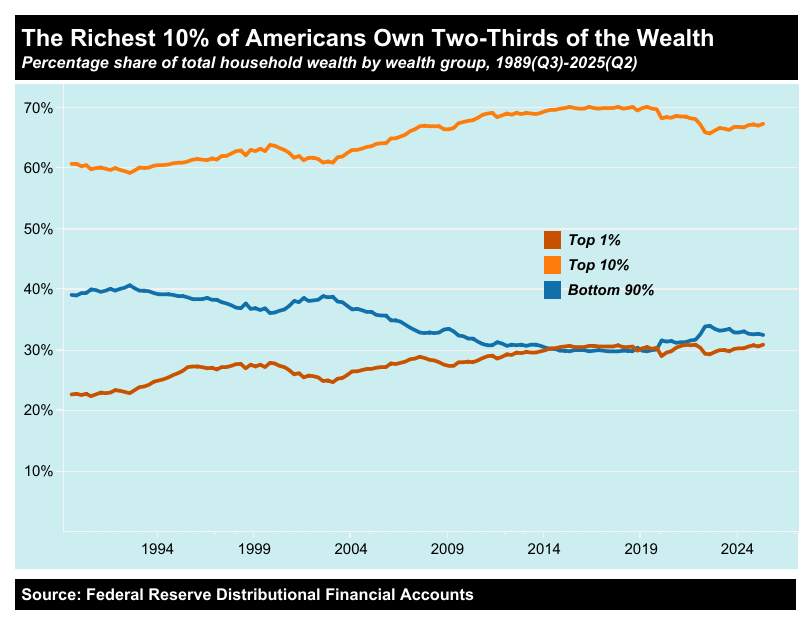
Since 1989, the share of America’s wealth held by the nation’s wealthiest has risen steadily. The latest Federal Reserve data show that the richest 10 percent of American households now own over two-thirds of the nation's total wealth. The top 1 percent holds 31.0 percent of total wealth — just slightly less than the entire bottom 90 percent of U.S. households.
For an interactive version of this chart and more on wealth inequality, click the link to our Inequality.org Facts section below. |
|
|
PETULANT PLUTOCRAT OF THE WEEK |
The High-Tech Billionaire Who Has Wall Streeters Lusting This week’s dour deep pocket: Sam Altman, the billionaire CEO of OpenAI, the artificial intelligence giant that has just passed Elon Musk’s SpaceX to become the world’s most valuable startup.
What has Altman sour: the analyst unease over what Reuters has described as a wild investor class scramble to buy into OpenAI and get on board “an already overcrowded train.” That scramble, analysts fear, is pumping up a massive stock market bubble that will eventually burst — and take down, in its wake, the U.S. economy. OpenAI, counters Altman, needs capital to “build AI that can do science,” with it also being “nice to show people cool new tech/products along the way, make them smile, and hopefully make some money.”
Reactions to one of those “cool” products, the new Sora social media app, have not gone down well within the tech community. Altman, one widely shared social media posting taunts, has gone from claiming that OpenAI needs trillions in investment dollars to cure cancer to “launching AI slop videos.”
The last word: Sam Altman’s OpenAI, sums up tech analyst Brian Merchant, “has been on a desperate quest to build an AI monopoly.” Altman “has been following the playbook of his mentor Peter Thiel, who has long held that the best way to succeed in tech is to create a novel market — say, for digital chatbots — and then to move to monopolize that market.” |
|
|
Lauren Aratani, Boom time for US billionaires: why the system perpetuates wealth inequality, The Guardian. We need to better understand, Inequality.org’s Chuck Collins explains in his new book, not just how billionaires get their wealth and defend it, but how they capture our politics and exploit that capture to extract ever more wealth from American everyday life.
Brakeyshia Samms, Trump Tax Law Erases Economic, Racial Progress in the Tax Code, Bloomberg Tax. The massive federal tax-and-spending package enacted earlier this year does more to transfer wealth upward than any other legislation in decades — while at the same time penalizing low-income Americans.
Branko Milanovic, How to Control the Increase of Income Inequality Due to New Technologies? Social Europe. The world’s richest nations ought to be spreading the ownership of capital more widely, raising taxes on the highest capital incomes, and banning non-productive financial stunts that only enrich the well-heeled.
Caroline O’Donovan and Will Oremus, This billionaire Trump ally and his son are building an unprecedented media empire, The Washington Post. The holdings of the world’s second-richest man now include Hollywood studios, TV networks, and soon a massive chunk of the globally popular TikTok social media app.
Joseph Winters, So many climate solutions, so few emissions reductions. A new book explains why, Grist. “Adaptation” has become a convenient excuse to consolidate resources among a privileged few, a mindset that gives the appearance of doing something about the climate crisis without having to confront its causes.
Cory Doctorow, Way past its prime: how did Amazon get so rubbish? The Guardian. A company that becomes too big to fail becomes too big to jail and then too big to care — about anything but squeezing suppliers and customers to enrich the already rich.
Matt Stoller, Wall Street Gets to Keep Its Government Open, The Big. Federal agencies have suspended their consideration of challenges to corporate mergers during the ongoing federal government shutdown. But they are continuing to accept filings for merger approvals.
Robert Reich, What the Democrats need least: a new think tank financed by billionaires, Substack. The Democratic Party’s biggest problem hasn’t been the “left” but its dependence on wealthy donors and corporate PACs that have argued for moving the party to the “center” and away from working people.
Brock Hrehor, Private Equity’s New Playground: America’s Schools, The Lever. Under the guise of championing “school choice,” the new school voucher program in Donald Trump’s latest federal budget will likely divert millions in taxpayer dollars to private equity billionaires. |
|
|
Our research, editorial, and publishing team depends on hundreds of paid subscribers who make monthly gifts. Some give $3 each month. Others give $200! All told, this support enables our team to stay focused on identifying causes and solutions to our deep economic inequality. Paid subscribers have contributed more than $20,000 in the past year. Ready to become a paid subscriber? Sign up today. | |
|
Inequality.org | www.inequality.org | inequality@ips-dc.org Institute for Policy Studies
1301 Connecticut Avenue Ste 600
Washington, DC 20036
United States
Managing Editor: Chris Mills Rodrigo
Co-Editors: Sarah Anderson, Chuck Collins, Bella DeVaan, Reyanna James, and Sam Pizzigati |
|
|
|