A weekly newsletter from the Institute for Policy Studies |
|
|
Our federal and state government budgets have descended into a crisis mode that the current federal shutdown, now in its fifth week, has only complicated. Social services are teetering at risk of collapse. In such a situation, what can we do? Progressive economists and unions are showing the way.
Last week, in California, the powerful Service Employees International Union joined with UC-Berkeley’s Emmanuel Saez and Robert Reich to unveil a ballot proposal that would tax billionaire fortunes to safeguard Medicaid access. The tax still has to qualify for the 2026 ballot, but, if passed, would go a long way to covering the massive healthcare shortfall Trump’s “One Big Beautiful Bill Act” has brought us.
That sort of proposal can be a model for moving forward. Poll after poll shows broad public support for reining in runaway concentrations of wealth and redirecting deep-pocket dollars into needed social services. If our politicians won't heed the demands of the people, ballot measures can be a good way to go.
Chris Mills Rodrigo
for the Institute for Policy Studies’ Inequality.org team |
|
|
INEQUALITY BY THE NUMBERS |
|
|
Leveraging Worker Pension Funds Against Musk’s $1 Trillion Pay Package
This week’s frontline face: Erin Markiewitz, a senior corporate research analyst for the AFL-CIO who focuses on leveraging union pension funds to advance working families’ long-term best interests.
What she’s doing to help create a more equal world: Markiewitz and her AFL-CIO colleagues are among a growing number of institutional investors urging shareholders to torpedo the Tesla board’s obscene $1-trillion pay package proposal for Elon Musk.
Financial officers representing seven states and New York City have so far pledged to vote “no” on the pay package at Tesla’s November 6 annual meeting. Proxy advisory firms Glass Lewis and ISS have also urged investors to reject the plan, and a coalition web site makes it easy for anyone to urge their state pension funds to join the opposition. What makes this fight so important to her: “The AFL-CIO’s member unions represent 15 million people, and they, like many American working families, invest in capital markets to save for a rainy day, a dignified retirement, and a better future for their children,” notes Markiewitz. “With growing economic insecurity, it’s more important than ever to ensure capital markets reward growth — not greed.”
For more on what’s at stake at Tesla’s shareholder meeting, click the link below. |
|
|
Good Things Can Happen When Conservatives Learn Facts on Inequality
You might assume that conservative-leaning voters will always be highly unlikely to support policies to fight inequality, even in the face of actual facts about the impact of our economic divides. A new academic study suggests otherwise.
Drawing on surveys across the United States and five other high-income countries, former World Bank economist Christopher Hoy and his colleagues have found that most people dramatically underestimate the pay gap between CEOs and average workers and other indicators of income inequality. Most people turn out to prefer much lower levels of inequality than actually exist.
Those on the right end of the political spectrum, when they learn the true extent of today’s extreme income inequality, become much more likely to support redistributive policies like increasing taxes on the rich and increasing public investment in opportunities for low-income families. For more on Hoy’s research, click on the link below and check our following Chart of the Week. |
|
|
In a new study from the Melbourne Institute of Applied Economic and Social Research, survey respondents were randomly assigned to receive either no information about wage gaps or basic facts showing how much more top earners actually make compared to average- and low-wage workers.
Overall, learning these facts didn’t change most people’s views on redistribution, except among far-right voters. After learning the true extent of wage inequality, these voters became significantly more likely to support redistributive policies, including higher taxes on the top 1 percent.
This finding challenges the conventional wisdom that far-right voters will always be the least likely to support redistribution policies. For an interactive version of this chart, click the link below. |
|
|
PETULANT PLUTOCRAT OF THE WEEK |
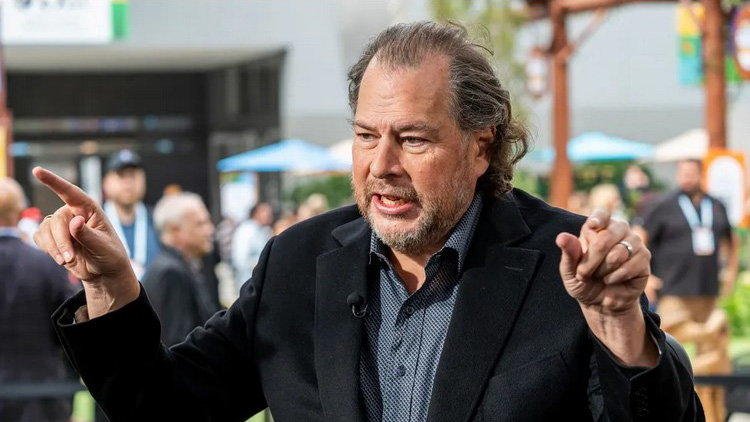
A Once-Promising Chief Exec Takes Bootlicking Up a Notch This week’s dour deep pocket: Marc Benioff, the billionaire CEO of Salesforce, the cloud-computing giant that ranks as San Francisco’s largest private employer, and the current owner of Time magazine.
What has Benioff sour: the hostile public pushback against his abrupt about-face from defending society’s least fortunate — “You’re either for the homeless or you’re for yourself,” Benioff declared in 2019 — to applauding Trump II.
“I fully support the president,” he noted in one recent interview. “I think he’s doing a great job.”
Benioff is also making a full-court press for a significant chunk of ICE’s new mega-billions in federal contracting dollars. He’s cozying up as well with one of the Bay Area’s “most notorious conservatives,” David Sacks, the venture capitalist Trump has running his administration’s AI and crypto show.
The last word: “Gone is the talk of business as a force for good or tech as a tool for making the world a better place,” Bloomberg’s Beth Kowitt observes in an appraisal of Benioff’s latest take on Team Trump. CEOs are instead “quashing their critics and slashing their workforces” and “taking their meetings from their mansions in Hawaii even as they demand employees return to the office.”
|
|
|
What's new on Inequality.org?
William Rice and Miriam Strauss, Sick Profits: How Profit-Driven Healthcare Is Bad for Our Financial and Physical Health. Healthcare giants are saving millions from tax cuts but still not improving care.
Karina Smith, California Can Lead a Just Climate Transition. A new report from the United Auto Workers calls for a green industrial policy in the Golden State.
Take a reading break on Wednesday, November 12 at 1 p.m. ET for a 90-minute webinar on "Activists and the Academy: Bridging the Divide." Register here. Elsewhere on the web
Chuck Collins, The Billionaire Oligarchs Are Coming for Your Pets, The Nation. And they want to make bigger profits.
Harold Meyerson, The First Politically Viable Wealth Tax, The American Prospect. A newly proposed 2026 California ballot initiative would levy a 5 percent tax on the state’s billionaires and direct 90 percent of the proceeds to Californians on Medicaid and the institutions that serve them, with the rest going to K-12 schools.
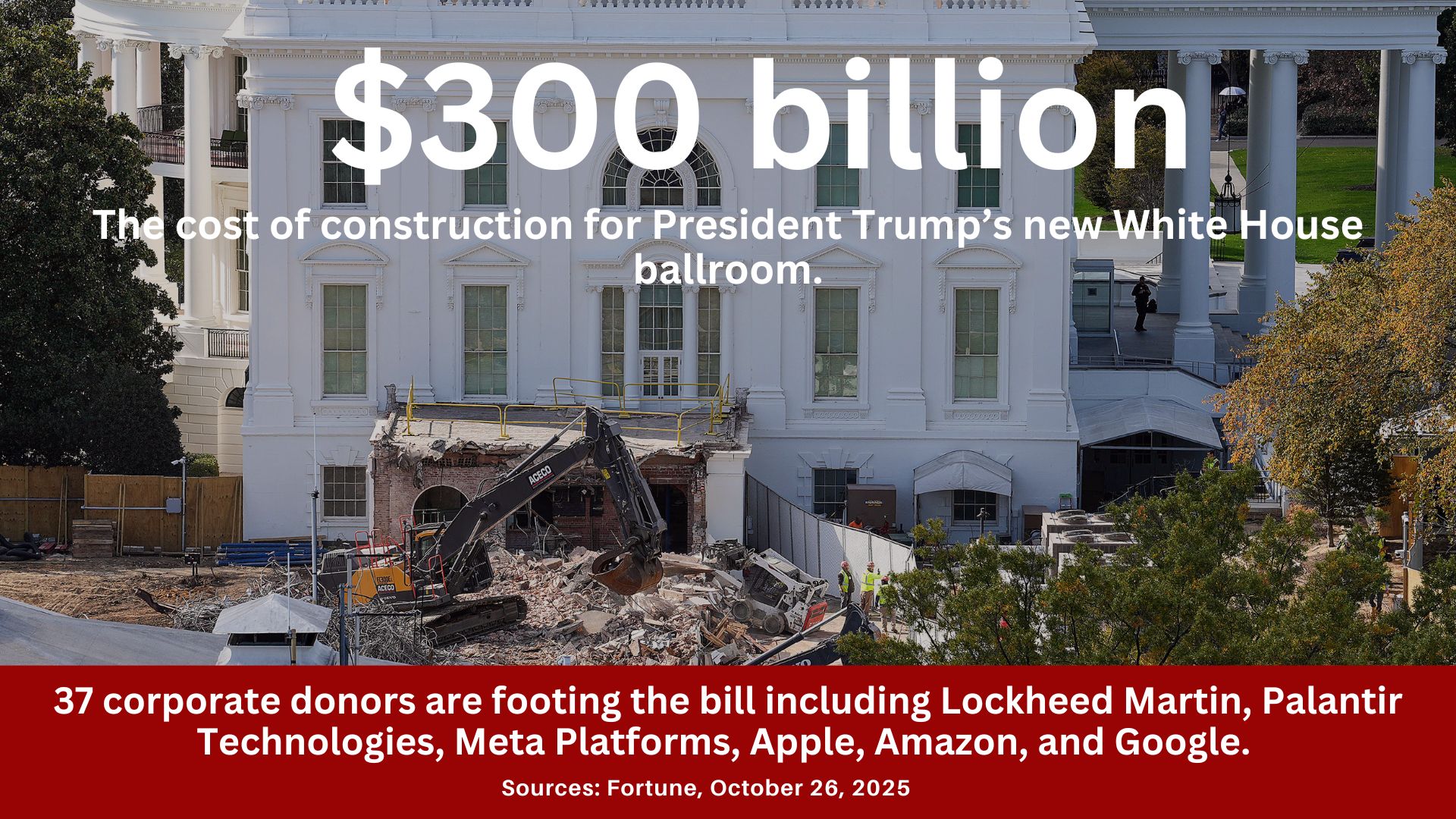
Igor Volsky, How billionaires benefit from government shutdowns, Columbian Missourian. Government dysfunction means big paydays for America’s ultra-wealthy. They take advantage of shutdowns to evade taxes and skirt consumer protections to maximize profits. Robert Reich, The Billionaire’s Ballroom, Substack. America’s new robber barons are rapidly consolidating their control over what Americans read, hear, and learn.
Igor Volsky, If Dems Won’t Tax Billionaires After This, What Are They Even Doing? The New Republic. First, billionaires pass legislation to enrich themselves. Then they shut the government down to avoid helping working Americans afford health care, a system these same billionaires profit from. And now they’re trying to leverage the shutdown to fire thousands of workers who protect vulnerable Americans.
A Closer Look, Patriotic Millionaires. Why we don’t need billionaires. Why our democracy can’t survive them.
Peter Hanson, A Look at the Salaries of Airline CEOs in the US in 2025, SimpleFlying. How airline CEOs reach the profit goals that bring them mega-millions: by having their airlines cut corners and discomfort customers.
Caleb Ecarma, Is Musk’s humanoid robot army worth $1 trillion? Oligarch Watch. With Tesla’s quarterly income down 37 percent, Elon Musk is focusing on anything but the automaker’s vehicle sales — to justify his new trillion-dollar personal pay plan.
David Badash, ‘Thank God we’re rich’: How Megachurches are using the Bible to justify wealth inequality, Alternet. A new study investigates how evangelical leaders confront the conflicts between their preachings and the Bible’s egalitarian passages.
Orlando Whitfield, Fear and loathing at Frieze, Observer. One artist’s reflection at this year’s huge annual London art fair: “You forget how rich rich people really are, don’t you?” |
|
|
Our research, editorial, and publishing team depends on hundreds of paid subscribers who make monthly gifts. Some give $3 each month. Others give $200! All told, this support enables our team to stay focused on identifying causes and solutions to our deep economic inequality. Paid subscribers have contributed more than $20,000 in the past year. Ready to become a paid subscriber? Sign up today. | |
|
Inequality.org | www.inequality.org | inequality@ips-dc.org Institute for Policy Studies
1301 Connecticut Avenue Ste 600
Washington, DC 20036
United States
Managing Editor: Chris Mills Rodrigo
Co-Editors: Sarah Anderson, Chuck Collins, Bella DeVaan, Reyanna James, and Sam Pizzigati |
|
|
|