A weekly newsletter from the Institute for Policy Studies |
|
|
As a co-editor of Inequality.org, I get a lot of fan mail mixed in with some chiding. Some of the latter came in recently. Noted a Greg B: “None of my problems exist as a result of someone else being a billionaire.” An economy rigged to funnel so much wealth and power to the billionaire class, I wrote back, undermines all our lives in many major ways.
That theme runs through my new book, Burned by Billionaires: How Concentrated Wealth and Power Are Ruining Our Lives and Planet. In it, I break down how extremely concentrated wealth is impacting us all, by everything from limiting our political influence to poisoning our environment and weakening social services. But Burned by Billionaires does more than criticize the richest among us. The book aims to be tool that all of us can use to educate our communities about the damage that inequality brings — and organize those same communities to fight back. We have many more of us, always remember, than they have of them! Chuck Collins
for the Institute for Policy Studies’ Inequality.org team |
|
|
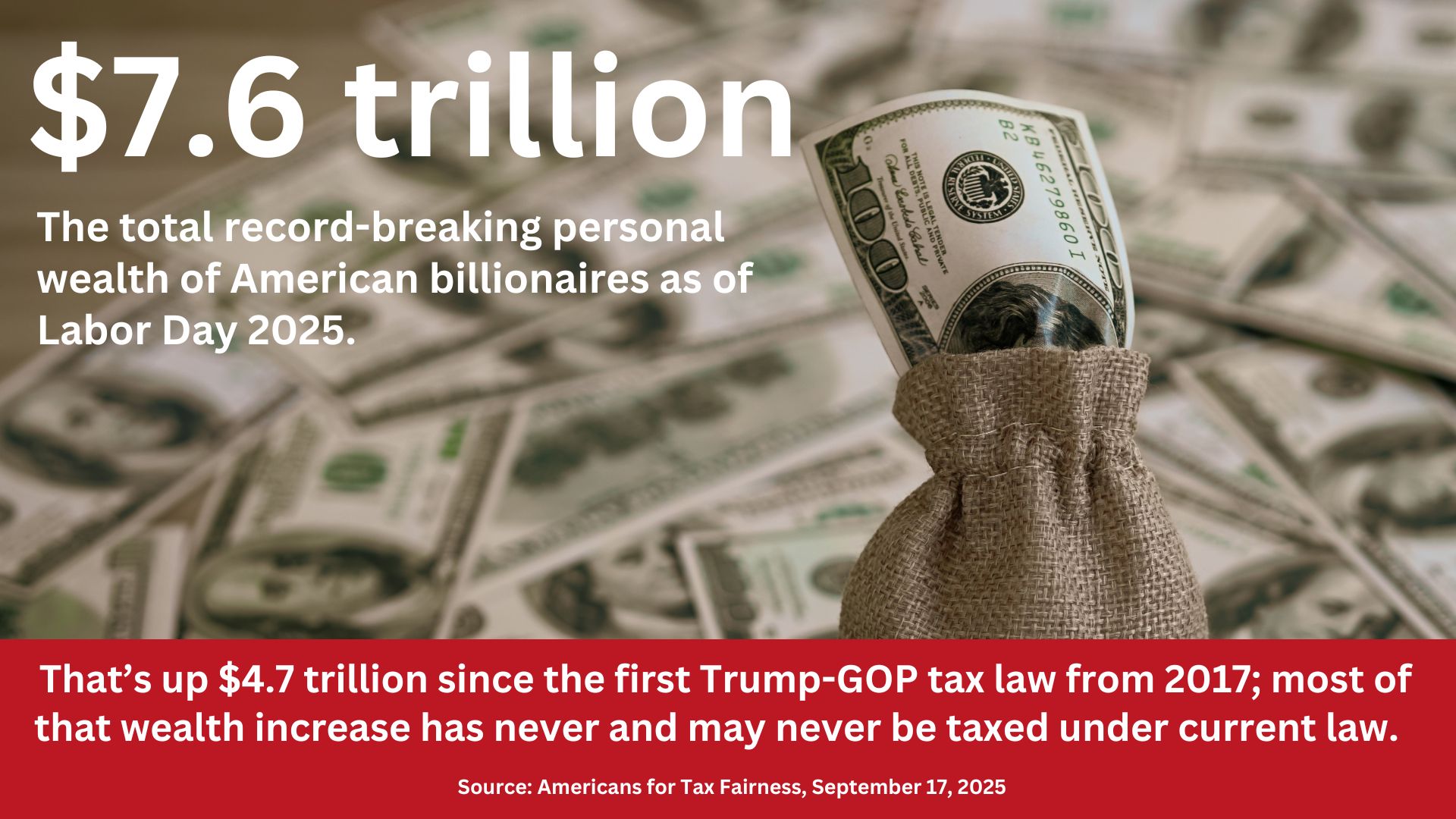
INEQUALITY BY THE NUMBERS |
|
|
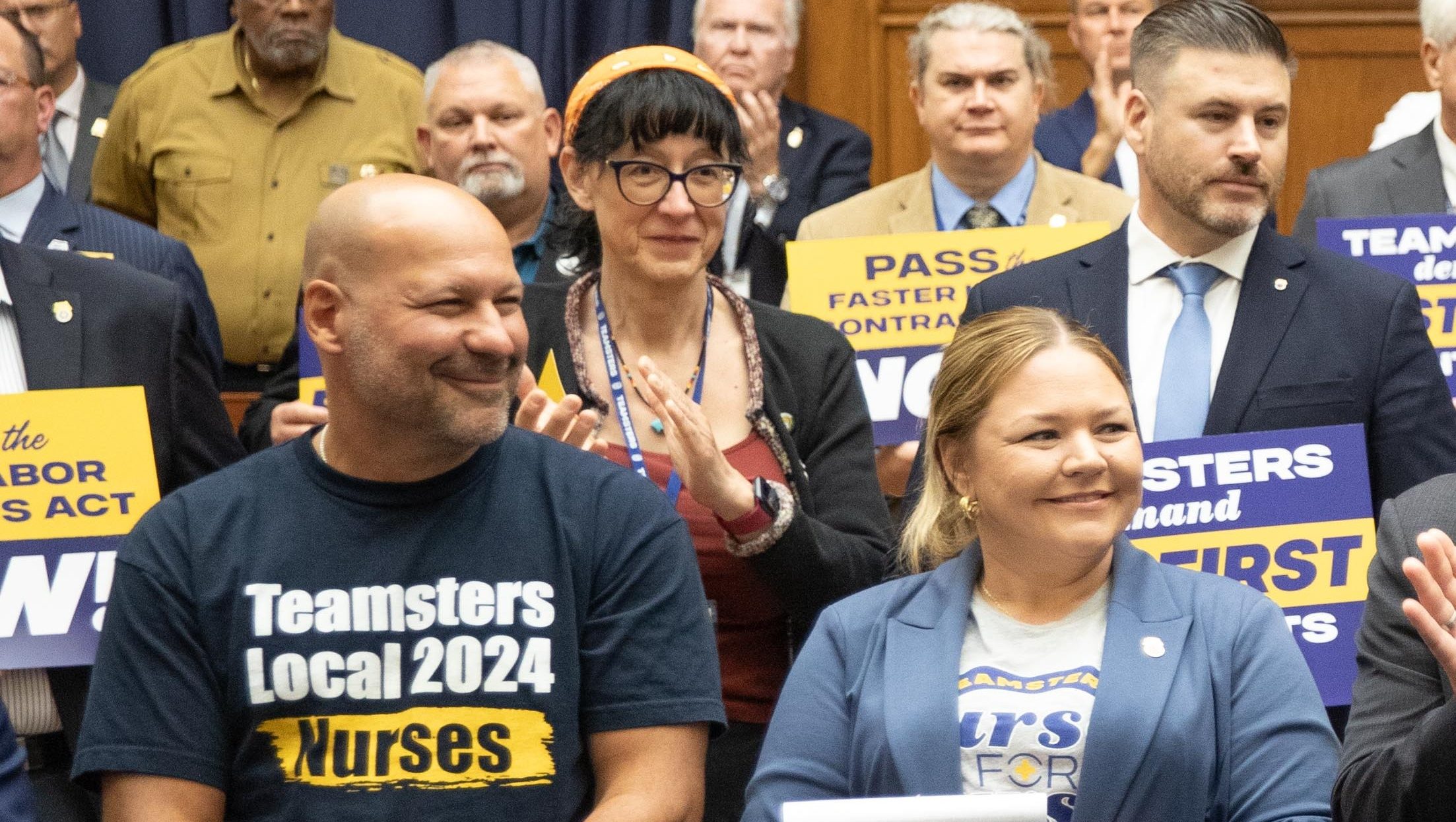
The Widening Struggle To Guarantee Timely Union Contracts This week’s frontline faces: Sarah Johnson and Jason Fratangelo, registered nurses at Corewell Health East and members of Michigan Teamsters Local 2024.
What they're doing to help create a more equal world: Johnson and Fratangelo helped win a union recognition campaign at Corewell last November. Since then, their bosses have used every trick in the book to draw out negotiations and deny Corewell workers a union contract.
That's why the two nurses are fighting, with the Teamsters, for federal legislation that would require employers to begin negotiating no later than 10 days after workers have voted to form a union. It took the Corewell workers seven months to get Corewell to the bargaining table. The legislation the Corewell workers seek would have disputes go to mediation if no agreement is reached within 90 days.
What makes this fight so important: “The Faster Labor Contracts Act would finally level the playing field,” Johnson and Fratangelo recently wrote for Inequality.org. “It would give working people across this country a fair chance at the contracts they’ve already earned and stop corporations from slow-walking negotiations into the ground.”
|
|
|
How Can Progressives Best Win Back America’s Working Class?
How best to answer that key question? A good start, suggests an analysis of a new Center for Working-Class Politics survey, would be to emphasize economic populism, to tap into the resentment and insecurity that decades of corporate excess and bipartisan neglect have burned into modern American life.
But in the swing states of Michigan, Wisconsin, Ohio, and Pennsylvania that the Brooklyn-based Center surveyed, these economic populist ideas turn out to become much less popular when they come attached to a Democratic Party label. So what should those of us hoping to build an equal society via the ballot box do?
In purple districts, running as independents would likely split the vote and guarantee conservative success. In those cases, the new Center for Working-Class Politics survey analysis advises, a movement hoping to win back the working class should work to build a Democratic brand that centers on reducing the costs of everyday life, creating good jobs, and holding elites accountable. In deep red or blue districts? The Center’s advice: Try running as independents. |
|
|
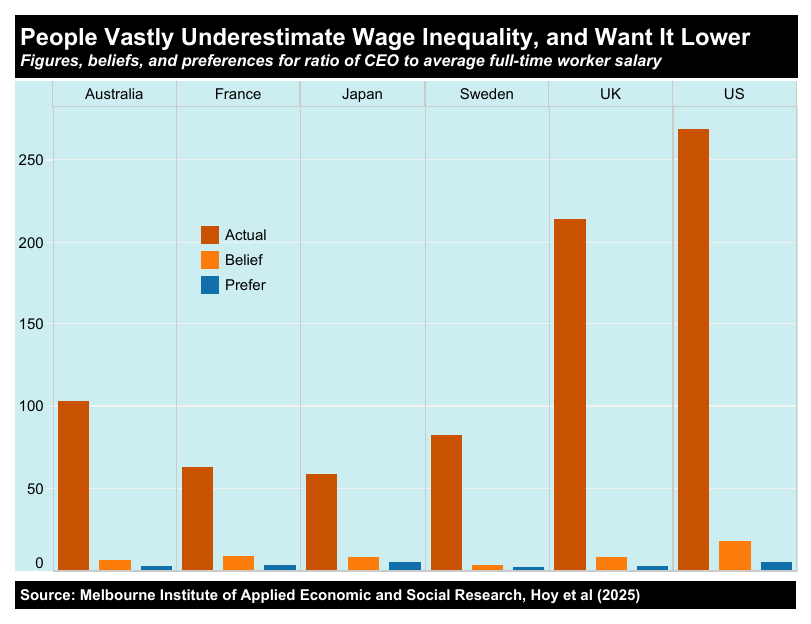
A new study from the Melbourne Institute of Applied Economic and Social Research finds that people across the world dramatically underestimate how much CEOs earn compared to regular workers and prefer far smaller gaps.
In the United States, CEOs earn about 269 times more than average workers. But the U.S. public estimates that gap at only 18 times — and would prefer that CEOs make no more than five times average worker pay. The same pattern appears worldwide. Even in Japan, where executive pay runs far more restrained, people still underestimate the CEO-worker pay gap and want to see it smaller. For an interactive version of this chart, click the Inequality.org link below.
|
|
|
PETULANT PLUTOCRAT OF THE WEEK |
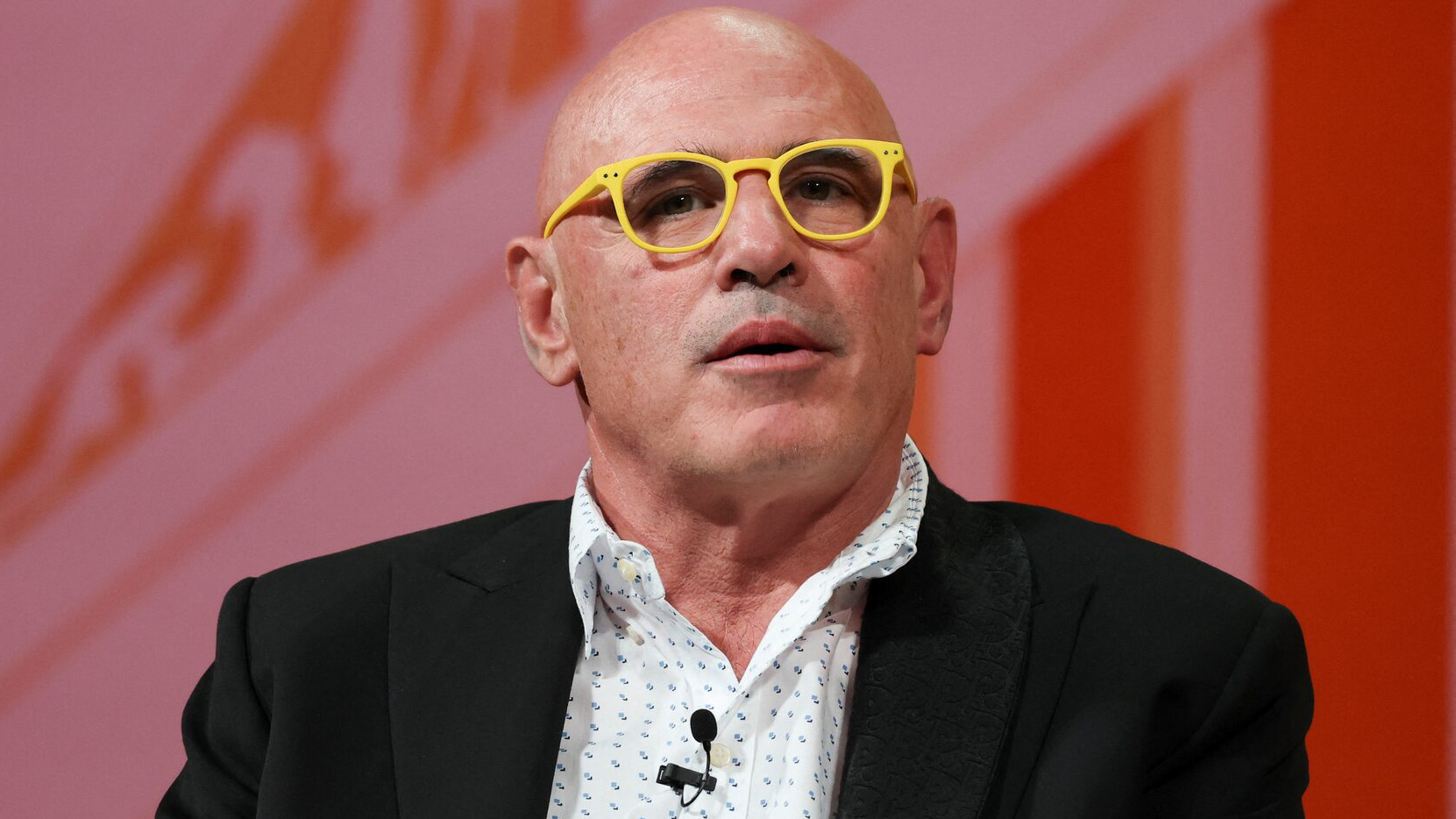
A Small-Time Billionaire with a Big-Time Pal in Trump’s Treasury This week’s dour deep pocket: Robert Citrone, the founder of the Discovery Capital Management hedge fund, a finance-biz buddy of current U.S. Treasury Secretary Scott Bessent and the possessor of a personal fortune never worth much more than a mere single billion.
What has Citrone sour: the embarrassing media coverage of the huge U.S. federal bailout that has gone to prop up the failing regime of Argentina’s “free-market” president, the libertarian Javier Milei. That bailout has just happened to also bail out Citrone, a huge investor in Argentinian bonds and equities after Milei took office in late 2024.
Citrone, notes Popular Information’s Judd Legum, had been sure that Milei’s governing emphasis on deregulating business and slashing public spending “would revitalize the Argentine economy.” Milei’s economy unraveled instead and left a third of Argentina’s population under the poverty line.
A desperate Citrone, Argentine media report, then turned to Bessent for a helping hand — and soon after invested more himself in Argentina’s shaky bonds, a move observers have linked to Citrone’s advance knowledge that the bailout he sought for Milei’s sinking economy would shortly be on its way.
The last word: “The Trump administration really hates giving foreign aid that serves any kind of humanitarian purpose,” observes the economist Paul Krugman. “But a $20 billion lifeline to the right-wing government of Argentina… No problem!” |
|
|
What's new on Inequality.org?
Chuck Collins, Ten Ways You Are Being Burned by Billionaires. Wealth concentration affects your life, whether you realize it or not.
Christopher Hoy, When Far-Right Voters Learn Wage Inequality Facts, Their Support for Policy Solutions Jumps. A new study of voters in the United States and five other countries finds that those on the far right start to support redistributive policies when they learn the true extent of the wage-gap problem. Elsewhere on the web
Tobi Thomas, Study links greater inequality to structural changes in children’s brains, The Guardian. Inequality, suggests landmark new research, creates a toxic social environment that is literally reshaping how young minds develop.
Amanda Gerut, More CEOs want Elon Musk-style ‘moonshot’ pay packages — but comp experts are raising alarms, Yahoo! Finance. Moonshot grants tie CEO compensation almost entirely to seemingly impossible performance targets — and, in the process, incentivize executive recklessness.
Nitasha Tiku, Elizabeth Dwoskin, and Gerrit De Vynck, Inside billionaire Peter Thiel’s private lectures: Warnings of ‘the Antichrist’ and U.S. destruction, The Washington Post. Lectures delivered by Peter Thiel detail how this mega-billionaire has evolved a good-vs.-evil worldview that has all our futures depending on whether tech “innovators” — like himself — gain a free rein to do whatever they want to do.
Megan O’Matz and Jennifer Smith Richards, These Activists Want to Dismantle Public Schools. Now They Run the Education Department, ProPublica. Billionaire-bankrolled groups are now scheming to undermine teacher unions and open huge new profit opportunities via school privatization.
Nicole Winfield, Pope Leo condemns economies that marginalize the poor while the wealthy live in a bubble of luxury, Associated Press. In a world where the poor abound, Pope Leo notes, “we paradoxically see the growth of a wealthy elite” chasing an “illusion of happiness.”
David Sirota and Jared Jacang Maher, The Right’s Secret Plan to Help Billionaires Buy Elections, Rolling Stone. How two lawsuits are threatening to expand the Supreme Court’s 2010 Citizens United decision and turn America straight into a kleptocracy.
Steve Taylor, Research suggests rich people tend to be more selfish — but why is that? The Conversation. How a lack of empathy can make it easier to attain financial success: by green-lighting ruthlessness in the pursuit of wealth.
Dean Baker, Weakening Patent Monopolies: The Most Effective Wealth Tax, Beat the Press. Why is taking riches back from the rich — via taxes — so much harder than keeping the rich from getting rich in the first place? Two reasons: Our wealthiest remain highly adept at hiding their money from taxing authorities — and equally adept at using that money to beat back efforts to tax their riches.
Robert Reich, Why has the media become so vulnerable to Trump, and what can we do about it? Substack. Ultra-wealthy individuals — the people most likely to be biased against the public’s right to know — are now controlling our major media.
Jim Hightower, While We Tout America’s Democracy, Plutocracy Is Taking Over, Black Star. How our MAGA government is shoveling massive giveaways of public money to corporate elites — at the expense of the journeys we take, the air we breathe, and the jobs we need. |
|
|
Our research, editorial, and publishing team depends on hundreds of paid subscribers who make monthly gifts. Some give $3 each month. Others give $200! All told, this support enables our team to stay focused on identifying causes and solutions to our deep economic inequality. Paid subscribers have contributed more than $20,000 in the past year. Ready to become a paid subscriber? Sign up today. | |
|
Inequality.org | www.inequality.org | inequality@ips-dc.org Institute for Policy Studies
1301 Connecticut Avenue Ste 600
Washington, DC 20036
United States
Managing Editor: Chris Mills Rodrigo
Co-Editors: Sarah Anderson, Chuck Collins, Bella DeVaan, Reyanna James, and Sam Pizzigati |
|
|
|