A weekly newsletter from the Institute for Policy Studies |
|
|
The chip manufacturer Nvidia has just announced a new $100-billion investment in OpenAI, the creator of ChatGPT. The news has triggered a predictable big stock market bump. But should anyone concerned about the state of our economy actually be cheering on this latest AI mega-deal?
That $100 billion isn’t going to be flowing throughout our economy. We have here instead another typical high-tech circular financing scheme: OpenAI is going to turn around and spend those new billions on Nvidia chips. This is also another instance of high-tech speculation: OpenAI, despite its key product’s popularity, has never been able to turn a profit.
This latest speculative splurge has our S&P 500 stock index running at all-time highs. The problem? Nvidia accounts for a whopping 7 percent of the index. The soaring stock values of Nvidia and the rest of the “Magnificent 7” — Alphabet, Amazon, Apple, Meta, Microsoft, and Tesla — are propping up Wall Street’s record gains. The market, in other words, is floating on a wave of AI mystique.
Nearly three years out from the release of ChatGPT, heralded as a world-altering development, what transformative use cases have we really found for generative AI? Reports of chatbots “coaching” teens to commit suicide don’t inspire much confidence. Whether or not the AI bubble bursts, we need to be more skeptical of the deeply unequal economy riding on its back.
Chris Mills Rodrigo
for the Institute for Policy Studies’ Inequality.org team |
|
|
INEQUALITY BY THE NUMBERS |
|
|
Calling Out the Billionaires Who Are Driving the Climate Crisis This week’s frontline face: Collin Rees, U.S. campaigns manager for Oil Change International, one of the organizational endorsers of the “Make Billionaires Pay” rally in New York City this past Saturday.
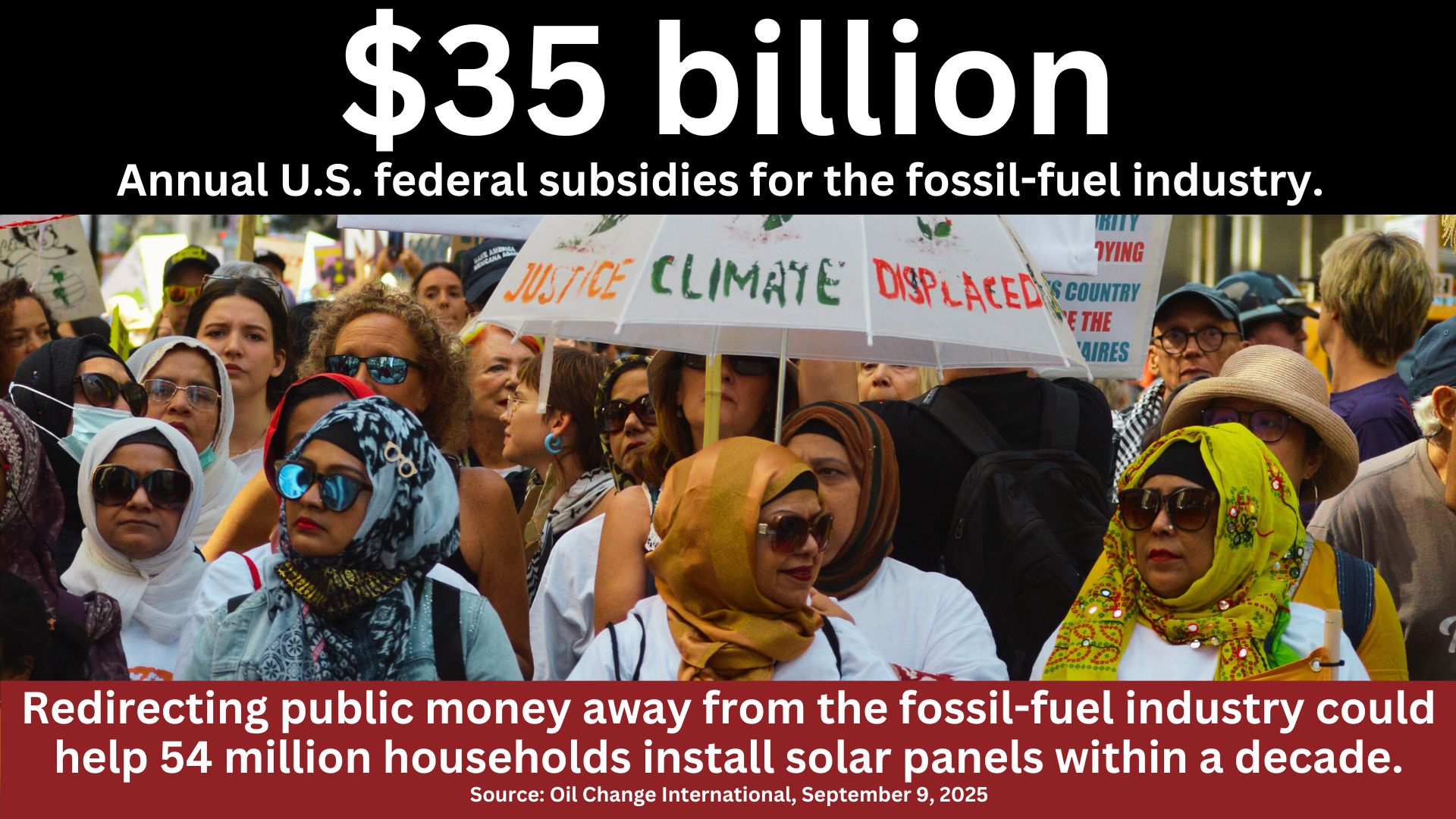
What he’s doing to help create a more equal world: Rees and his colleagues are working to expose the true costs of fossil fuels and facilitate a just transition to clean energy. In a recent report, they documented that our federal government is annually showering the fossil-fuel industry with $35 billion in taxpayer giveaways. At the New York rally, Rees and other activists demanded an end to a rigged system where the people causing the crisis profit from it and the rest of us pay the price. Our leaders, Rees urged, must “act now to end fossil fuel subsidies, tax the rich, and fund a liveable future.”
What makes this fight so important to Rees: “While hurricanes ravage our communities and wildfires destroy our homes,” he notes, “billionaires drive the climate crisis and get richer by the day.” |
|
|
Why We So Need To Protect Our Retirements from Private Equity
The slow march of private equity across the American economy — a march that’s been raising billions from investors to purchase firms, then flipping those firms after stripping them for parts — is now endangering our retirements.
What’s creating this new danger? Deep pockets have begun to shy away from investing in traditional private equity schemes. So private equity kingpins have gone hunting for new sources of cash and found one big one. These kingpins are now seeking to rake in cash from average Americans’ retirement accounts, and they’ve found, in the Trump White House, an ideal ally in that effort.
But we can stop private equity from endangering Americans’ retirement future. We can strengthen regulations requiring retirement programs to invest prudently in diversified assets that can help us hold onto the money we put away. But to really ensure that we can safely live out our golden years, we'll need to do more. We’ll need a broader revamping of Social Security that guarantees comfort and peace of mind for us all. |
|
|
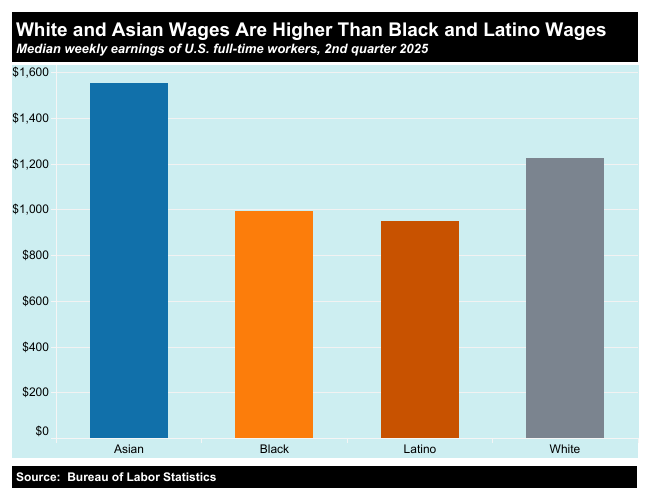
Hispanic Heritage Month offers us an opportunity to honor historic contributions to labor rights and equality from Latino and Hispanic communities — while also recognizing the work that still needs to be done. Recent Bureau of Labor Statistics data show that Latino workers remain the lowest-paid U.S. racial or ethnic group, making just 77 cents for every dollar a white worker earns.
For an interactive version of this chart and more on racial income inequality, click the link to our Inequality.org Facts section below. |
|
|
PETULANT PLUTOCRAT OF THE WEEK |
A Super-Rich Computer King May Finally Be Facing Real Public Scrutiny This week’s dour deep pocket: the 81-year-old Larry Ellison, the co-founder of the Oracle computing colossus and the world’s second-wealthiest man, with a fortune currently valued at over $350 billion.
What has Ellison sour: the growing public attention to the deal-making that may soon have him in firm — and distinctly Trump-friendly control — over media heavyweights ranging from CNN and CBS News to HBO Max and the Warner Bros. movie studio.
That control could bring us “something way too close to what is served up on a daily basis by the Murdochs” who run the Fox news empire, notes former Wall Street banker William Cohan. “And that will put yet another chink in the fragile armor that is America’s democracy.”
Ellison also appears to have maneuvered Oracle into control over all U.S. TikTok user data, a control that will lock in when American investors soon take over this social media giant’s operations in the United States.
The last word: Ellison and his son, the Financial Times observed last week, “have quietly been building a media and cultural empire that is likely to transform their family into the Rockefellers of our times.” |
|
|
Matt Stoller, When Corporate America Set America Down a Dark Path, The Big. A reflection on last week’s latest instance of U.S. political violence: Our social fabric has been ripping apart for a long time — and the avarice of America’s top corporate chiefs has been doing the most to drive that ripping.
Dustin Guastella, AI will make the rich unfathomably richer. Is this really what we want? Guardian. The ludicrous valuations of AI startups rest on the idea that this tech will eliminate the need for human labor. The AI boom could bring modern history’s most “efficient” upward redistribution of wealth ever.
Polly Cleveland, Mamdani Needs to Catch the Value Capture Bus, Dollars & Sense. How best to finance the leading New York City mayoral candidate’s popular proposal for free bus service? “Value capture” taxes offer a progressive option that the city’s richest residents would have a hard time dodging.
Andrew Kessel, Starbucks Faces Scrutiny as CEO's Pay Is 6,666 Times That of the Median Barista, Investopedia. That ghastly ratio just happens to be the largest among all S&P 500 companies.
Francis Fukuyama, Our Coming Plutocracy, Persuasion. In 1992, after the USSR’s collapse, political scientist Fukuyama argued that liberal democracy’s triumphant ascendancy had brought us to the “end of history.” History begged to differ, and Fukuyama is now exploring western civilization’s implosion. Lenore Palladino, To restore democracy, end shareholder primacy at U.S. corporations and on Wall Street, Washington Center for Equitable Growth. Giving workers a voice in corporate decision-making can improve their own — and the American public’s — experience of economic growth and democracy.
Luke Kemp, The Rewards of Ruin, Aeon. Worried about an impending societal collapse? Understandable. But a new book from this Cambridge scholar notes that past collapses have actually improved the lives of average people. The reason: Past empires and their predations fueled enormous inequalities.
Hank Tucker, How The 10 Richest American Hedge Fund Managers Got $20 Billion Richer In A Year, Forbes. The new Forbes 400 ranking of the nation’s wealthiest has our top ten hedge fund execs now worth a combined $174 billion. Ten median-income U.S. households would have to together work over 200,000 years to earn that much.
Benjamin Dodman, ‘Zucman tax’: Push to tax the super-rich could make or break France’s next government, France24. Economist Gabriel Zucman’s proposed annual 2 percent tax on assets over 100 million euros, about $117 million, would apply to 1,800 French rich and annually generate up to 20 billion euros.
Heather Altamirano, The Ultra-Wealthy Are Investing In a Unique Luxury: Custom-Built Cars, Yahoo! Finance. Elite buyers are teaming up with luxury brands to create personalized vehicles tailored to their own special preferences. |
|
|
Our research, editorial, and publishing team depends on hundreds of paid subscribers who make monthly gifts. Some give $3 each month. Others give $200! All told, this support enables our team to stay focused on identifying causes and solutions to our deep economic inequality. Paid subscribers have contributed more than $20,000 in the past year. Ready to become a paid subscriber? Sign up today. | |
|
Inequality.org | www.inequality.org | [inequality@ips-dc.org] Institute for Policy Studies
1301 Connecticut Avenue Ste 600
Washington, DC 20036
United States
Managing Editor: Chris Mills Rodrigo
Co-Editors: Sarah Anderson, Chuck Collins, Bella DeVaan, Reyanna James, and Sam Pizzigati |
|
|
|