A weekly newsletter from the Institute for Policy Studies |
|
|
Last week we released our annual Executive Excess report exposing in stark detail just how much CEO pay has soared while worker pay has stalled.
Our report sent flacks for overpaid CEOs running for cover. Reporters for the Guardian and Barron’s reached out to Starbucks, Walmart, Home Depot, Lowe’s, and Ulta Beauty for comment. Not one of them would respond. That's not surprising, given the indefensible pay gap figures our report details. For the third year in a row, we zeroed in on the 100 S&P 500 firms with the lowest median wages, a group we’ve dubbed the “Low-Wage 100.” Our blockbuster finding: The CEOs at these companies now earn 632 times more than their typical workers.
Average CEO pay at the Low-Wage 100, over the past six years, has jumped at over double the rate of median worker pay. In other words, at a time when U.S. workers are struggling with rising costs for groceries and housing, the nation’s largest low-wage employers are making their overpaid CEOs even richer.
Between 2019 and 2024, these firms spent $644 billion on stock buybacks, a scam that artificially inflates the value of a company’s stock — and CEO pay. Every dollar spent on buybacks represents a dollar not spent on workers.
The tradeoffs can be downright staggering. At Lowe’s, for instance, every one of the retail giant’s 273,000 employees could have received an annual $28,456 bonus over the past six years with the money the retailer blew on stock buybacks. Half of Lowe’s workers made less than $31,000 last year. Such disparities are not just bad for workers – they’re also bad for our democracy.
“This gap between CEO and worker pay,” I summed up for the Financial Times last week, is driving “rising inequality and the concentration of wealth at the top” and giving our ultra-wealthy “too much influence over our political system.” Much more from our new Executive Excess report below.
Sarah Anderson
for the Institute for Policy Studies’ Inequality.org team |
|
|
INEQUALITY BY THE NUMBERS |
|
|
LAST YEAR’S TOP CEO GREED GRABS |
|
|
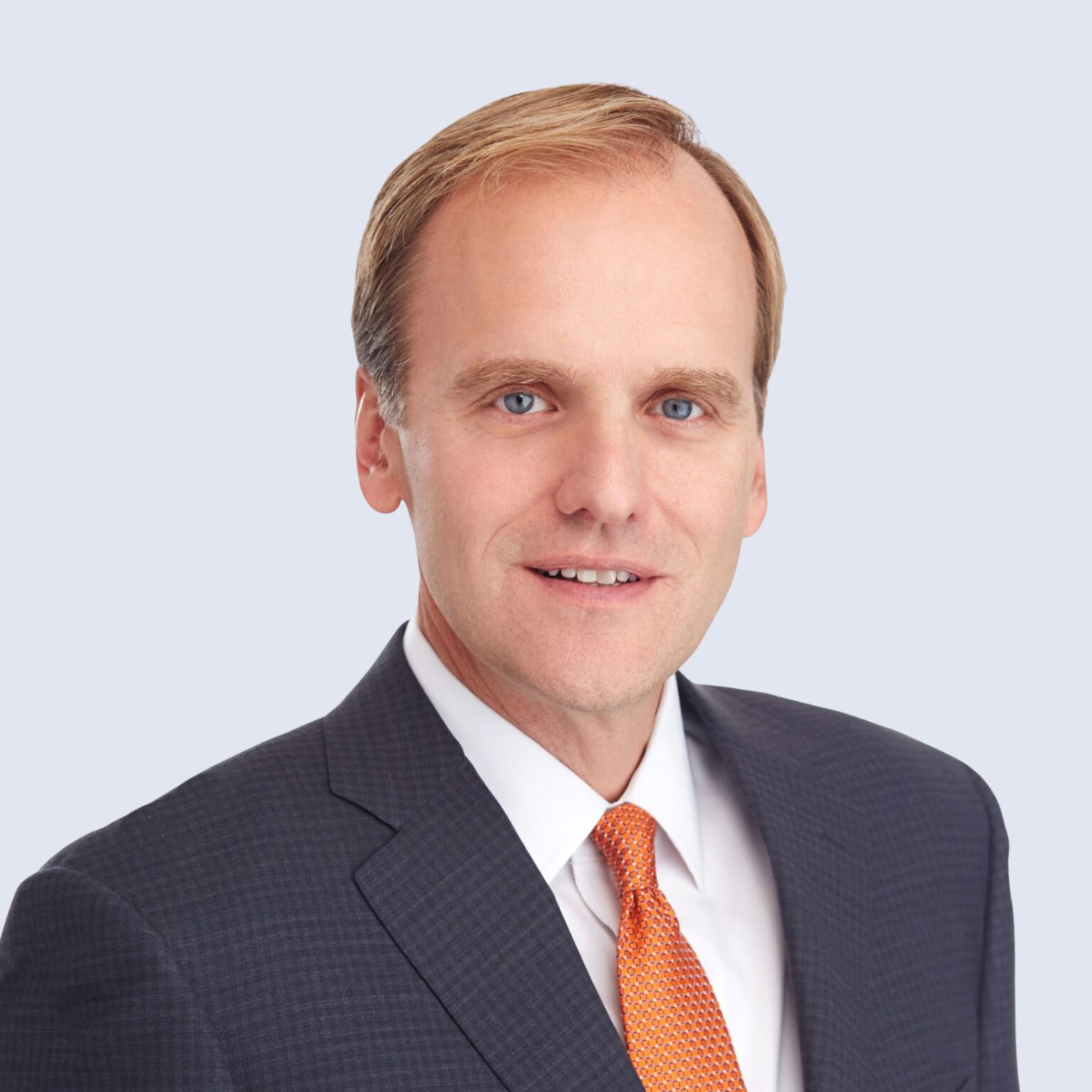
| Starbucks CEO Brian Niccol After exiting the top spot at Chipotle, Niccol took home a whopping $95.8 million in 2024.
The median Starbucks worker last year took home just $14,674. That works out to a mind-boggling CEO-to-worker pay ratio of 6,666 to 1. |
|
|
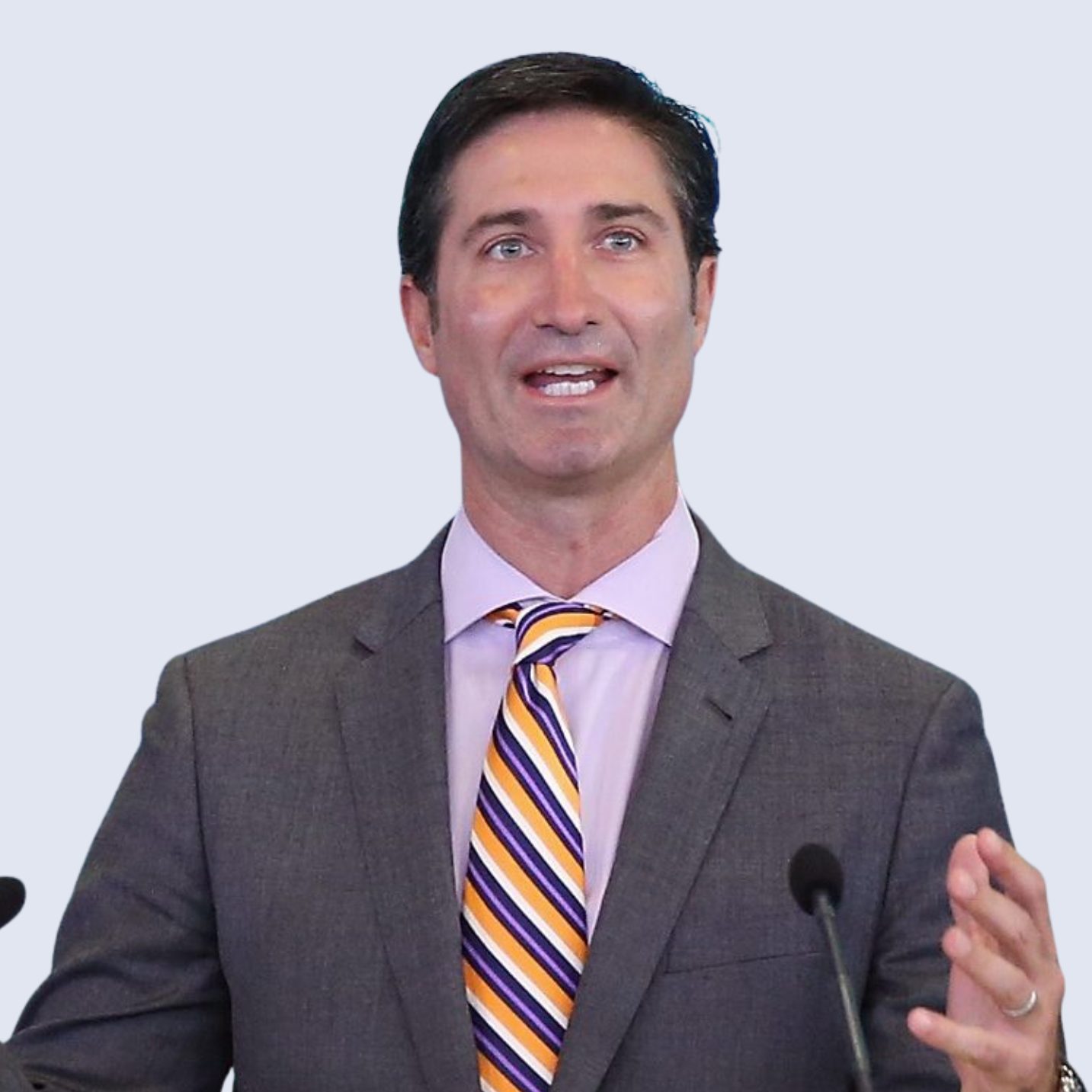
| Ulta Beauty CEO David Kimbell
Between 2019 and 2024, the company's real median pay plunged by 46 percent to $11,078.
Those cuts didn’t impact Kimbell much. He brought home $12.5 million in 2024. Ulta's CEO-worker pay gap: 1,130 to 1. |
|
|
| DoorDash CEO Tony Xu On the surface, this one doesn’t look too bad: Xu made $318,518 in 2024, and DoorDash median pay stood at $38,112.
But that median pay figure only covers DoorDash corporate employees and doesn’t include any of the drivers who actually deliver food. Their pay? Some estimates put their yearly earnings at $2,250. |
|
|
We Can Use Our Tax System to Discourage Excessive CEO Compensation
Excessive CEO pay has Americans across the political spectrum frustrated. Our government, Americans believe, ought to be doing something about that excess. One option: Lawmakers could be levying higher taxes on corporations with particularly wide gaps between CEO and worker pay.
Such a move would likely be overwhelmingly popular. In one survey of likely voters, 89 percent of Democrats, 77 percent of Independents, and 71 percent of Republicans said they’d like to see tax hikes on companies that pay their CEOs more than 50 times what they pay their median employees. Read more about antidotes to CEO greed from Sarah Anderson below. |
|
|
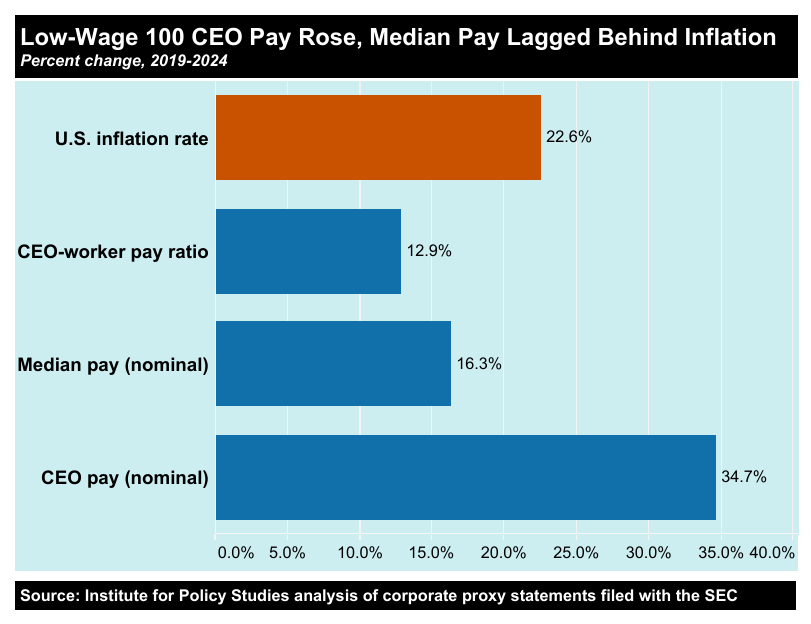
Between 2019 and 2024, average CEO compensation within major U.S. low-wage corporations rose 34.7 percent in nominal — unadjusted for inflation — terms, more than double the 16.3 percent increase in these firms’ average median worker pay. The U.S. inflation rate over this same period: 22.6 percent. For an interactive version of this chart and more on CEO-worker pay gaps, click the link below to our full Executive Excess report. |
|
|
PETULANT PLUTOCRAT OF THE WEEK |
Could Coca-Cola Ever Be Sweeter than the Coke CEO’s Pay?
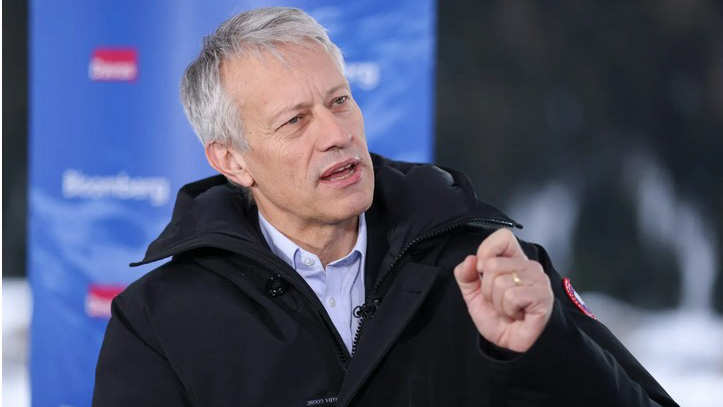
This week’s dour deep pocket: James Quincey, the Coca-Cola CEO who last year pulled down $28 million in pay, 1,980 times what Coke’s most typical workers earned and 49.7 percent more, adds the latest Institute for Policy Studies Executive Excess report, than what Quincey made in 2019.
What has Quincey sour: Donald Trump’s crowing over Coca-Cola’s decision to offer Americans a Coke made with cane sugar instead of high-fructose corn syrup. U.S. Health and Human Services secretary Robert F. Kennedy Jr. has called corn syrup “just a formula for making you obese and diabetic.” “I have been speaking to Coca-Cola about using REAL Cane Sugar in Coke in the United States, and they have agreed to do so,” Trump gloated last month on Truth Social. “You’ll see. It’s just better!”
In fact, both corn syrup and cane sugar, a 2021 National Institutes of Health-funded study found, increase fatty liver disease and Type 2 diabetes, with “no significant differences” between the two.
The last word: Celebrating the swap of cane sugar for high-fructose corn syrup “as a win for public health,” notes Eva Greenthal at the Center for Science in the Public Interest, “makes no sense.” |
|
|
What's new on Inequality.org
Sara Steffens, The Progressive Case for Tariffs. Trade policy can protect domestic workers, but tariffs only work if used in confluence with other industrial policy strategies.
Helen Flannery, Donor-Advised Funds: A Power Tool for Political Engagement. Donors disproportionately use donor-advised funds to support politically engaged charities. Anonymity amounts to a big reason why.
Hanna Homestead, Trump’s Invasion of D.C. Costs over $1 Million a Day. What Could That Fund Instead? Deploying the National Guard against D.C.’s unhoused population costs four times more than simply housing them. Elsewhere on the web
Sarah Anderson, CEOs Are Getting Richer. Everyone Else Is Falling Behind, OtherWords. Between 2019 and 2024, major U.S. low-wage firms spent $644 billion on stock buybacks, a maneuver that inflates CEO pay. Top execs at those firms last year pocketed 632 times more than their median workers.
Tobias Burns, Tax rate for ultrarich drops dramatically after GOP tax cuts: Study, The Hill. The wealth of America’s richest 400 equaled 2 percent of U.S. GDP in 1982. That share has now hit 20 percent, reports a new UC-Berkeley study.
April Corbin Girnus, For every $1 earned by gaming industry workers, these CEOs get hundreds, Rhode Island Current. The gambling industry has become no gamble for top gaming corporation chief execs.
Osita Nwanevu, To Make Democracy Work, Give More of It to Workers, The Nation. Our efforts to tackle inequality will be incomplete unless we’re willing to address how our basic economic institutions — including company ownership — produce inequality to begin with.
Colleen Shaddox, When Sleeping Is a Crime, The American Prospect. Billionaires are now pushing the line that the federal government has the right to lock up people who have committed no crime. Hamilton Nolan, Three Crises of Labor, How Things Work. How did the USA sink into its current democracy-challenged state? Credit an explosion of economic inequality that has locked in place an appalling oligarchy.
Eileen Appelbaum, Private Equity is Breaking out the Champagne. What Do They Know That We Don’t? Center for Economic and Policy Research. Thanks to a new Trump executive order, the $9 trillion sitting in worker 401(k) accounts could soon be bailing out struggling private equity funds and their billionaire managers.
Sona Wyse, Ian Berlin, and William Gale, When tax laws defy public opinion: What OBBBA reveals, Brookings. Legislative outcomes, studies consistently show, tend to reflect the preferences of the wealthy. Trump’s “One Big Beautiful Bill Act” of 2025 and his 2017 tax bill both became law despite widespread public opposition to the tax cuts for the rich that both bills advanced.
Aya Iskandarani, Less tax, more luxury: millionaires flock to Dubai, Japan Times. The rapid development of Dubai into a world-leading playground for the rich is generating closer attention to a city where armies of low-paid migrant workers form the backbone of the economy. |
|
|
Our research, editorial, and publishing team depends on hundreds of paid subscribers who make monthly gifts. Some give $3 each month. Others give $200! All told, this support enables our team to stay focused on identifying causes and solutions to our deep economic inequality. Paid subscribers have contributed more than $20,000 in the past year. Ready to become a paid subscriber? Sign up today. | |
|
Inequality.org | www.inequality.org | [email protected] Institute for Policy Studies
1301 Connecticut Avenue Ste 600
Washington, DC 20036
United States
Managing Editor: Chris Mills Rodrigo
Co-Editors: Sarah Anderson, Chuck Collins, Bella DeVaan, Reyanna James, and Sam Pizzigati |
|
|
|