A weekly newsletter from the Institute for Policy Studies |
|
|
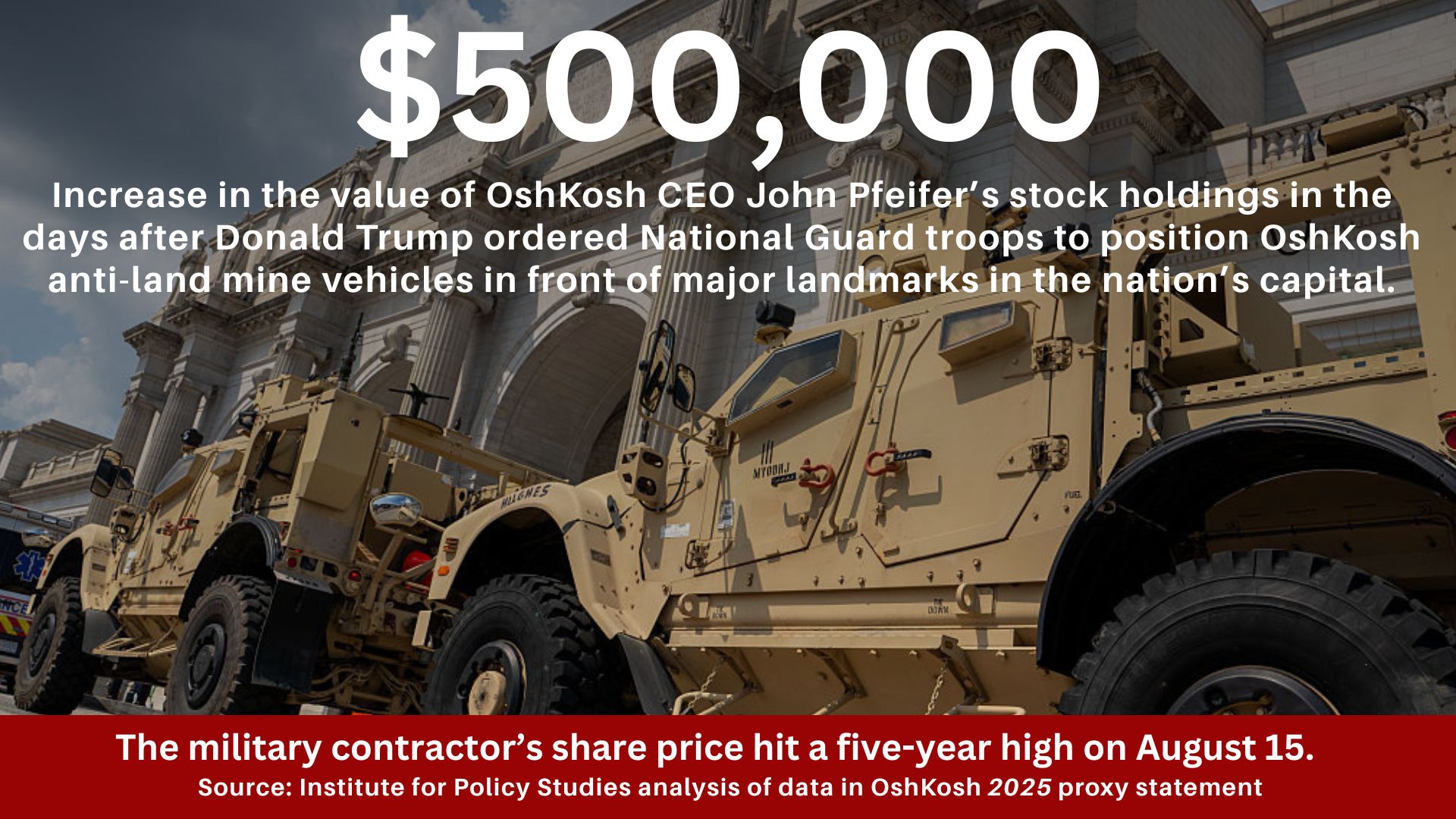
Coming out of Union Station in Washington, D.C. last week, I was floored by the sight of bumper-to-bumper heavy-duty military vehicles. One of our capital’s most ornate buildings looked like a war zone.
By now, you’ve likely also seen images of hulking vehicles stationed with National Guard troops around various D.C. high-visibility sites. I later learned their technical name: mine-resistant, ambush-protected all-terrain vehicles, M-ATVs for short. The company that makes them, OshKosh, boasts of the trucks’ “integrated blast protection” and “performance-based battlefield technology.”
Donald Trump is now threatening to send National Guard troops to still more U.S. cities, and those threats could be great news for OshKosh’s bottom line. At least that’s what Wall Street seems to think. Investors have sent the company’s share price — along with the value of the CEO’s personal stock holdings — soaring.
The relationship between authoritarian power grabs and windfalls for Wall Streeters goes way back. Let this latest link-up serve as a trenchant reminder that the fight against fascism and the fight against oligarchy need to go hand in hand. Sarah Anderson
for the Institute for Policy Studies’ Inequality.org team |
|
|
The Nation’s Longest Ongoing Strike Passes the 1,000-Day Mark
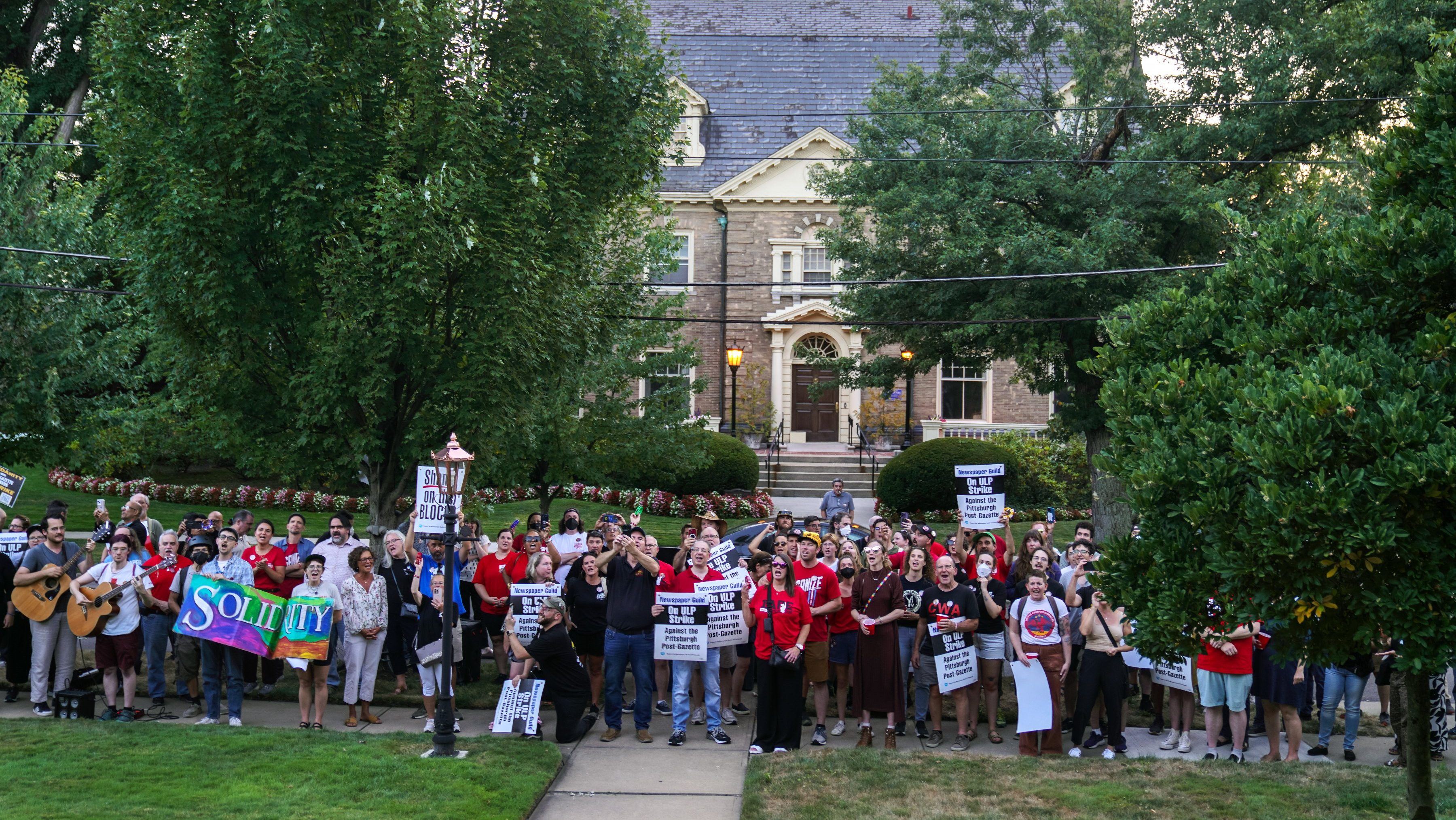
This week’s frontline faces: The striking workers of the Pittsburgh Post-Gazette, pictured above by striker Alexandra Wimley, with fellow Communications Workers of America members rallying at the home of the daily’s publisher, John Block.
What they're doing to help create a more equal world: Post-Gazette workers began their walkout on October 18, 2022, after ownership tore up a legally negotiated union contract, robbing employees of dignified health care.
After over 1,000 days on strike, hints of a resolution are beginning to emerge. The U.S. 3rd Circuit Court of Appeals recently ordered the paper’s owner, Block Communications, to restore health benefits and return to the bargaining table. After months of appeals and delays, a court mediator will meet with both sides to reach a resolution later this week.
The on-strike journalists haven’t just fought a legal battle the last two-plus years. They’ve also launched their own news vehicle, the Pittsburgh Union Progress.
Why the fight matters: “The Post-Gazette’s attempts to evade its responsibility have exhausted the courts and exhausted every legal delay tactic, while our strikers’ determination and solidarity have only grown,” Zack Tanner, president of the Newspaper Guild of Pittsburgh, recently noted. Check the link below to support the striking Post-Gazette workers.
|
|
|
America’s Cities and States Can Fill the New Federal Tax Vacuum
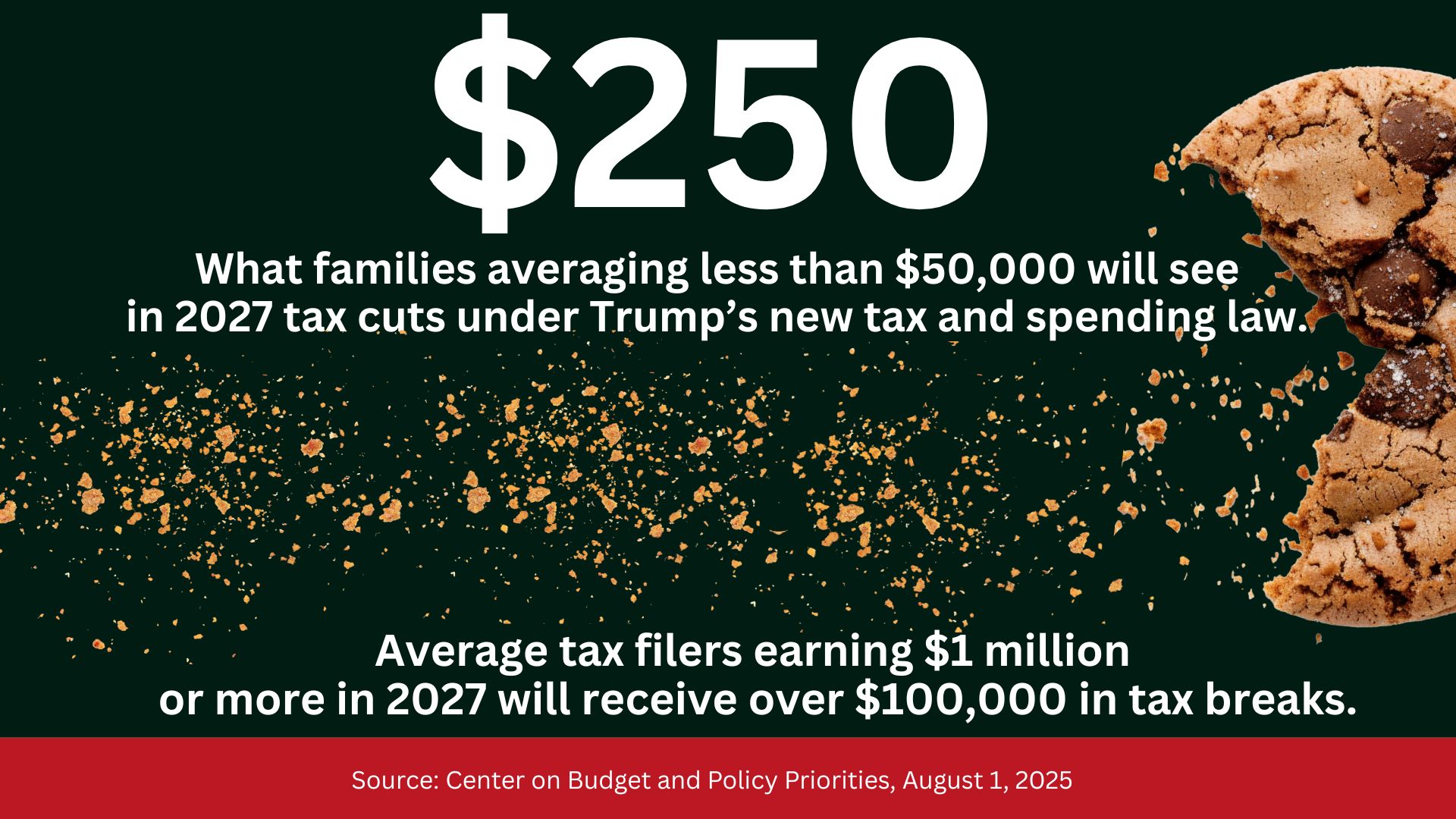
The Trump-driven federal tax legislation that went into effect earlier this summer provides tax breaks for our country’s wealthiest at the expense of critical social benefit programs. States are already feeling the impact of these harsh cuts. They’re losing federal funding for health care, food, and other core necessities.
Only the federal government has the capacity to raise the dollars needed to fully fund the programs essential to U.S. family well-being, notes Institute on Taxation and Economic Policy director Amy Hanauer. But state governments can help fill in the gaps by making sure their own wealthy pay their fair tax share.
Several states have recently enacted new taxes on their wealthiest. Several others have clamped down on corporations that are hiding earnings in other tax jurisdictions. Cities, for their part, can pass local income taxes or mansion levies. Raising the revenue needed to keep all of us safe and secure will take, given the new federal budget cuts, a host of new commitments to tax justice. More below. |
|
|
The Congressional Budget Office has released an updated analysis of Donald Trump’s so-called “Big Beautiful Bill” that details how America’s high-income households will benefit even more than originally estimated.
The new federal budget, the CBO projects, will annually lower average household resources for the nation’s poorest 10 percent by 3.1 percent, or $1,200, over the next decade. Resources for the nation’s most affluent 10 percent of households, by contrast, will likely increase by an average 2.7 percent, or $13,600. For an interactive version of this chart and more on taxes and inequality, click the link to our Inequality.org Facts section below.
|
|
|
PETULANT PLUTOCRAT OF THE WEEK |
This Crafty Crypto Billionaire Has Plenty of Friends in High Places This week’s dour deep pocket: Changpeng Zhao, the founder of Binance, the world’s largest cryptocurrency exchange. His current net worth: $41.1 billion.
What has Zhao sour: his guilty plea on U.S. money-laundering charges that had him behind bars for four months last year. The deep-pocket Canadian — who currently claims the United Arab Emirates as his residence — is now paying fixers in the Trump orbit big bucks to gain a White House pardon.
To grease that campaign along, Zhao’s Binance has already struck a deal with World Liberty Financial, the Trump family’s own crypto firm. Also boosting the odds for a Zhao pardon: Trump’s Securities and Exchange Commission this past spring dropped a pending lawsuit against Zhao and Binance for lying to regulators and scamming customers.
The last word: Pardoning Zhao and Binance, charges U.S. senator Richard Blumenthal from Connecticut, would let “criminals off the hook to the personal profit of the president and his family” and unleash “a convicted felon on a virtually unregulated crypto market.” |
INEQUALITY BY THE NUMBERS |
|
|
Chuck Collins and Bella DeVaan, These Billionaires Pledged To Give Away Their Wealth. Instead, Most Are Getting Wealthier, Newsweek. The “Giving Pledge” launched in 2010 to encourage our richest to give away much more to charity remains unfulfilled — and not our ticket to a fairer, better future.
Hayley Cuccinello, The Giving Pledge was meant to turbocharge philanthropy. Few billionaires got on board, CNBC. A new Institute for Policy Studies analysis has identified only one living couple to have fulfilled the billionaire Giving Pledge over its 15-year existence.
Kate Pickett, The wealth gap – and the health trap, London School of Economics. Nations with higher levels of income inequality sport higher rates of everything from adult obesity and mental illness to asthma and drug abuse.
Robert Borosage, How the Constant Noise Distracts From the True Peril of Trump’s Misrule, The Nation. Trump’s tax policies and wanton corruptions only exacerbate the obscene inequality that’s corrupting our democracy.
John Miller, How the Rich Got Richer, Dollars & Sense. With more and more “pass-through” business income going to the ultra-rich, the income share of America’s top 1 percent has more than doubled. Eyal Press, “No Tax on Tips” Is an Industry Plant, The New Yorker. This “populist” Trump misdirection maneuver would let the restaurant industry’s deepest pockets continue to pay servers below the minimum wage.
Roger Kerson, Henry Ford vs. Elon Musk: A Century of Hate Speech, Washington Monthly. The 20th-century auto titan Henry Ford spread antisemitism until falling car sales forced his hand. Now Tesla is tanking, and its South African-born mogul is doubling down on bigotry.
Carolyn Fortuna, Should Tesla Shareholders Rebel Against Musk’s Pay Raise? CleanTechnica. Brad Lander, the New York City comptroller who oversees pension funds that own Tesla shares, is charging that Tesla’s board is once again enriching Musk “at investors’ expense.”
Luc Olinga, AI Is Creating Billionaires at Record Speed, Gizmodo. AI has ignited a gold rush, creating a new caste of ultra-wealthy. Their massive fortunes are already having a painful impact on the rest of us.
Paul Krugman, Predatory Financialization, Stone Center on Socio-Economic Inequality. The biggest fortunes in America primarily come from high-tech’s quasi-monopolies. But drop down the Forbes 400 list just a bit and you’ll see plutocrats who’ve made — via hedge funds — tens of billions in finance.
|
|
|
Our research, editorial, and publishing team depends on hundreds of paid subscribers who make monthly gifts. Some give $3 each month. Others give $200! All told, this support enables our team to stay focused on identifying causes and solutions to our deep economic inequality. Paid subscribers have contributed more than $20,000 in the past year. Ready to become a paid subscriber? Sign up today. |
|
|
Inequality.org | www.inequality.org | [inequality@ips-dc.org] Institute for Policy Studies
1301 Connecticut Avenue Ste 600
Washington, DC 20036
United States
Managing Editor: Chris Mills Rodrigo
Co-Editors: Sarah Anderson, Chuck Collins, Bella DeVaan, Reyanna James, and Sam Pizzigati |
|
|
|