A weekly newsletter from the Institute for Policy Studies |
|
|
This week we’ve been pouring through the 432-page House Republican tax plan — and following the boring committee mark-up process — so you don’t have to. Trust me, this hasn’t been fun.
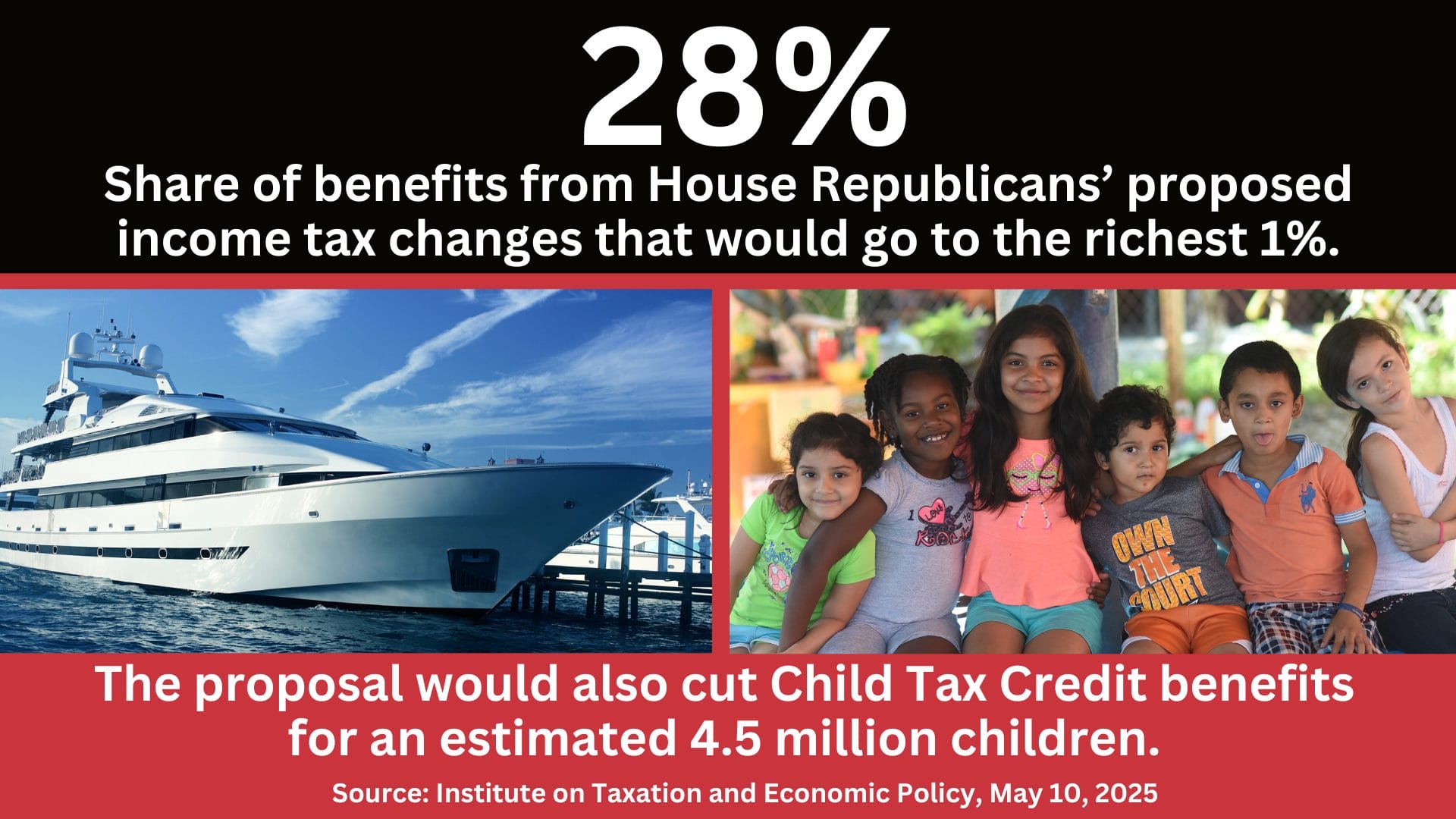
What President Trump is calling a “big, beautiful bill” would deliver more than $1 trillion in tax giveaways to our richest 1 percent while kicking millions of Americans off their health insurance and taking food away from hungry children. If enacted, Trump's tax plan would become our nation’s largest single transfer of wealth from the poor to the rich ever.
But this budget battle still has a ways to go. Politically vulnerable Republican lawmakers are expressing discomfort about the severity of the pending cuts to Medicaid, food stamps, and other programs their constituents rely on. And the public outcry will only grow as more details come to light. As one of my friends puts it, “these bills age like milk.” We’ll be keeping you up on all this as the budget debate rolls on.
Sarah Anderson
for the Institute for Policy Studies’ Inequality.org team |
|
|
INEQUALITY BY THE NUMBERS |
|
|
A Fired Federal Worker Warns: Hurricane Prevention Cuts Will Hurt the Poor
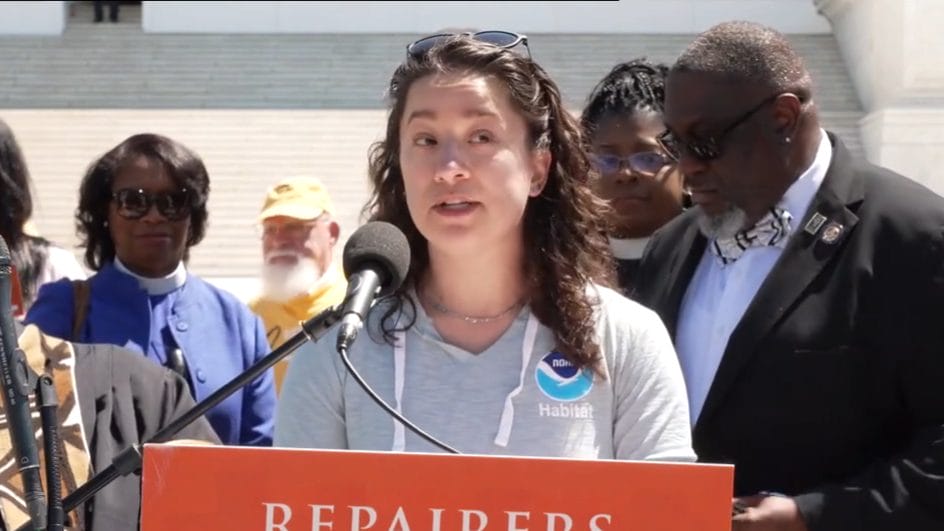
This week’s frontline face: Sabrina Valenti, one of the more than 120,000 federal employees who’ve lost their jobs under the Elon Musk-DOGE assault on public spending. Valenti worked for the National Oceanic and Atmospheric Administration, helping to restore coastal wetlands to protect communities from hurricanes. Her work particularly aided poor households, those least likely to be able to evacuate and most likely to suffer the consequences of severe storms. What she's doing to help create a more equal world: Valenti, since she lost her job, has been speaking out at rallies and in the media to help Americans better understand the critical role that federal workers have played in hurricane prevention and tracking — and the potentially disastrous effects of mass layoffs.
What makes this fight so important to her: Valenti grew up in the Gulf Coast area and remembers having to evacuate for Hurricane Ivan and having refugees from Katrina pouring into her school district.
“I’m no stranger to natural disasters, and that’s exactly why I felt called to spend my career at NOAA,” Valenti explains. “It’s not too late to protect the federal workers who remain in their roles working on hurricane preparedness. Much of the damage from hurricanes this summer can be restored, but you can’t bring back the dead.” |
|
|
Cities and States Can Lead the Way on Taxing Excessive CEO Pay
With Congressional leaders fixated on delivering new tax giveaways for the wealthy, fair tax advocates have high hopes for progressive reform at the city and state levels. This past week, Steve Novick, a member of the Portland, Oregon city council, released a plan to expand one of the most innovative municipal “tax the rich” policies: a surcharge on firms with huge CEO-worker pay gaps.
Back in 2016, Novick led the successful effort to enact this ground-breaking law. How does the law work? For companies doing business in Portland, the standard local business profits tax stands at 2.6 percent. But under the city’s “pay ratio surcharge,” that tax increases by 10 percent if a company’s CEO compensation runs more than 100 times its median worker pay. Companies with pay ratios of more than 250 to 1 face a 25 percent increase. Novick now wants to hike the surcharge to 50 percent for companies with gaps of 100-to-1 and to 100 percent for a 250-to-1 ratio. This boost, he estimates, will raise Portland’s annual revenue from its excessive-CEO-pay tax from $5 million to about $27 million. For more info on curbing extensive CEO pay, including the latest on federal bills that mirror the Portland law, click the link below. |
|
|
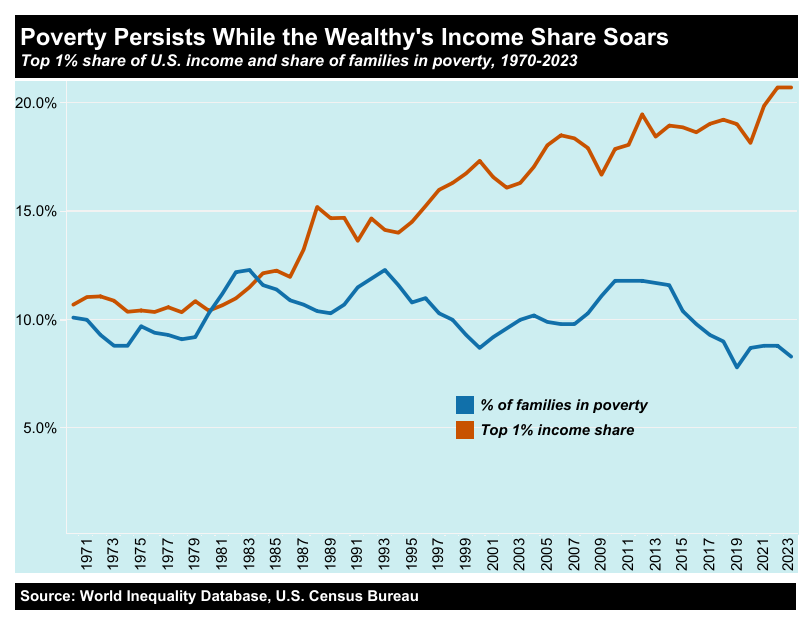
The U.S. poverty rate has declined by merely 1.8 percentage points since 1970. Over those same years, the top 1 percent of American earners have enjoyed a 10 percentage point increase in their share of national income. In the current budget negotiations, House Republicans are considering a variety of changes that would increase poverty, including deep cuts to Medicaid and Child Tax Credit restrictions that would exclude 4.5 million children. For an interactive version of this chart and more on income inequality, click the link to our Inequality.org Facts section below.
|
|
|
PETULANT PLUTOCRAT OF THE WEEK |
For the U.S. Postal Service, a New Privatizing Head Honcho
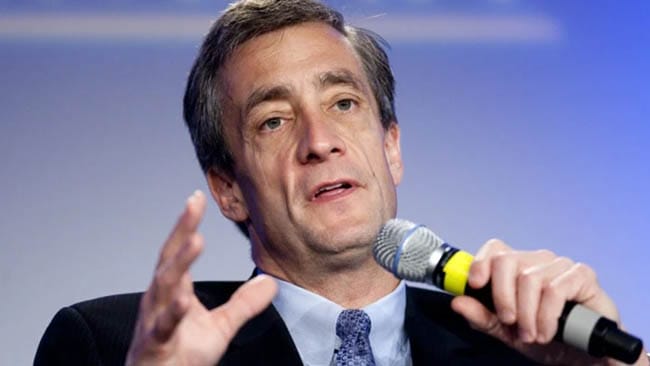
This week’s dour deep pocket: David Steiner, the former CEO of Waste Management and current FedEx board member just named the nation’s latest U.S. postmaster general.
What has Steiner sour: Attacks on his appointment from the unions that represent U.S. Postal Service workers. National Association of Letter Carriers president Brian Renfroe is calling Steiner’s naming “an aggressive step toward handing America’s mail system over to corporate interests.”
“Private shippers,” Renfroe adds, “have been waiting to get USPS out of parcel delivery for years.”
FedEx executive chair Frederick Smith, meanwhile, is publicly lauding Steiner’s “sharp business acumen.”
The last word: Instead of privatizing the U.S. Postal Service, notes American Postal Workers Union president Mark Dimondstein, we need to be expanding it, taking steps as varied as setting up electric vehicle charging stations in USPS parking lots and letting the USPS once again cash checks. Adds the postal worker leader: “This is the people’s postal service, emphasis on ‘service.’ It shouldn’t be sold off or diminished.”
|
|
|
New on Inequality.org
Bob Lord, America’s Most Regressive Tax Levy: Our Tax on Capital Gains. Our nation’s current effective tax rate on capital gains shrinks as the gains grow in size and duration, inviting the tax dodge — Buy–Hold for Decades–Sell — that’s driving America’s wealth concentration.
Sabrina B. Valenti, Spending Cuts Put Low-Income Coastal Residents at Even Greater Risk of Hurricanes. Valenti, one of the many laid-off federal employees who worked to prevent, predict, and repair hurricane damage, fears for those whose lives are threatened by these cuts. Elsewhere on the web
Alex Zielinski, Portland councilor pitches tax hike on companies with huge CEO salaries to address budget shortfalls, Oregon Public Broadcasting. Portland lawmaker Steve Novick is seeking to double the city’s existing “pay ratio surcharge” on firms that pay their CEOs over 250 times median worker pay.
Cassandra Alvarez, How Income Inequality Is Redrawing the Map of American Neighborhoods, NewsBreak. Wealthier families are increasingly clustering in well-funded enclaves with top-tier schools and services, while middle- and lower-income households see their needs go ignored. Robert Reich, Keep demonstrating against Trump — but also for a better future, Substack. In the 2016 election cycle, the first that delivered the White House to Trump, our richest 0.01 percent accounted for 40 percent of all campaign donations. In 1980, those rich accounted for only 15 percent of that cash.
Huck Gutman, Protecting democracy is not enough: five things Americans must fight for, Guardian. Those who fight for the future of our nation need to struggle for the equitable future that raising taxes on our rich would help bring into being. Hans Dembowski, Global oligarchy, shrouded in secrecy, Development and Cooperation. People must be “free” to buy whatever they can pay for, our new global oligarchs are insisting, and governments breach that “freedom” when they pass any regulations that limit rich people’s reach.
Peter Dreier, Whatever Happened to the Power Elite? New Republic. A new look at the legacy of The Power Elite, the 1956 classic by sociologist C. Wright Mills that warned against America’s growing concentration of wealth and power — well before that concentrating hit warp speed in the 1980s.
Steve Wamhoff, Matthew Gardner, and Spandan Marasini, What Corporations Have to Gain from the Gutting of the IRS, Institute on Taxation and Economic Policy. Top CEOs have plenty to gain from hobbling the IRS capacity to probe suspicious corporate tax claims. Bill McKibben, How Is Elon Musk Powering His Supercomputer? New Yorker. Musk’s artificial intelligence corporation — with no oversight, no permitting, and no regard for families living nearby — has built a huge polluting power plant in South Memphis .
Thomas Edsall, Who’s the Greatest Grifter of Them All? New York Times. Donald Trump has discovered that creating a big-time presence in crypto — an industry he decried as “not money” six years ago — can be the ideal route to maximizing the personal profits he can grab from his presidency.
Calen Razor, Not All Billionaires: Democrats Aren’t Against Big Money Donors If They Share Their Values, NOTUS. The Congressional Progressive Caucus chair is calling on the Democratic Party to sever ties with billionaires and “clearly become the pro-worker, anti-billionaire, anti-corruption party.” |
|
|
Our research, editorial, and publishing team depends on hundreds of paid subscribers who make monthly gifts. Some give $3 each month. Others give $200! All told, this support enables our team to stay focused on identifying causes and solutions to our deep economic inequality. Paid subscribers have contributed more than $20,000 in the past year. Ready to become a paid subscriber? Sign up today. |
|
|
Inequality.org | www.inequality.org | inequality@ips-dc.org Institute for Policy Studies
1301 Connecticut Avenue Ste 600
Washington, DC 20036
United States
Managing Editor: Chris Mills Rodrigo
Co-Editors: Sarah Anderson, Chuck Collins, Bella DeVaan, and Sam Pizzigati |
|
|
|