A weekly newsletter from the Institute for Policy Studies |
|
|
Millions of demonstrators took to the streets of America this past weekend to oppose the second Trump administration’s weaponization of White House power. Americans flocked to more than 1,300 rallies all across the country.
But demonstrating resistance in the streets will not be enough, by itself, to bring transformative change. Think back to the Women's March at the beginning of his first term. That protest brought a record-breaking 500,000 to D.C. and yet we've still seen a rollback of women's rights.
History, fortunately, doesn’t have to repeat itself. The “Hands Off” movement can build upon its incredibly solid start by going beyond that “Hands Off” slogan, by providing a positive vision beyond resistance. One useful frame for that vision? Confronting the growing economic chasm that America’s income inequality has created — and working toward a much more egalitarian future for us all. Chris Mills Rodrigo
for the Institute for Policy Studies’ Inequality.org team |
|
|
INEQUALITY BY THE NUMBERS |
|
|
Working Ever So Effectively To Get People to the Streets This week’s frontline face: Leah Greenberg, co-executive director of Indivisible.
What she’s doing to help create a more equal world: Indivisible, one of the main groups organizing the April 5 demos against the Trump administration, has built a grassroots network that’s played a key role in mobilizing opposition to Team Trump in so many different places across the country.
Just a few days after helping to organize Saturday’s protests, the largest demonstration of resistance to Trump so far this year, Greenberg appeared at a rousing Patriotic Millionaires conference in Washington on how to fight back most effectively against America’s oligarchs.
What makes this fight so important to her: “We are in a pretty dark time right now, but the good news that I can share is that people are responding, people are rising up,” Greenberg told the Patriotic Millionaires gathering. “We have seen a steady escalation in the number of people who are looking around and saying 'What can I do? How can I get involved? I'm ready to lead.’”
To watch this week’s full Patriotic Millionaires conference, click the link below. |
|
|
Demystifying Where All Those Donor Dollars Are Ending Up
Donor-advised funds — known as DAFs — have become central players in U.S. charitable giving over the last few decades. Under current federal tax rules, donors can take immediate tax deductions for contributions into DAFs, without any guarantee that these gifts will end up in the hands of actual working charities in anything close to a timely manner.
The Charity Reform Initiative at Inequality.org has released a new report this week that sheds some badly needed light on the otherwise mysterious DAF industry. The report offers some insightful ideas for breaking the donor-dollar bottleneck. Read all about them by clicking below. |
|
|
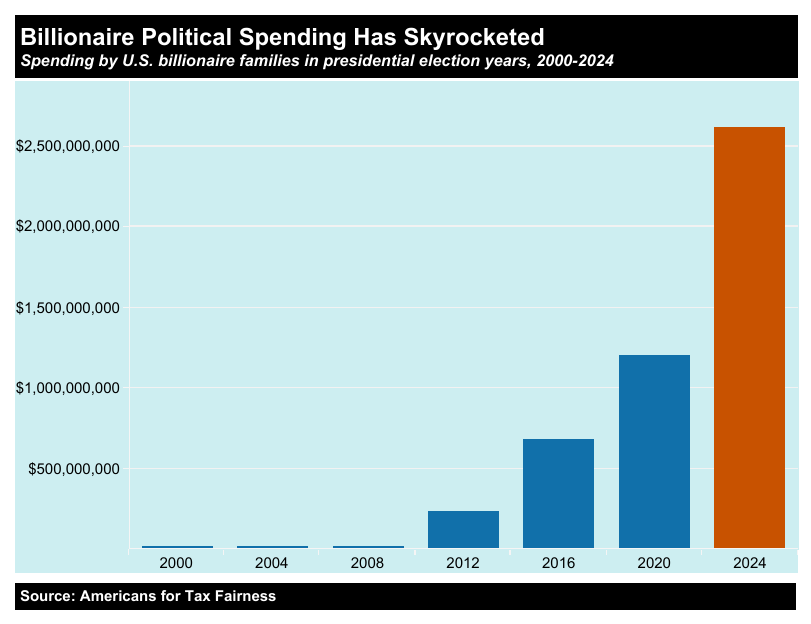
Billionaire political spending has skyrocketed over the past quarter century, an Americans for Tax Fairness analysis shows. In 2024, 100 billionaire families spent a staggering $2.6 billion, 16.5 percent of total political contributions. In 2000, billionaires spent just $18 million to influence the election, just 0.6 percent of total political contributions. For an interactive version of this chart and more on wealth inequality, click the link to our Inequality.org Facts section below.
|
|
|
Are the Trumpistas Seeking To Shrink the IRS — or Sink It? Back in the 1950s, through both of Dwight Eisenhower’s two presidential terms, America’s wealthiest faced a 91 percent tax rate on their individual income over $200,000, the equivalent of about $2.3 million today.
Today’s top-bracket tax rate? Just 37 percent — and precious few rich actually pay taxes at anywhere near that rate. Now, with Donald Trump in the White House, this year’s annual Tax Day will dawn with our super rich — even the oldest among them — paying federal taxes at the lowest actual rates of their lifetimes. Inequality.org co-editor Sam Pizzigati has more. |
PETULANT PLUTOCRAT OF THE WEEK |
In This Trumpian Land of Oz, We See Not a Wizard in Sight
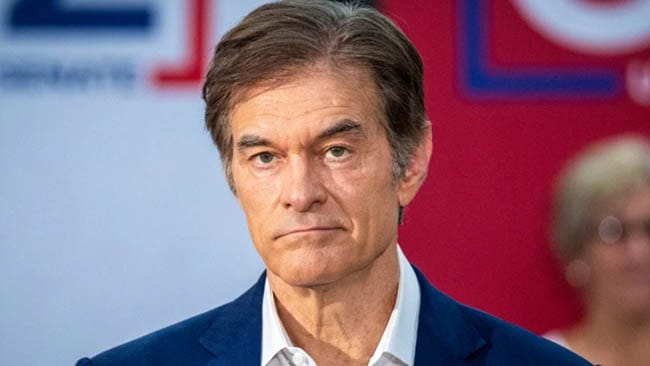
This week’s dour deep pocket: Mehmet Oz, the mega-millionaire celebrity TV doctor that the U.S. Senate has just confirmed, on a straight party-line vote, as the top administrator of the Centers for Medicare and Medicaid Services
What has Oz sour: any suggestion that he, as the new chief of Medicare and Medicaid, will continue to shill for the same private-sector health care interests that have helped make Oz a mega-millionaire. His current personal fortune may total as much as $332 million.
At his Senate Finance Committee confirmation hearing, Oz announced that he would be the “new sheriff” protecting America’s seniors. He even acknowledged problems with Medicare Advantage, the private Medicare option that has generated huge profits for health care giants like UnitedHealth.
“We’re going to make it easy for America to do the right thing when it comes to their health,” Oz assured senators during his confirmation hearing.
But Oz also “dodged questions” over whether he would push back against the deep health care cuts the Trump administration is seeking to finance big tax cuts for America’s rich.
The last word: Oz, notes Georgetown University health analyst Lawrence Gostin, “has his fingerprints” all over America’s health care system. His conflicts of interest with profit-making health corporations have become “so intertwined” with his own personal finances, adds Gostin, that “I don’t know how he disentangles himself from it all.” |
|
|
New on Inequality.org
Denton Cohen, Organized Labor’s Best Defense is a Good Offense. The best way to fight back against the Trump administration and reverse declines in union density: new organizing drives.
Natalia Renta, NYC Comptroller Pursues Lawsuit Against Tesla and Musk for Stock Plunge. Comptroller Brad Lander is aiming to hold Elon Musk and his board accountable while Republican financial officers are blaming protestors. Elsewhere on the web
Matt Stoller, Monopoly Round-Up: The Trump Market Crash? BIG. Roughly half of spending in the United States comes from America’s wealthy. These rich can immediately cut expenditures — and will — when stocks tumble, worsening any economic meltdown in the process. Timothy Noah, Only One Thing Explains Trump’s Tariff Madness, New Republic. Donald Trump believes he’s figured out how to ax the progressive income tax.
Dean Baker, Donald Trump Is Confused: Tariffs and Taxes, Beat the Press. Higher tariffs will cost working people a much higher share of their income than for high income people — because working people tend to spend most of their income while deep pockets save a large portion of theirs.
Jake Johnson, New Projected Cost of Trump-GOP Tax Cuts for the Rich: ‘Staggering’ $7 Trillion, Common Dreams. The latest GOP congressional plan that couples an extension of the 2017 Trump tax cut with new tax breaks benefiting the rich is coming at the same time as tariff hikes that amount to the single largest tax increase on average Americans in the nation’s history.
Amir Barnea, People before profits. How a Spanish co-op provides a possible solution to Trump tariffs, Toronto Star. A visit to Mondragón — a collection of 81 co-operatives operating in Spain’s Basque region — reveals alternatives to the pure capitalist way that offer major social and economic benefits.
Kelly Garino, Fascinating reason super-rich are still buying nine-figure mega mansions in dangerous flood zones, Daily Mail. As one deep pocket explained to a psychiatrist: “Why not? We can take the hit.”
Zachary Tashman and William Rice, Billionaires Buying Elections: They’ve Come to Collect, Americans for Tax Fairness. Billionaire political spending in the United States, this new report details, has soared 160-fold since the Supreme Court’s 2010 decision gave the green light to unlimited campaign donations.
John Feffer, The Growing Inequality Among Countries and the Worsening Climate Crisis, Resilience. The inequality of industrialization has ushered in our current climate crisis. Addressing that inequality will be the only way out.
Irene Wright, Europeans are outliving Americans — even the wealthy, study finds. Why? Miami Herald. People with more wealth tend to live longer than those with less wealth, especially in the United States, where the gap between the rich and poor runs much wider than in Europe. |
|
|
Our research, editorial, and publishing team depends on hundreds of paid subscribers who make monthly gifts. Some give $3 each month; others give $200! All told, this support enables our team to stay focused on identifying causes and solutions to our deep economic inequality. Paid subscribers have contributed more than $20,000 in the past year. Ready to become a paid subscriber? Sign up today. |
|
|
Inequality.org | www.inequality.org | inequality@ips-dc.org Institute for Policy Studies
1301 Connecticut Avenue Ste 600
Washington, DC 20036
United States
Managing Editor: Chris Mills Rodrigo
Co-Editors: Sarah Anderson, Chuck Collins, Bella DeVaan, and Sam Pizzigati |
|
|
|