A weekly newsletter from the Institute for Policy Studies |
|
|
Amid the ongoing onslaught from our billionaire class, a rare piece of good news has just broken through. In a closely watched Wisconsin Supreme Court race, the candidate actively backed by Donald Trump — and well over $20 million in campaign spending from Elon Musk — has lost! And the race didn’t even end up close. As of this morning, the winner Susan Crawford was leading by almost double digits, buoyed by record-breaking turnout. What can we take from this result? Trump carried Wisconsin last November. Many of the voters who believed in his promises to make America more affordable for working people are clearly starting to have second thoughts. And many folks in Wisconsin also clearly don’t like watching the world’s richest billionaire handing out million-dollar checks to buy their votes.
All those millions Musk spent on this race couldn’t defeat the will of the people. Sometimes all $20 million will buy you is just a cheesehead. Chris Mills Rodrigo
for the Institute for Policy Studies’ Inequality.org team |
|
|
INEQUALITY BY THE NUMBERS |
|
|
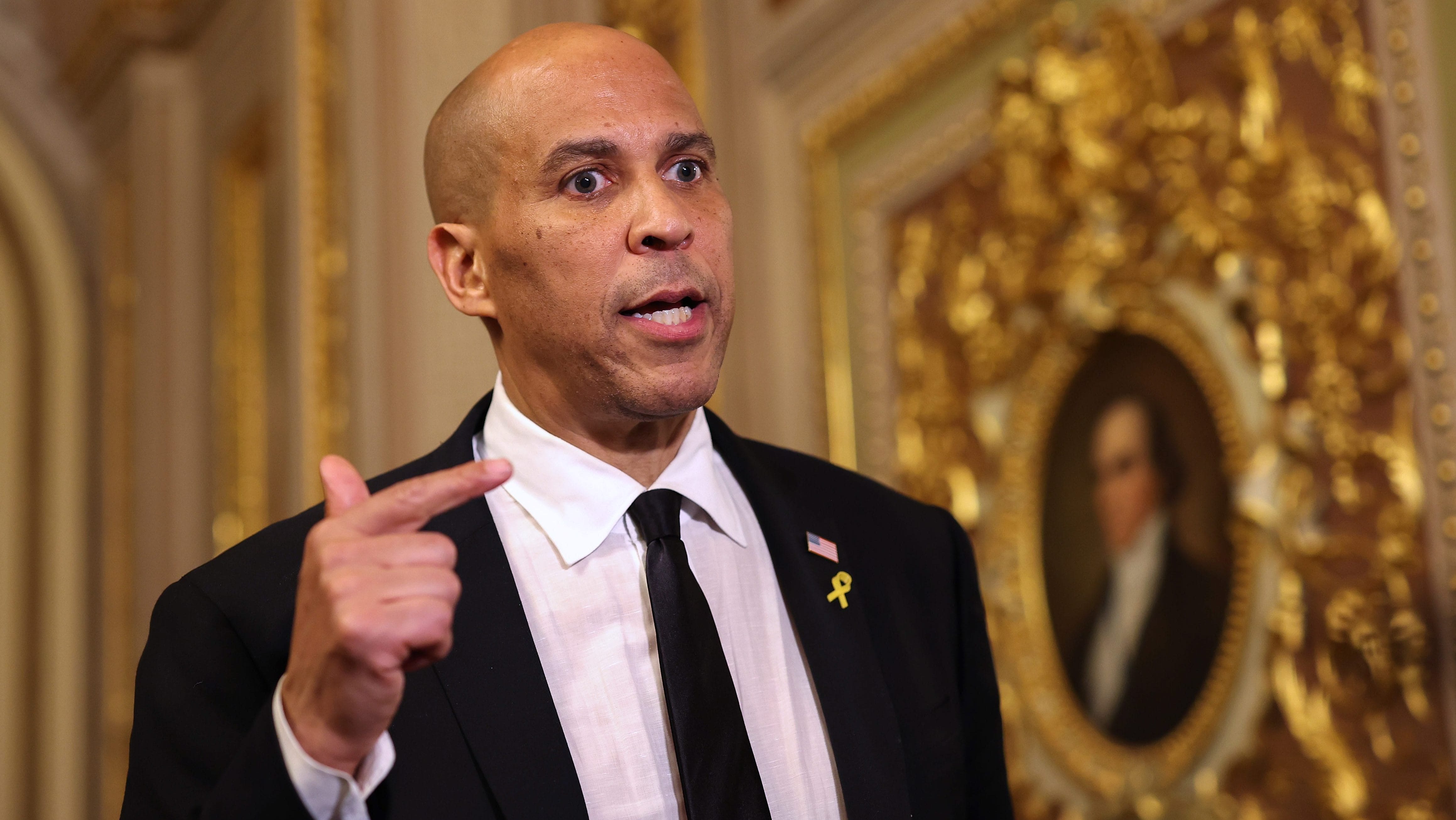
An Extremely Long Break from U.S. Senate Business as Usual This week’s frontline face: Cory Booker, a Democratic Party U.S. senator from New Jersey since 2013.
What he's doing to help create a more equal world: Booker has just broken the record for the longest Senate speech ever delivered. He stood and spoke for 25 hours, without breaks, effectively gumming up the Senate’s normal legislative business in the process.
The New Jersey senator called out Republican plans to extend the 2017 tax cuts, defended programs like Medicaid and Social Security, and underscored the impact of rising healthcare costs and stagnant wages on inequality.
Booker’s speaking marathon, by itself, isn’t going to radically alter any specific policy outcome. But his filibustering does signal a break from the tepid, accommodating posture that the Democratic congressional leadership has mostly taken during the early months of the second Trump administration.
What makes this fight so important to him: “It is wrong to take away health care for millions of Americans,” Booker noted at one point during his record-breaking-speech, “just to pay for tax cuts for the rich.” |
|
|
Trump’s ‘Liberation Day’ Tariffs Will Concentrate Wealth Even More
A raft of new tariffs on foreign imports will be going into effect today, April 2, on what Donald Trump is calling “Liberation Day.” Trump is touting his new trade measures as a way to boost domestic manufacturing and fill up America’s revenue coffers. But the immediate material result from this new wave of import taxes, economists agree, will be higher costs for consumers.
The new Trump tariffs, Institute for Policy Studies analyst Omar Ocampo explains in a new piece for Inequality.org, will leave U.S. corporate execs richer while doing nothing to improve goods and services for average Americans. Trump’s trade war, notes Ocampo, amounts to “a class war designed not to revitalize American manufacturing, but to weaken progressive taxation.” |
|
|
The undocumented immigrants President Trump has vowed to deport make up just under 5 percent of the U.S. workforce. These undocumented workers make enormous contributions to our economy, but generally earn rock-bottom wages. U.S. agricultural workers — many undocumented — earn only $37,370 annually. The all-occupation U.S. earnings average: $65,470. For more on income inequality, click the link to our Inequality.org Facts section below. |
|
|
Can the Richest Among Us Dodge the Climate-Change Bullet? So where do you see yourself living the rest of your life? America’s richest are keeping their options all open.
On the one hand, our deepest pockets are buying up new super-luxury abodes as if the gravy trains that their lives have become will never stop running. On the other hand, our richest are running scared. Or, to be more accurate, our rich are descending scared — into fabulously luxurious underground bunkers.
Should these behaviors leave the rest of us optimistic about what the future may bring? Or pessimistic? Our wealthiest need not choose one or the other. They can easily afford to cover all the bases, and, these days, they’re doing just that. Inequality.org co-editor Sam Pizzigati has more. |
PETULANT PLUTOCRAT OF THE WEEK |
A Trump Pick to Head Social Security Has Eyebrows Rising
This week’s dour deep pocket: Wall Street insider Frank Bisignano, Donald Trump’s choice to lead the Social Security Administration.
What has Bisignano sour: any suggestion from critics of his nomination that Bisignano, currently the CEO at the payment processing giant Fiserv, would in any way “touch” the legitimate benefits that go to America’s seniors.
But Bisignano, in an interview with CNBC, had earlier called himself “fundamentally a DOGE person,” and the moving force behind DOGE remains Elon Musk, who last month infamously labeled Social Security as “the biggest Ponzi scheme of all time.” Bisignano first grabbed national attention back in 2018 when the Equilar annual list of America’s 200 highest-paid CEOs had him ranked second. He pocketed $102.2 million that year, over 2,000 times the year’s pay of his company’s most typical employees.
The last word: At his Senate confirmation hearing last week, Senator Catherine Cortez Masto from Nevada asked Bisignano to respond with a yes or no on whether he supported Musk’s charge that Social Security now rates as a Ponzi scam. Bisignano sidestepped the question. |
|
|
New on Inequality.org
Bob Lord, The Harsh Unfairness of ‘Buy-Hold for Decades-Sell.' How this ongoing tax avoidance strategy is making an oligarchic concentration of America’s wealth ever more inevitable.
Chuck Collins, 2025 Is Shaping up to Be a Banner Year for Global Oligarchs. Over 3,000 global billionaires now control $16.1 trillion.
Helen Flannery, DAFs Are America’s Top Charities. Almost two-thirds of the money donated to America’s top 20 charities is going to donor-advised funds.
Manuel Pérez-Rocha, Trump’s April 2 Deadline for New Tariffs Is a Distraction from Deeper North American Trade Challenges. Negotiations between the United States, Mexico, and Canada should address all the flaws in the current trade pact that have contributed to rising inequality.
Juan Montecino, Mary Hansen, Aina Puig, and Ignacio González, Raising Capital Gains Taxes Would Reduce Inequality Without Economic Costs. Contrary to conventional wisdom, increasing capital gains tax rates could modestly improve economic growth by reducing national debt and making investment cheaper. Elsewhere on the web
Stephen Lerner, For Labor, Caution Is Fatal, In These Times. Elon Musk and the new tech oligarchy are creating a techno-fascist future where wealth and power sit concentrated in the hands of the elites at working people’s expense.
William Gale, Oliver Hall, and John Sabelhaus, Follow the money: Tax inheritances, not estates, Brookings. Converting the current federal estate tax into an inheritance tax would both raise considerable revenue and increase the progressivity of America’s tax system.
Algernon Austin, The Trump Administration: Government by Billionaires, for Billionaires, Center for Economic and Policy Research. A look at how Trump II is enriching America’s super rich. Alice Toomer-McAlpine, Co-operative approaches to pay, Coop News. At thriving co-ops like Mondragon in Spain, no one on staff is making more than six times any other staffer.
Samantha Jacoby, Congress Should End Pass-Through Tax Break for Millionaire Business Owners, Extend Tax Credit That Helps Small Business Owners Buy Health Coverage, Center on Budget and Policy Priorities. GOP leaders are seeking to extend a 2017 Trump tax cut provision that primarily benefits 200,000 millionaire owners of profitable privately held companies.
Taylor Telford, The average Wall Street bonus is now 4 times a U.S. worker’s salary, The Washington Post. Last year’s financial industry bonus pool ended up at $47.5 billion. Karlyn Bowman, The Polls And Politics Of Inequality, Forbes. Since 1966, the Harris Poll has asked Americans if they feel the rich are getting richer and the poor poorer. For decades now, agreement has run in the 60 to 70 percent range.
Branko Milanovic, What Comes After Globalization? Jacobin. Donald Trump is doubling down on neoliberalism’s domestic precepts, on everything from cutting taxes on the rich and deregulating the companies they run to exploiting natural resources and privatizing public services.
Matt Stoller, How the American Medical Association Screws Doctors, BIG. The AMA has turned itself from a voice of doctors into a Silicon Valley tech incubator financed with money extracted from America’s doctors.
Emily Witt, The Six-Figure Nannies and Housekeepers of Palm Beach, The New Yorker. Drawn by Florida’s low tax rates, conservative politics, and balmy weather, over 100 top financial firms have opened offices in Palm Beach since 2020, creating what deep pockets are calling “Wall Street South.”
|
|
|
Our research, editorial, and publishing team depends on hundreds of paid subscribers who make monthly gifts. Some give $3 each month; others give $200! All told, this support enables our team to stay focused on identifying causes and solutions to our deep economic inequality. Paid subscribers have contributed more than $20,000 in the past year. Ready to become a paid subscriber? Sign up today. |
|
|
Inequality.org | www.inequality.org | inequality@ips-dc.org Institute for Policy Studies
1301 Connecticut Avenue Ste 600
Washington, DC 20036
United States
Managing Editor: Chris Mills Rodrigo
Co-Editors: Sarah Anderson, Chuck Collins, Bella DeVaan, and Sam Pizzigati |
|
|
|