A weekly newsletter from the Institute for Policy Studies |
|
|
Back in February, my Institute for Policy Studies colleague Sarah Anderson and I met with Senator Bernie Sanders to strategize about his upcoming “stop oligarchy” tour. Bernie had been hesitant about hitting the road. Now 83, he had been hoping another opposition leader would step forward. None did, and, two weeks ago, the tour began.
The first stop: Iowa City. Since then, 4,000 have gathered with Bernie in Kenosha, Wisconsin and 2,600 more in Altoona, Wisconsin, both swing districts that Republicans represent in Congress. On Saturday, my niece Jenny attended the senator’s rally along with 9,000 of her neighbors in Warren, Michigan.
“It rocked my world,” Jenny told me. “Who else is standing up to Trump so effectively and speaking to the fear and anger of the people who voted for him?” UAW president Shawn Fain introduced Sanders in Warren. More Democrats, Fain noted, needed to follow Bernie’s lead, and Bernie promptly did plenty of leading.
“The people of this country will not allow us to move toward an oligarchy,” Sanders told the overflow crowd. “They will not allow Trump to take us into authoritarianism. We’re prepared to fight. And we’re going to win.”
Here at Inequality.org, we‘ll continue to keep a close eye on the Stop Oligarchy movement – and the disruptive impact of billionaires on our everyday lives. This week is looming particularly large, with the House opening its tax-writing work. For more, check out this terrific More Perfect Union video featuring Inequality.org contributor Bob Lord and me talking about “The Biggest Tax Dodge in History.”
Next Tuesday, March 18, I'll be speaking at The New School in New York on “Inequality by Design” with filmmaker Justin Schein, director of Death and Taxes, and former Ohio senator Nina Turner. For registration info, check here. Thanks!
Chuck Collins
for the Institute for Policy Studies’ Inequality.org team |
|
|
INEQUALITY BY THE NUMBERS |
|
|
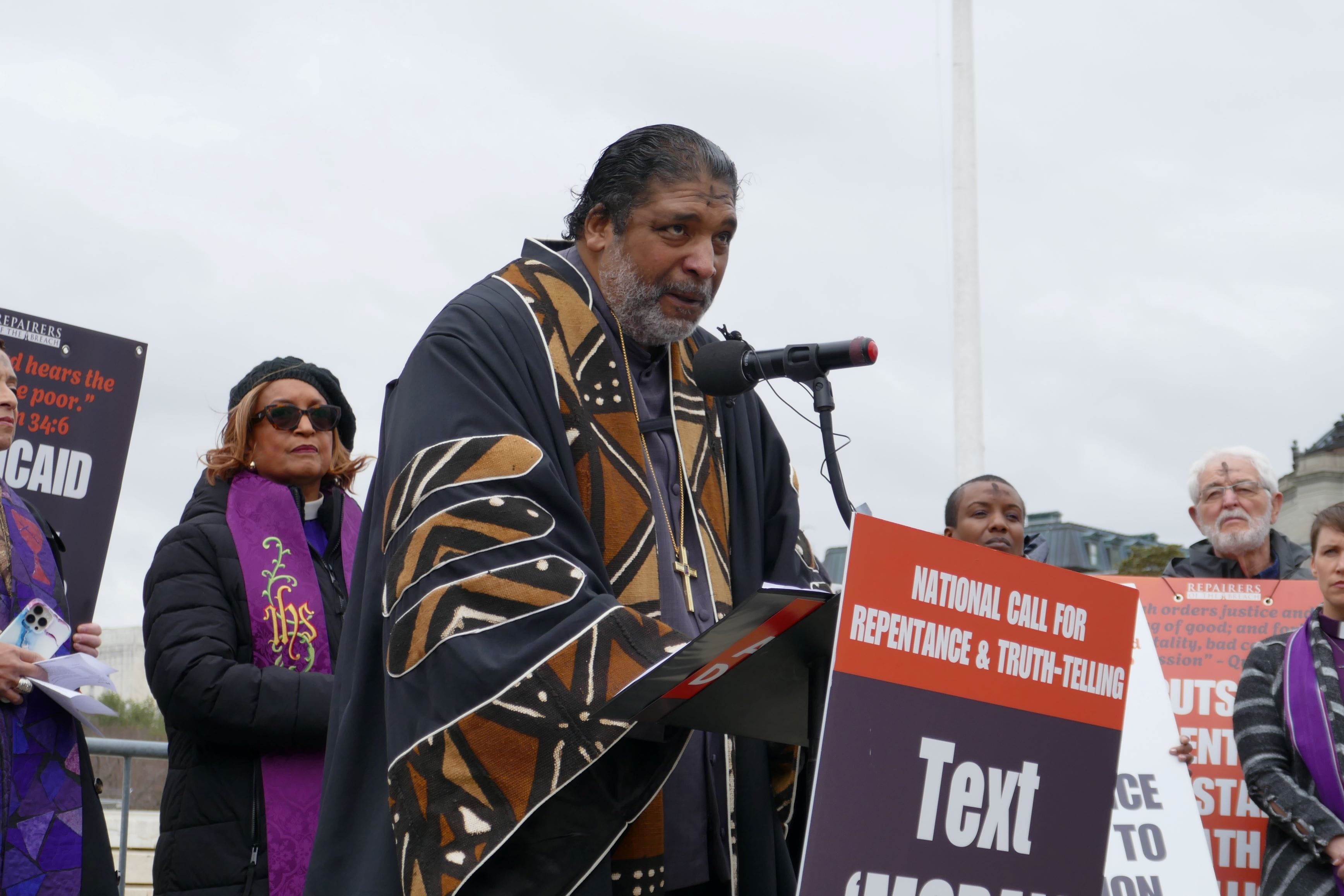
Mobilizing Faith Leaders Against Immoral Federal Budget Proposals This week’s frontline face: Bishop William J. Barber II, founder of the faith-based advocacy group Repairers of the Breach and national co-chair of the Poor People’s Campaign.
What he’s doing to help create a more equal world: Barber recently mobilized several hundred faith leaders at the U.S. Capitol to denounce the Trump-Republican agenda of slashing programs for the poor and spreading the green instead on huge giveaways for the rich and the war machine.
What makes this fight so important: In Barber’s view, the GOP federal budget proposals have become “the most dangerous thing going on in this country right now.” To spotlight that danger, Repairers of the Breach, the Institute for Policy Studies, and the Economic Policy Institute have released a new report on the impact of these budget proposals on everything from Medicaid to food stamps.
“If political leaders,” Barber warned his fellow clergy, “are willing to forsake their constitutional oath to establish justice, ensure domestic tranquility, provide for the common defense, and promote the general welfare in order to appease billionaires — and we don’t say anything — we will reject our ancient faith and the moral foundations of our common lives.” |
|
|
President Trump is now promoting $5-million “gold card” tickets to U.S. citizenship for wealthy foreigners. Many immigrants, meanwhile, continue to face a deadly daily reality. In 2023, nearly six out of every 100,000 foreign-born Latino workers in the United States suffered a fatal workplace injury.
Among all U.S. workers, that death rate stood significantly lower, at just over three out of 100,000 workers. Why the contrast? Immigrants — particularly those undocumented — often take on the most dangerous jobs. The undocumented, for instance, make up 23 percent of construction laborers. For an interactive version of this chart and more on health and inequality, click the link below. |
|
|
Paris and Washington, D.C.: An Inequality Tale of Two Capital Cities Nine of the world’s ten wealthiest billionaires now call the United States home. The remaining one? He lives in France. And that one — the driving force behind our largest global maker of luxury goods — is now feeling some heat.
What has French deep pockets beginning to sweat? Lawmakers in France’s National Assembly have just given a green light to the world’s first significant tax on billionaire wealth. What makes this legislation even more significant? That tax-the-rich move has come at a time when the world’s most powerful nation — the United States — is moving in the exact opposite direction. Inequality.org co-editor Sam Pizzigati has more. |
PETULANT PLUTOCRAT OF THE WEEK |
A New Message from Wall Street: A Pinch for Thee, Not for Me
This week’s dour deep pocket: The billionaire hedge fund manager Scott Bessent, Donald Trump’s current secretary of the treasury.
What has Bessent sour: any hint from the press that America’s sinking economy represents anything more than — in Trump’s words — “a little bit of disturbance.” The nation, Bessent emphasized in a CNBC interview Friday, is just going through “a much-needed course adjustment,” a “detox period.”
That “detox” includes plenty of feel-good stimulants for America’s rich — including “mass” cutbacks in IRS audits on high-income taxpayers — and a painful “pinch” on average consumers. These average Americans are starting to realize, relates KPMG chief economist Diane Swonk, that “wage growth has slowed, people are working fewer hours, and prices are still elevated.”
Average families shouldn’t be expecting much in the way of relief from Bessent. “Access to cheap goods,” Trump’s treasury chief told the Economic Club of New York earlier this month, “is not the essence of the American Dream.”
The last word: Scott Bessent “is using all the budget high jinks at his disposal,” observes Washington Post economic commentator Catherine Rampell, “to produce a pseudoscientific plan that’s rosier, more magical, and more paper-thin than the past several decades of GOP budget fantasies.” |
|
|
New on Inequality.org
Helen Flannery, DAFs Gave $17 Billion… to Other DAFs. Billions of charitable dollars took the scenic route from 2020 to 2023.
Nancy Altman, The Greatest Threat to Social Security in Its 90-Year History. Donald Trump and Elon Musk are planning to utterly demolish Social Security’s workforce to pay for billionaire tax cuts.
Elsewhere on the web
Janet Nguyen, How do researchers measure income inequality? Marketplace. A round-up of expert analysts — including Inequality.org’s Chuck Collins — run down our many options.
Robert Reich, The biggest Ponzi scheme in history, Substack. Trump’s “$Trump” cryptocurrency soared and then crashed, just like every other crypto scheme, generating enormous profits for insiders like Trump and $2 billion in losses for over 800,000 average investors.
Max Lawson, The sanctity of selfishness, Equals. The governments and leaders we have today, notes Oxfam’s inequality policy coordinator, represent the logical next step in a world that has sanctified selfishness and beatified bullying.
Matt Bruenig and Kamau Chege, Creating an Alaska-Style Permanent Fund in Washington State, People’s Policy Project. Alaska shows that states can tackle wealth inequality if they really want to.
Mihir Desai, Musk’s Tweet-Fueled Bubble May Be About to Burst, New York Times. Musk owes his fortune to a financial cult. Legions of dazzled investor-followers have shielded him from critics who question his corporate governance, his obscene pay packages, and now his migration into politics.
Carter Price, Measuring the Income Gap from 1975 to 2023: Extending Previous Work, Rand. After World War II, worker incomes grew at the same pace as the broader economy. Then, in the late 1970s, earnings began flowing disproportionately to high-income households. Where would we be now if worker earnings had kept pace? A look at the eye-opening stats.
Amy Hanauer, Trump’s Address to Congress Obscures His Actual Tax Agenda, Institute on Taxation and Economic Policy. One clear goal guides Trump and the billionaires who support him: gaining enormous tax cuts that enrich those who least need federal help.
Les Leopold, Mass Layoffs: The Breakfast of Billionaires, Wall Street’s War on Workers. The power of billionaires is rising. In 1990, 66 billionaires lived in the United States. In 2023: 748. And U.S. billionaire wealth in 2024 increased by $1.4 trillion, $3.9 billion a day. How did all that happen?
Greg Godels, Why Class Matters, Dissident Voice. The top 10 percent of U.S. “earners” — those now reporting at least $250,000 in income — are currently making 49.7 percent of our nation’s consumer purchases, this segment’s largest share since the Federal Reserve began tracking these numbers in 1989.
Peter Bloom, Capitalism’s Free Speech Trap: Bezos Shows How Billionaires Set the Boundaries of Debate, Common Dreams. The Washington Post’s recently announced shift toward upfront free-market advocacy reinforces the dominant ideological framework that benefits our billionaire class. |
|
|
ON BILLIONAIRES AND THE REST OF US |
This newsletter and the whole Inequality.org project are powered by donations. We’re not raking in cash from the billionaire class, though. We’re counting on people to see why this reporting, research, and advocacy matters, and then to become paid subscribers, by making a recurring monthly donation of any amount. Make a monthly gift as a paid subscriber. Start your paid subscription today. |
|
|
Inequality.org | www.inequality.org | inequality@ips-dc.org Institute for Policy Studies
1301 Connecticut Avenue Ste 600
Washington, DC 20036
United States
Managing Editor: Chris Mills Rodrigo
Co-Editors: Sarah Anderson, Chuck Collins, Bella DeVaan, and Sam Pizzigati |
|
|
|