A weekly newsletter from the Institute for Policy Studies |
|
|
With 2024 drawing to a close, our Inequality.org team has been reflecting on the year’s strides toward a more just society. Amid the year’s severe setbacks, highlighting wins — and, even more importantly, investigating what made those wins possible — is more important than ever. But just talking among ourselves doesn't cut it! We want to hear from you, our readers, about your successes in 2024.
Your successes this past year may have been purely local or incremental. Doesn’t matter! We can all learn from your steps to a more equal world, be they city council resolutions or victories at a union bargaining table. Please share your stories by replying directly to this email!
In next week’s Inequality.org issue, this year’s last, we'll be adding your victories to our own list of the top inequality advances of 2024. Hopefully it'll be a reminder of the progress that is being made in the face of an unfriendly political landscape. Chris Mills Rodrigo
for the Institute for Policy Studies’ Inequality.org team |
|
|
INEQUALITY BY THE NUMBERS |
Since last week’s Inequality.org edition, six billionaires have joined Donald Trump’s incoming new administration. Newcomers this week include the private equity CEO kingpin Stephen Feinberg at the Pentagon and present still more evidence that the ultra-rich have undue influence on American politics — and that Trump’s “populism” remains just pure posturing. |
|
|
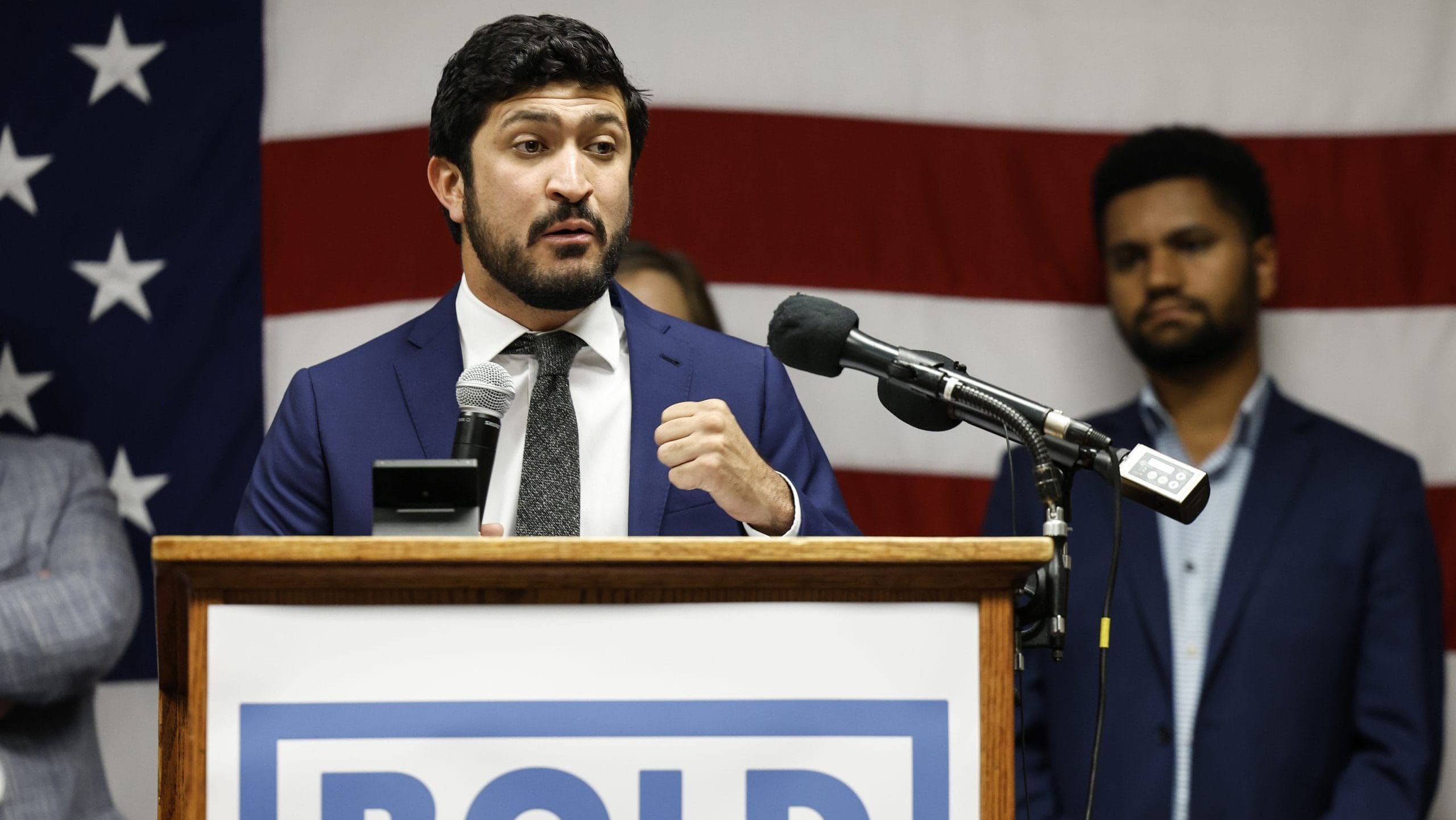
New Leadership for Progressives In Congress This week’s frontline face: Greg Casar, the new chair of the Congressional Progressive Caucus.
What he's doing to help create a more equal world: Casar, a congressman from Texas, is stepping into big shoes. He’s replacing the term-limited Rep. Pramila Jayapal from Washington State. As the new head of an over 100-member-strong caucus, Casar will play an important role in fighting back against Trump and rebuilding the Democratic party around working-class issues.
Before his 2022 election to Congress, Casar spent years organizing around worker, immigrant, and housing rights issues. Our own Inequality.org co-editor Chuck Collins crossed paths with Casar while organizing mobile home residents in Austin, Texas.
What makes equality so important to him: “The members of the Progressive Caucus know how to fight billionaires, grifters, and Republican frauds in Congress," Casar noted in a statement after becoming the new Progressive Caucus chair. “Our caucus will make sure the Democratic Party stands up to corporate interests for working people.” |
|
|
Time for Labor to Go On the Offensive
While Trump's election is not welcome news for the labor movement — expect legal protections to be rolled back and for the National Labor Relations Board to be far less pro-worker — it's certainly not a death sentence either. Unions are still well-positioned to keep notching wins, argue labor researchers Chris Bohner and Eric Blanc.
With low unemployment likely to continue, Bohner and Blanc point out, workers will have continuing leverage over their employers to negotiate for improved conditions. The labor movement also retains the financial capacity to defend workers and organize new ones. And unions remain trusted across the political spectrum. For more on why labor can fight back and win, check the link below. |
|
|
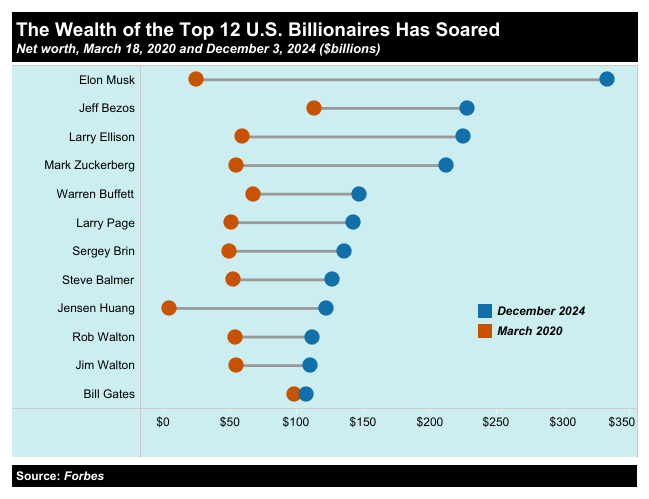
The collective net worth of America’s top 12 billionaires surpassed $2 trillion this month. The combined wealth of the oligarchic dozen has now grown an astounding 193 percent over the last five years, a period that has coincided with increasing billionaire influence over our media and political system. For an interactive version of this chart and more on wealth inequality, click the link below. |
|
|
A Murder on the Streets Now Has Plenty of Fear Rising in the Suites After last week’s murder of UnitedHealthcare CEO Brian Thompson, America’s health care powers-that-be are feeling and fearing the American public’s anger now more than ever. Health care’s corporate giants, Reuters reports, have already begun enhancing the security they provide their top execs.
The challenge for the rest of us? We need to help channel the anger about health care that so many Americans feel today toward ending the system that has so failed America’s health. We need to remake health care into a vital and vibrant public service.
Our health care system, in the end, shouldn’t be making our rich richer. Our richest instead should be paying enough in taxes to help all Americans stay healthy. Inequality.org co-editor Sam Pizzigati has more. |
PETULANT PLUTOCRAT OF THE WEEK |
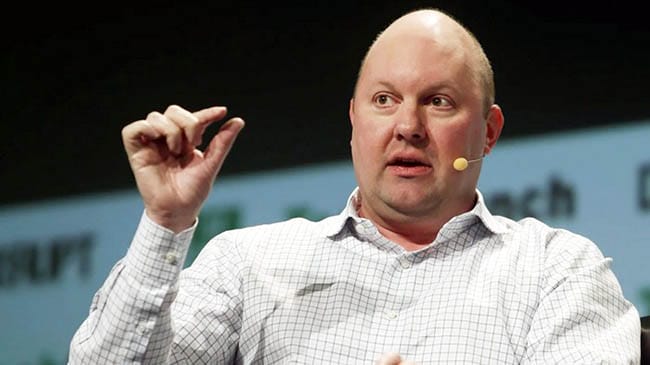
A Billionaire Busy Laying the Groundwork for Plutocracy
This week’s dour deep pocket: Marc Andreessen, the Silicon Valley venture capital exec now playing a key behind-the-scenes role interviewing candidates for top positions in the second Trump administration.
What has Andreessen sour: any federal regulations on cryptocurrency speculators and the anti-monopoly advocacy of Lina Kahn, the current chair of the Federal Trade Commission. Andreessen, reports the New York Times, has likely been the Elon Musk ally “most involved in the transition” at the current Trump team headquarters in Florida’s West Palm Beach.
The last word: Billionaires like Andreessen, notes MSNBC’s Ryan Teague Beckwith, have been blasting a Washington teeming with “unelected” agency chiefs like the FTC’s Kahn.
But Congress created agencies like the FTC to regulate powerful corporations, and lawmakers, adds Beckwith, gave these agencies independence “to avoid the temptation to meddle with their work.” Andreessen and his billionaire pals “don’t really mind” this independence “as long as they’re the ones in charge.” |
|
|
What's new on Inequality.org
Omar Ocampo, Twelve U.S. Billionaires Now Have a Combined $2 Trillion. Nvidia's Jensen Huang joins the oligarchic dozen, a group that has more influence over our media and politics than ever.
Jon Golinger, Shareholders Unite! Opportunities Ahead in 2025 to Increase Corporate Lobbying Transparency and Accountability. The success of shareholder proposals promoting lobbying transparency offers an encouraging avenue for positive change.
Connie Choi, We Need a Care System That Treats Patients With Dignity. A daughter’s experience trying to get her father adequate care shows just how broken our health system has become. Elsewhere on the web
Sara Wexler and Rob Larson, Economic Inequality Is Even Worse Than You Think, Jacobin. An eye-opening discussion of Larson's new book on lavish wealth concentration.
Raphael Hernandes, Lauren Aratani, and Will Craft, Revealed: the tech bosses who poured $394.1m into US election — and how they compared to Elon Musk, Guardian. The bulk of high-tech donations to the Trump campaign came from Musk’s $243 million in contributions.
Alexandra Rojas, Democrats Will Keep Losing Until They Cut Ties With Billionaires, Zeteo. Instead of campaigning against billionaires who make mega-millions while everyday people struggle, Democrats employed billionaires like Mark Cuban as a surrogate to satisfy Wall Street and Big Tech.
Maureen Tkacik, Manhattan Medicare Murder Mystery, American Prospect. Only about 50 million customers of America’s reigning medical monopoly might have had a motive to exact revenge upon the UnitedHealthcare CEO. Ricardo Reyes, Trump’s Deportation Plans Benefit Billionaires at the Cost of Our Communities, Common Dreams. The real threat Americans face: the billionaires and politicians who use anti-immigrant hate to grow their wealth and power.
Cat Zakrzewski, Trump has assembled an uber-wealthy Cabinet, raising risks of ethics conflicts, Washington Post. Trump’s picks for his first cabinet had a combined net worth of $6.2 billion. His 2025 Cabinet picks appear sure to far surpass that total. The net worth of a typical American family: $192,900.
Theodore Schleifer, Maggie Haberman, and Jonathan Swan, The Silicon Valley Billionaires Steering Trump’s Transition, New York Times. The involvement of wealthy investors has made this presidential transition one of the most potentially conflict-ridden in modern history.
Rick Edmonds, Soon-Shiong and Bezos provide fresh evidence for the downsides of billionaire news ownership, Poynter. The billionaire Los Angeles Times owner now wants the paper’s editors to clear all headlines on opinion pieces with him.
J. A. Aunión, The professionals working for the super-rich, El País. Move over private tutors and chefs. The latest addition to the professions that specialize in serving the world’s wealthiest: interior designers for home-invasion “panic rooms” and disaster bunkers.
Jane Denton, Why the super-wealthy in Britain are getting richer slower than their US counterparts, This Is Money. The top 1 percent share of UK household wealth has inched up from 20 to 21 percent since 1980. America’s top 1 percent share has jumped over the same period from 23 to 35 percent. Take a reading break
EQUALS, Flowers or Bars on the Windows? An insightful episode from the inequality focused podcast on how more equal societies are safer and happier.
Background Briefing, The Champion of Working Class Voters' Big Con. Journalist Ian Masters had our own Sarah Anderson on his show discussing the composition of Trump's new administration. |
|
|
Our research, editorial, and publishing team depends on hundreds of paid subscribers who make monthly gifts. Some give $3 each month; others give $200! All told, this support enables our team to stay focused on identifying causes and solutions to our deep economic inequality. Paid subscribers have contributed more than $20,000 in the past year. Ready to become a paid subscriber? Sign up today. |
|
|
Inequality.org | www.inequality.org | inequality@ips-dc.org Institute for Policy Studies
1301 Connecticut Avenue Ste 600
Washington, DC 20036
United States
Managing Editor: Chris Mills Rodrigo
Co-Editors: Sarah Anderson, Chuck Collins, Bella DeVaan, and Sam Pizzigati |
|
|
|