A weekly newsletter from the Institute for Policy Studies |
|
|
Candidates at all levels this election season are finally talking about the severe housing crisis that’s impacting Americans the nation over. But these candidates are not talking nearly enough about a driving force that’s depriving millions of us of the right to stable living situations. That force: billionaire investors.
We’re simply not going to break the grip on housing billionaires now hold until we begin taxing luxury mansion sales and using the funds that step raises to expand the social housing sector. My Institute for Policy Studies colleague Omar Ocampo and I, together with our fellow activist Amee Chee at Popular Democracy, make that point in our just-released new report, Billionaire Blowback on Housing.
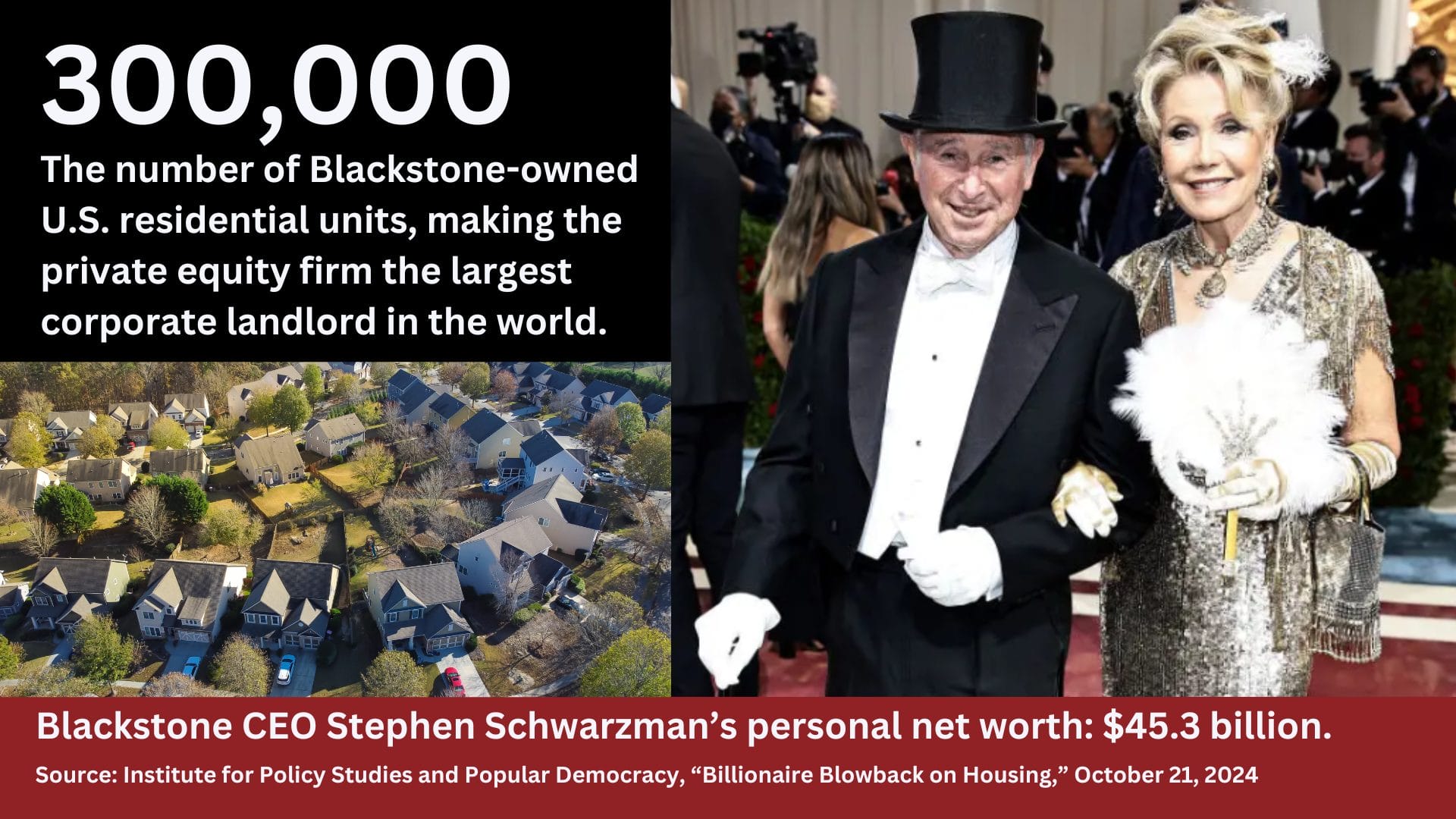
Bringing together some 50 grassroots organizations, Popular Democracy is working at the frontlines of bringing transformational change to Black, brown, and low-income communities. In our joint report, we detail how billionaires have been disrupting local housing markets by acquiring huge swaths of housing.
These billionaires are using their new massive housing presence to drive up the cost of land and shelter by any means necessary, doing everything from expanding short-term rentals and supercharging gentrification to holding properties vacant and engaging in assorted other predatory practices. We have more on this crisis — and how to end it — in this week’s issue. Chuck Collins
for the Institute for Policy Studies’ Inequality.org team |
|
|
INEQUALITY BY THE NUMBERS |
|
|
Standing Up to Politicians Who Slash Food Aid While Enriching the Rich
This week’s frontline face: Brazil Jefferson, a resident of Victorville, California. Jefferson has managed to overcome struggles with poverty and serious mental illness and earn a college degree. But Jefferson now fears that if she uses that degree to get a better job, she might earn slightly too much to qualify for basic assistance — and wind up living poorer than she was living before.
What she’s doing to help create a more equal world: Jefferson is volunteering with the RESULTS anti-poverty group and speaking out against politicians like House of Representatives Agriculture Committee chair Glenn Thompson, the Pennsylvania Republican who’s proposing new restrictions that would cut $30 billion from the federal SNAP food aid program.
Rep. Thompson, at the same time, is calling on Congress to make the Trump tax cuts for America’s wealthy permanent. What makes equality so important to her: “When I hear plans to defund assistance programs even more, I feel hopeless,” Jefferson notes. “I wish these lawmakers understood how hard people like me work to do the right thing, to get ahead, to give back — and how many obstacles their decisions put in our way.” |
|
|
We Need a Housing Solution Equal to the Mammoth Crisis We Now Face
Billionaire Blowback on Housing, the new joint report from the Institute for Policy Studies and Popular Democracy, examines the multiple ways that billionaire investors are disrupting local housing markets. Expanding housing supply by giving incentives to for-profit developers, the report shows, has utterly failed to add to the stock of permanently affordable housing.
What could significantly expand the availability of affordable housing in the United Sttes? Billionaire Blowback on Housing describes a broad menu of policies that could grow our nation’s stock of community-controlled or publicly owned housing outside the speculative market. This housing can take many forms, from community land trusts to resident cooperatives.
And the nation can certainly afford to invest in this new housing. The new funding we need could and should come from taxing billionaires, levying mansion taxes, and regulating harmful practices. |
|
|
Over the past four decades, the richest 1 percent of Americans have enjoyed by far the nation’s fastest income growth, with the most rapid increase coming at the tippy top of our economic ladder. Between 1979 and 2021, the average income of America’s richest 0.01 percent of households, a group of just over 12,000 households, grew 27 times faster than average bottom 20 percent incomes.
For an interactive version of this chart and more on income inequality, click the link to our Inequality.org Facts section below. |
|
|
How Did Elon Musk Become the Richest Person on Earth? The quick answer: The quarter-trillionaire has had plenty of help — from U.S. taxpayers. Musk just happens to be, notes one just-published analysis, “the single biggest beneficiary of U.S. government contracts.” Our tax dollars, in effect, are supersizing the wealthiest of our wealthy.
Back in the middle of the 20th century, the United States took quite a different approach to what was going in and out of rich people’s pockets. From the early 1940s through the mid-1960s, the incomes of America’s richest faced a tax bite stiff enough to be simply unimaginable today. Inequality.org co-editor Sam Pizzigati has more. |
PETULANT PLUTOCRAT OF THE WEEK |
Deep in the Heart of Texas, a Wake-Up for American Higher Education
This week’s dour deep pocket: Harlan Crow, the billionaire real-estate developer now helping to bankroll a brand-new “anti-woke” university in Austin. What has Crow sour: the unsavory “indoctrination” that this Dallas-based deep pocket feels America’s colleges and universities are inflicting upon their students.
“Much of higher ed today,” Crow claims, “seems to want to reject Western accomplishments and the accomplishments of Western civilizations in their entirety.”
The Crow-backed University of Austin, or UATX for short, opened last month in a former department store — with 92 students. Crow and like-minded billionaires have so far raised over $200 million for their still unaccredited school. A Crow-owned office park in Dallas is hosting UATX’s summer school.
The last word: The UATX curriculum features what the school describes as “advanced inquiries into moral judgments, debates within conservatism, and the state of evolutionary biology.” |
|
|
What's new on Inequality.org
Ernesto Castañeda and Edgar Aguilar, Arriving at a New Consensus: Immigrants and Asylum Seekers are a Key Driver of Economic Growth. Narratives of immigrants draining resources from the United States have reality backwards. Immigration has become critical to maintaining a functional U.S. economy.
Jen Moore, Ellen Moore, and Carla García Zendejas, Third-party funder is the only winner in Odyssey Marine Exploration’s suit against Mexico. Mexicans will likely have to pay over $30 million to an American litigation firm because they wanted to protect their environment from harmful seabed mining.
Chris Mills Rodrigo, Want to Get Money Out of Politics? Arizona Had a Solution. With its decision in Arizona Free Enterprise Club v. Bennett, the Supreme Court has dealt a huge blow to meaningful public campaign financing. Elsewhere on the web
Bella DeVaan and Michael Hartmann, A conversation with The American Prospect’s Robert Kuttner, The Giving Review. The editor and journalist speaks about the dependence of progressive infrastructure on foundations.
Rev. Dr. Liz Theoharis, Billionaires Aren’t Going to Save Us, Nation. Our politicians, news agencies, and larger population must stop paying homage to billionaires who will profit off our predicaments.
Robert Reich, Harris’s closing argument: whose side she’s on, Substack. The biggest change over the last four decades has nothing to do with immigrants. The change that has undermined America’s working families has been the giant upward shift in our distribution of wealth and power.
Jonathan Mahler, Ryan Mac, and Theodore Schleifer, How Tech Billionaires Became the G.O.P.’s New Donor Class, New York Times. A group of Silicon Valley allies have built a shadow campaign to put Donald Trump back in office.
Steve Wamhoff, Carl Davis, Michael Ettlinger, Erika Frankel, Matthew Gardner, Galen Hendricks, and Joe Hughes, A Distributional Analysis of Donald Trump’s Tax Plan, Institute on Taxation and Economic Policy. The new Trump plan, if in effect by 2026, would have top 1 percenters enjoying an average $36,300 tax cut. America’s bottom 95 percent would see tax increases.
Marie Sherlock, Why Inequality Matters, NextAvenue. The higher the share of income held by a top 1 percent, research indicates, the lower the overall happiness and well-being of the general population. Bob Lord, Ron Johnson Is Working Tirelessly to Protect the Super-Rich From Paying Their Fair Share, Common Dreams. This Wisconsin U.S. senator is advocating for proposals obviously intended to benefit his rich benefactors and, worse yet, himself.
Jennifer Berkshire, Breaking the Public Schools, American Prospect. Red states are enacting educational voucher schemes that are shifting tax dollars away from poor and rural students and into the pockets of affluent parents, entrenching inequality in the process.
Benjamin Guggenheim and Bernie Becker, Progressives gear up for 2025, Politico. The challenge ahead: making sure the huge 2017 Trump tax cuts for the rich now due to expire at the end of 2025 do indeed expire.
Theron Mohamed, Media mogul Barry Diller slams fellow billionaires who back Trump for economic reasons: they ’don’t need another nickel,’ Business Insider. Many of his fellow super rich, Diller says, are refusing “to discuss character in this election and only seem to be supportive on pure economic terms for themselves.”
Katya Schwenk, Lawmakers Are Hiding Their Private Equity Millions, Lever News. With Wall Street fighting legislative crackdowns, J.D. Vance and other top lawmakers have tens of millions invested in private equity schemes — and most don’t have to disclose the details. |
|
|
ON BILLIONAIRES AND THE REST OF US |
This newsletter and the whole Inequality.org project are powered by donations. We’re not raking in cash from the billionaire class, though. We’re counting on people to see why this reporting, research, and advocacy matters, and then to become paid subscribers, by making a recurring monthly donation of any amount. Make a monthly gift as a paid subscriber. Start your paid subscription today. |
|
|
Inequality.org | www.inequality.org | inequality@ips-dc.org Institute for Policy Studies
1301 Connecticut Avenue Ste 600
Washington, DC 20036
United States
Managing Editor: Chris Mills Rodrigo
Co-Editors: Sarah Anderson, Chuck Collins, Bella DeVaan, and Sam Pizzigati |
|
|
|