A weekly newsletter from the Institute for Policy Studies |
|
|
We’re back from our two-week newsletter break! Hope nothing important happened while we were gone. I took advantage of the time off to visit family in Spain. It was a beautiful trip full of time with loved ones and the best food in the world. But I found no escape from inequality. Spain's wealth gap has widened considerably since the pandemic, and I could see the stark difference in the wildly divergent lifestyles of the nation’s working people and its wealthy. Spain hardly rates as an outlier in that regard. A new report from Oxfam has found that the wealth of the world’s top 1 percent has grown by $42 trillion over the last decade. That unacceptably exorbitant concentration of wealth is coming at a time when millions of families worldwide are struggling to make ends meet.
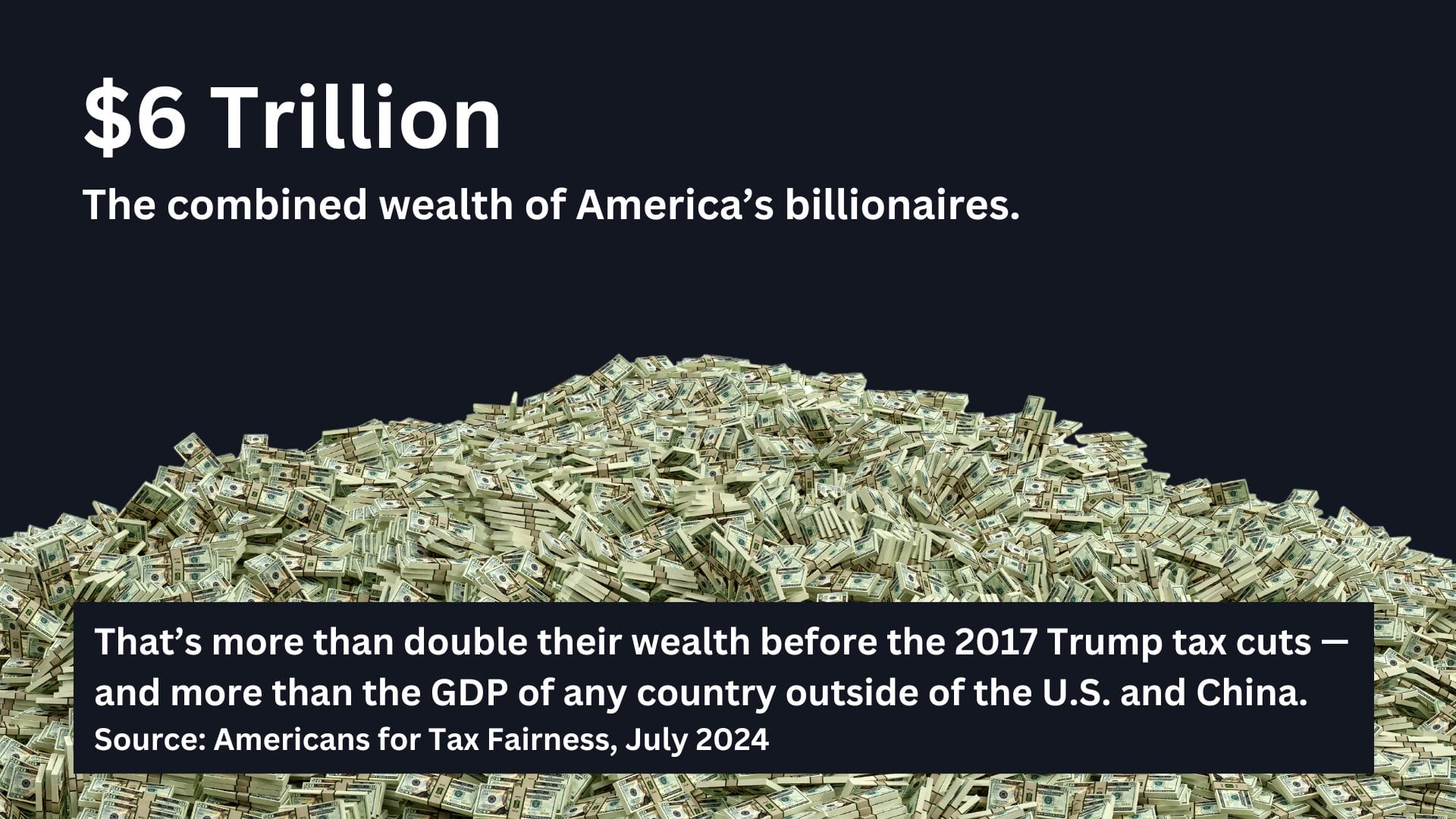
Domestically, the combined wealth of America’s roughly 800 billionaires has crossed over $6 trillion. That $6 trillion amounts roughly to the combined GDP of the United Kingdom and France. That $6 trillion also equals the amount of money the federal government spent in 2023. That enormous sum — concentrated in so few hands — is skewing our democracy at the expense of average Americans.
Here at Inequality.org, we’ll continue to highlight that skewing and do our best to analyze and advance the interventions needed to create a more just world. Chris Mills Rodrigo
for the Institute for Policy Studies’ Inequality.org team |
|
|
INEQUALITY BY THE NUMBERS |
|
|
Raising Public Awareness About Anti-Abortion Centers This week’s frontline face: Rebecca Hart Holder, the president of Reproductive Equity Now.
What she’s doing to help create a more equal world: Hart Holder and Reproductive Equity Now have partnered with the Massachusetts Department of Public Health to launch a public education campaign warning residents about dangerous and misleading anti-abortion centers, better known as “crisis pregnancy centers.”
Anti-abortion centers target low-income people and communities of color with the promise of free services, including free pregnancy tests, ultrasounds, or “pregnancy counseling.” They masquerade as legitimate medical clinics, then spread disinformation to dissuade people from seeking abortion care.
Reproductive Equity Now is working with the Department of Public Health to run campaign ads in both English and Spanish throughout the state, advising residents to avoid anti-abortion centers and directing them to pages where they can find accurate information and resources for their reproductive health needs.
What makes this fight so important to her: “Information is power,” says Hart Holder. “Public education is key to public health, and protected states can play a critical role to ensure residents have the tools and resources they need to make informed reproductive health care decisions.” |
|
|
Maximizing the Benefits of CHIPS Subsidies for Workers — Not CEOs
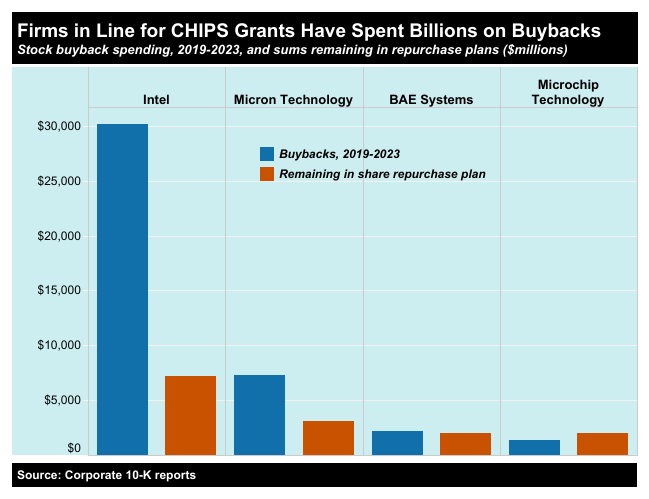
The 2022 CHIPS and Science Act created a huge opportunity to boost domestic production of the semiconductors that power everything from refrigerators and trains to whatever electronic device you’re reading from right now. To prevent CEOs from misusing CHIPS funds to enrich themselves and wealthy shareholders, the Biden administration is giving companies that agree to give up stock buybacks a leg up in the competition for grants. But if you take a look at our new report on the 11 companies with preliminary CHIPS agreements, you’ll understand why some Democrats are urging the administration to do more. Senator Elizabeth Warren, Rep. Pramila Jayapal, and others are calling on the Biden administration to put clear buyback restrictions in all final CHIPS contracts.
As Warren put it in a post about our report, the federal government “needs to ensure the American people aren’t subsidizing stock buybacks.” |
|
|
Eleven semiconductor corporations in line for federal CHIPS subsidies spent more than $41 billion combined on stock buybacks between 2019 and 2023. Intel spent the most, a whopping $30.2 billion. With that sum, the U.S. chipmaker could've given each of its 124,800 employees a $48,000 bonus every year for five years. Intel’s board has approved an additional $7.2 billion in buyback spending in the coming years. For more analysis on buybacks and CEO pay at companies competing for CHIPS grants, click the link below.
|
|
|
From the UK, a New Reminder Why Inequality Must Go
Fifteen years after the publication of this century’s most pivotal book on economic inequality’s direct impact upon our lives, the authors of that 2009 classic, the British epidemiologists Richard Wilkinson and Kate Pickett, are acknowledging a new reality they did not expect to encounter: “What we weren’t prepared for when we first wrote the book was how much worse things could get.” Inequality.org co-editor Sam Pizzigati has more on a powerful new report the pair have just co-authored.
|
PETULANT PLUTOCRAT OF THE WEEK |
A CEO Who Sees No ‘Utility’ in Protecting the Public
This week’s dour deep pocket: David Lesar, the 71-year-old corporate CEO who retired earlier this year as chief exec at the Houston-based CenterPoint Energy.
What has Lesar sour: The public revulsion at how ill-prepared CenterPoint turned out to be when Hurricane Beryl slammed into Houston earlier this month. The storm left 80 percent of the utility’s customers without power, many for over a sweltering week.
“Texas and CenterPoint both have compiled dubious records,” a Houston Chronicle analysis would later observe, “when it comes to protecting residents.”
One reason for those dubious records: the millions of dollars that Lesar’s CenterPoint, notes journalist Arielle Samuelson, invested in lobby groups and politicians with “a long history of publicly doubting the reality of climate science.”
Millions of other CenterPoint dollars went to Lesar himself. In 2021, Lesar pocketed $37.8 million, over double what his peer large utility CEOs took home.
The last word: This past February, CenterPoint customers in Indiana spent nine hours testifying against what the Evanston Courier & Press termed “yet another proposed rate increase from CenterPoint.”
Show “some kindness” to folks unable to afford CenterPoint’s rates, local nonprofit volunteer Keith Norberg urged Indiana’s state utility commissioners — and “tell CenterPoint to go to hell.” |
|
|
What's new on Inequality.org
A.J. Schumann and Omar Ocampo, AI Won’t Replace You — But It Will Spy on You. Short-term concerns about artificial intelligence replacing jobs are overblown, but that doesn’t mean we shouldn’t be aware of how it's already warping workplaces.
Sarah Anderson, Tax ‘Two-fers’ That Raise Revenue and Encourage Good Corporate Behavior. In Senate testimony, Sarah encouraged lawmakers to go bold in the 2025 tax debate to raise revenue and curb Wall Street and corporate recklessness. Elsewhere on the Web
Katya Schwenk, America’s Billionaires Are Teaching Your Kids To Cheat Taxes, The Lever. Corporations and arch-conservatives are pushing a public school curriculum that teaches children about the supposed dangers of taxing the wealthy.
Daniel de Vise, America’s billionaires are worth a record $6T. Where does that leave the rest of us? USA Today. Billionaires have more than doubled their share of America’s wealth since Donald Trump signed into law the Tax Cuts and Jobs Act of 2017.
Sonali Kolhatkar, Immigrants or Billionaires: Who’s a Bigger Threat to Democracy? LA Progressive. America’s 465 wealthiest people collectively donated $881 billion to influence the nation’s last midterm congressional elections. Joe Kloc, How Billionaires Die, New York. The more money you have, the longer you live — until...
Max Sawicky, The World’s Richest Just Got Extraordinarily More Wealthy — Taxing Them Doesn’t Go Nearly Far Enough, In These Times. We can’t stop at taxing the rich. We also need to limit their political power. Dan Primack and Scott Rosenberg, Tech leaders line up behind Trump, Axios. Silicon Valley execs in the past have sought to thrive under presidents from both parties and rarely took partisan sides. No longer.
Ryan Mac and Theodore Schleifer, How a Network of Tech Billionaires Helped J.D. Vance Leap Into Power, New York Times. Vance spent less than five years in Silicon Valley, but the connections he made there with Peter Thiel and other deep pockets would prove crucial to his political ascent. Lisa Pelling, Climate capabilities: realizing the green transition, Social Europe. How economic inequality limits our capacity to cope with climate change.
Mark Strassmann, Billionaires in Wyoming send housing prices sky-high: ‘This is super gentrification’, CBS Evening News. Vacationing one-percenters competing for second home — or fourths — are pricing long-time Wyoming residents out of Jackson Hole’s new Gilded Age.
Pat Garofalo, When McKinsey Comes to Your Hospital, Boondoggle. More private jets, less health care. Jan Weir, The DOJ’s Recent Plea Agreement with Boeing Is Outrageous, Medium. Why we need to fine Boeing’s top executives “down to their last cufflinks.” |
More Perfect Union, How Oil Barons Steal From Their Truckers. Haliburton is forcing Texas truckers to wait 32+ hours in their trucks with no restrooms and no pay. Now truckers are furious — and they're revolting. |
|
|
ON BILLIONAIRES AND THE REST OF US |
This newsletter and the whole Inequality.org project are powered by donations. We’re not raking in cash from the billionaire class, though. We’re counting on people to see why this reporting, research, and advocacy matters, and then to become paid subscribers, by making a recurring monthly donation of any amount. Make a monthly gift as a paid subscriber. Start your paid subscription today. |
|
|
Inequality.org | www.inequality.org | inequality@ips-dc.org Institute for Policy Studies
1301 Connecticut Avenue Ste 600
Washington, DC 20036
United States
Managing Editor: Chris Mills Rodrigo
Co-Editors: Sarah Anderson, Chuck Collins, Bella DeVaan, and Sam Pizzigati Production: Chris Mills Rodrigo and Georgia Jensen |
|
|
|