A weekly newsletter from the Institute for Policy Studies |
|
|
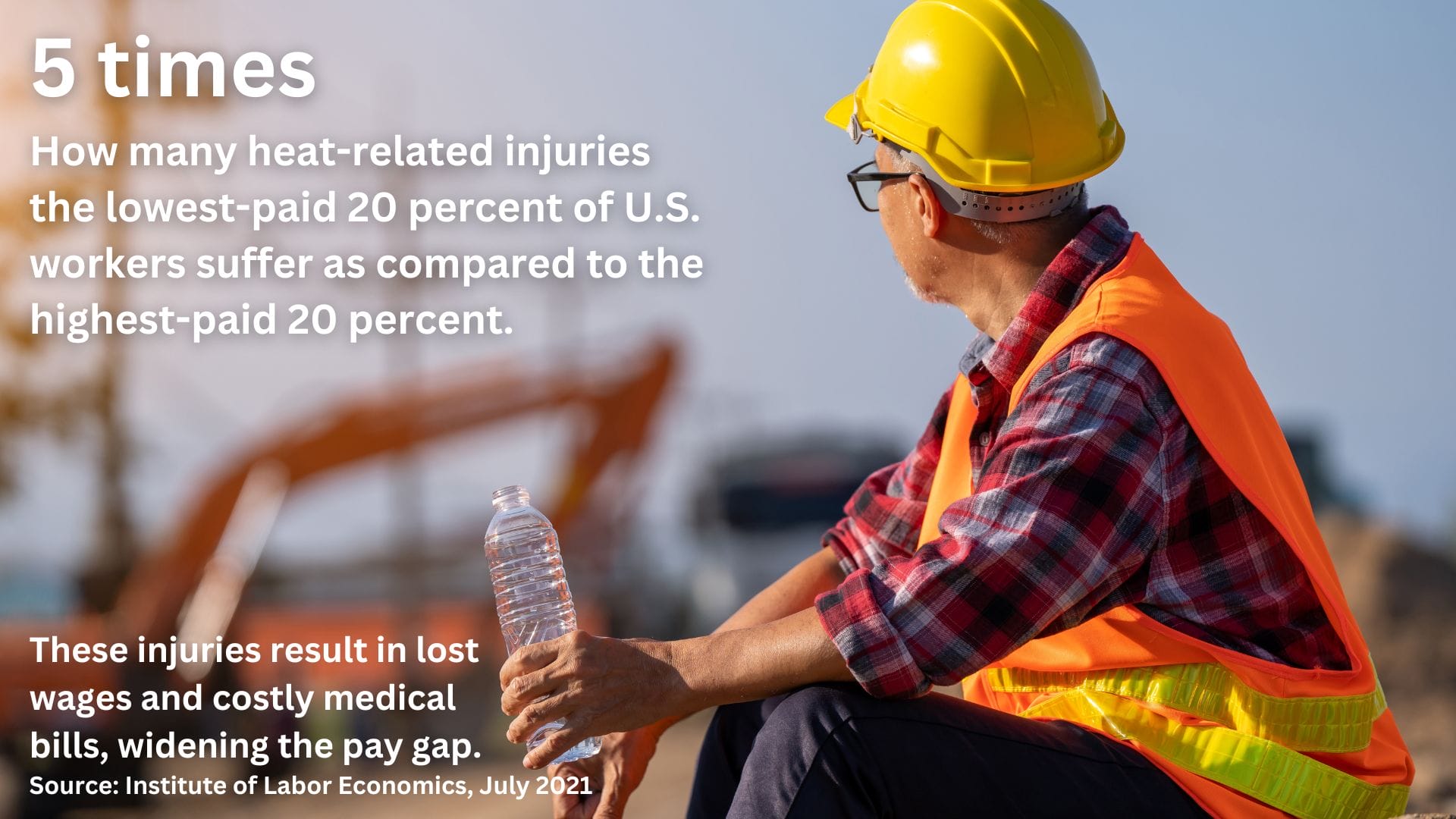
This summer may well end up our hottest ever. We’ve already had multiple record-breaking heat events. And who’s suffering the most from these sweltering temperatures? Two groups stand out: the unhoused and manual laborers.
Despite growing concerns over the risks to workers in these conditions from dehydration to heat stroke — not to mention lost wages and working hours — conservative lawmakers across the country have been stripping away crucial protections against overheated workplaces.
In Florida, for instance, Governor Ron DeSantis signed legislation into law this past April that actually bars local governments from requiring employers to provide water breaks. Texas Governor Greg Abbott last summer approved a measure overturning city rules requiring break time for construction workers.
The bright spot amid all this? The White House has just proposed a new rule that creates a federal safety standard specific to excessive heat in the workplace. This new initiative will now face a comment period. Wealthy industrialist groups will no doubt be pushing hard over the months to come to weaken this proposed new regulation. We need to push just as hard to save it. Chris Mills Rodrigo
for the Institute for Policy Studies’ Inequality.org team |
|
|
INEQUALITY BY THE NUMBERS |
|
|
Protecting the Promises of Olmstead on Its Twenty-Fifth Anniversary
This week’s frontline faces: Barbara Merrill and Doug Simmonsen, two activists who’ve been helping provide services to intellectually and developmentally disabled individuals.
What they’re doing to help create a more equal world: Merrill and Simmonsen are calling attention to the national shortage of direct service professionals — DSPs — who play a critical role in supporting those with intellectual and developmental disabilities in their daily lives, jobs, and personal relationships.
As a direct service professional, Simmonsen has watched the cost of everyday essentials skyrocket for the people he helps — and himself. Merrill leads a national association that represents thousands of direct service providers and their employees. She’s warning that a lack of increased funding for direct service providers will seriously worsen the DSP shortage.
What makes this fight so important: Twenty-five years ago, the Supreme Court ruled in Olmstead v. L.C. that “individuals with disabilities have the right to live in their communities” with as much independence and autonomy as possible.
“Olmstead and the ADA were milestones meant to ensure the civil and human rights of people with disabilities, and we must protect them against the possibility of going backwards,” note Merrill and Simmonsen. “Both state and federal leaders have the power to do just that, but they must be willing to commit to the long-term sustainability of the DSP workforce.” |
|
|
The Debate Over How to Really Close America’s Racial Wealth Gap
One school of thought in the United States today holds that the best way to close America's somehow still widening racial wealth gap would be to close the education gap, a move that would in turn start closing the earnings gap.
This ahistorical view, according to new research from the Samuel DuBois Cook Center on Social Equity at Duke University, ignores the impact of accumulated racial wealth disparities on current generations. Well-educated Black Americans with prestigious jobs often make less than white Americans with less schooling.
And focusing on “human capital,” the study adds, ignores intergenerational wealth transfers, via inheritances or gifts, that historically favor white families. To more holistically address America’s racial wealth gap, the Duke researchers recommend amending federal tax law to more aptly tax inheritances. They’re also suggesting reparations for descendants of the enslaved, a step that would acknowledge America's racist past and that past’s present day manifestations.
|
|
|
Nations with the smallest income gaps between their richest 10 percent and bottom 90 percent of households, as calculated by the OECD, show significantly fewer infant deaths than more unequal nations, according to new World Health Organization data. The United States sits at the extreme end among industrialized countries, with both high levels of inequality and the worst infant mortality rate. In 2021, the United States had an infant mortality rate of 5.4 deaths per 1,000 births, compared to 1.8 deaths per 1,000 births in the much more equal Norway. For more on health and inequality, check out the link below.
|
|
|
A Practical Prescription for Taxing Our World’s Super Rich
Ever wonder why the divide between the world’s richest and everybody else keeps getting wider? Gabriel Zucman, one of our world’s finest young economists, has just produced a report that riffs on one key reason: Our super rich pay next to nothing in taxes. Just how close to nothing? This close: Our richest have been paying, Zucman calculates, an effective tax rate “equivalent to 0.3% of their wealth.”
Other analysts have over recent years been sharing that same basic story. But none of those analysts have ever had the opportunity to share that story on a grander stage than Zucman. He prepared his landmark new report at the express request of Brazil, the nation that currently holds the presidency of the G20, the group that brings together the world’s most powerful economic nations. Inequality.org co-editor Sam Pizzigati has more. |
PETULANT PLUTOCRAT OF THE WEEK |
The Reclusive Mega Mogul Bankrolling Trump’s July 4 TV Ads
This week’s dour deep pocket: Timothy Mellon, the low-profile billionaire who this past spring became America’s first 2024 campaign donor to hand out $100 million in disclosed contributions to candidates in federal races, with $75 million of that going to Donald Trump.
What has Mellon sour: The heir to a Gilded Age fortune, the 81-year-old Mellon has likened social safety-net programs to “slavery redux” and charged that low-income people trade their votes for “yet more freebies” like food stamps.
Mellon’s own personal freebies have come from his great grandfather Thomas Mellon, an immigrant who piled up an enormous fortune in banking, and his grandfather Andrew, who, as U.S. secretary of the treasury, helped cut the top income tax rate on America’s richest from 77 to 25 percent.
In 1957, four of the eight wealthiest people in the United States belonged to Mellon’s family.
The last word: “The Mellon money trail,” notes former U.S. secretary of labor Robert Reich, “exemplifies the perils of dynastic wealth — and why we need a wealth tax in America.” |
|
|
What's new on Inequality.org
Rev. Lennox Yearwood Jr., The Paradox of Public Health Solutions that Worsen Climate Change. The unanticipated environmental effects of inhalers underscore the contradictions inherent in piecemeal climate solutions. Georgia Jensen, Two Years After Dobbs, the Fight Goes On. In the two years since Roe fell, access to abortion has become ever more restricted. Despite legal losses, the fight for reproductive rights rages on. Elsewhere on the Web
Samantha Waxman, Carl Davis, and Erika Frankel, States Should Enact, Expand Mansion Taxes to Advance Fairness and Shared Prosperity, Center on Budget and Policy Priorities and the Institute on Taxation and Economic Policy. States can build shared prosperity by progressively taxing the sale of high-value homes and using the revenue to support affordable housing.
Chuck Marr, Record Stock Buybacks Bolster Case for Raising Corporate Tax Rate, Off the Charts. Corporations appear poised to spend over $1 trillion next year buying back their own shares, a scam that raises share prices and enriches CEOs and other major shareholders.
Franziska Mager, Markus Meinzer, and Lucas Millán, How corporate tax incentives undermine climate justice, Tax Justice Network. A new report focuses on how fair corporate tax policy — a cornerstone of tax justice — intersects with the “polluter pays” principle — a cornerstone of climate justice.
Stewart Lansley, How Labour can tackle inequality, London School of Economics. Britain has become, as the Financial Times has put it, “a poor society with some very rich people.” The coming new Labour Party majority in Parliament must work to change that. Steve Macek, Dark Money Uncovered, Progressive. Massive funding for political candidates from undisclosed super-rich sources is going under the media radar. Mike Lofgren, The American Billionaires Who Fell In Love With Fascism Are Not the First, Common Dreams. The ultra-rich, history shows, will happily march us into dictatorship if we let them.
Taxing the super-rich? 74% of Indians support it – Here’s why, Times of India. Indians also strongly support a “polluter pays” approach to tackling climate change. Michael Hudson, Roman Oligarchs Avoided Tax Liability and Restrictions on Land Size, Resilience.org. A survey of ancient Roman attempts to share the wealth has lessons for today. |
Pitchfork Economics, The Code of Capital. Columbia Law professor Katharina Pistor joins host Nick Hanauer to discuss how laws create wealth inequality. |
|
|
SUBSCRIBERS MAKE THIS POSSIBLE |
Did you know that Inequality.org is a nonprofit project, part of the Institute for Policy Studies’ Program on Inequality? We depend on donations and paid subscriptions to keep this project free and available to all readers. Small monthly gifts are a huge part of that, whether you can donate $3 or $300 a month. If you’re ready to become a paid subscriber, sign up today. |
|
|
Inequality.org | www.inequality.org | inequality@ips-dc.org Institute for Policy Studies
1301 Connecticut Avenue Ste 600
Washington, DC 20036
United States
Managing Editor: Chris Mills Rodrigo
Co-Editors: Sarah Anderson, Chuck Collins, Bella DeVaan, and Sam Pizzigati Production: Chris Mills Rodrigo and Georgia Jensen |
|
|
|