A weekly newsletter from the Institute for Policy Studies |
|
|
Runaway wealth inequality can sometimes become disturbingly difficult to conceptualize. At moments like that, nothing helps more than the release of the latest stats on corporate CEO compensation, and this week we have some tangible — and enlightening — new figures from the Associated Press.
In 2023, these figures show, average compensation for our big-time chief execs soared 12.6 percent to $16.3 million. Median workers? They saw their wages grow just 4.1 percent. Half the CEOs the AP examined are making at least 196 times more than their median employee.
All those millions cascading into corporate corner offices are causing real harm to the rest of us, as our Inequality.org co-editor Sarah Anderson points out in the AP’s new CEO pay coverage. Average Americans, Sarah notes, are “feeling the pain of inflation more because they’re not seeing their wages go up enough.” And those wages are not going up fast enough because chief execs are making decisions that prioritize their own paychecks. We’ve had, as the congressional progressive Ro Khanna puts it, “40+ years of broken economic policy that put profits ahead of working people.” Chris Mills Rodrigo
for the Institute for Policy Studies’ Inequality.org team |
|
|
INEQUALITY BY THE NUMBERS |
|
|
Organizing To Foster an Ever More Vibrant Virtuous Cycle
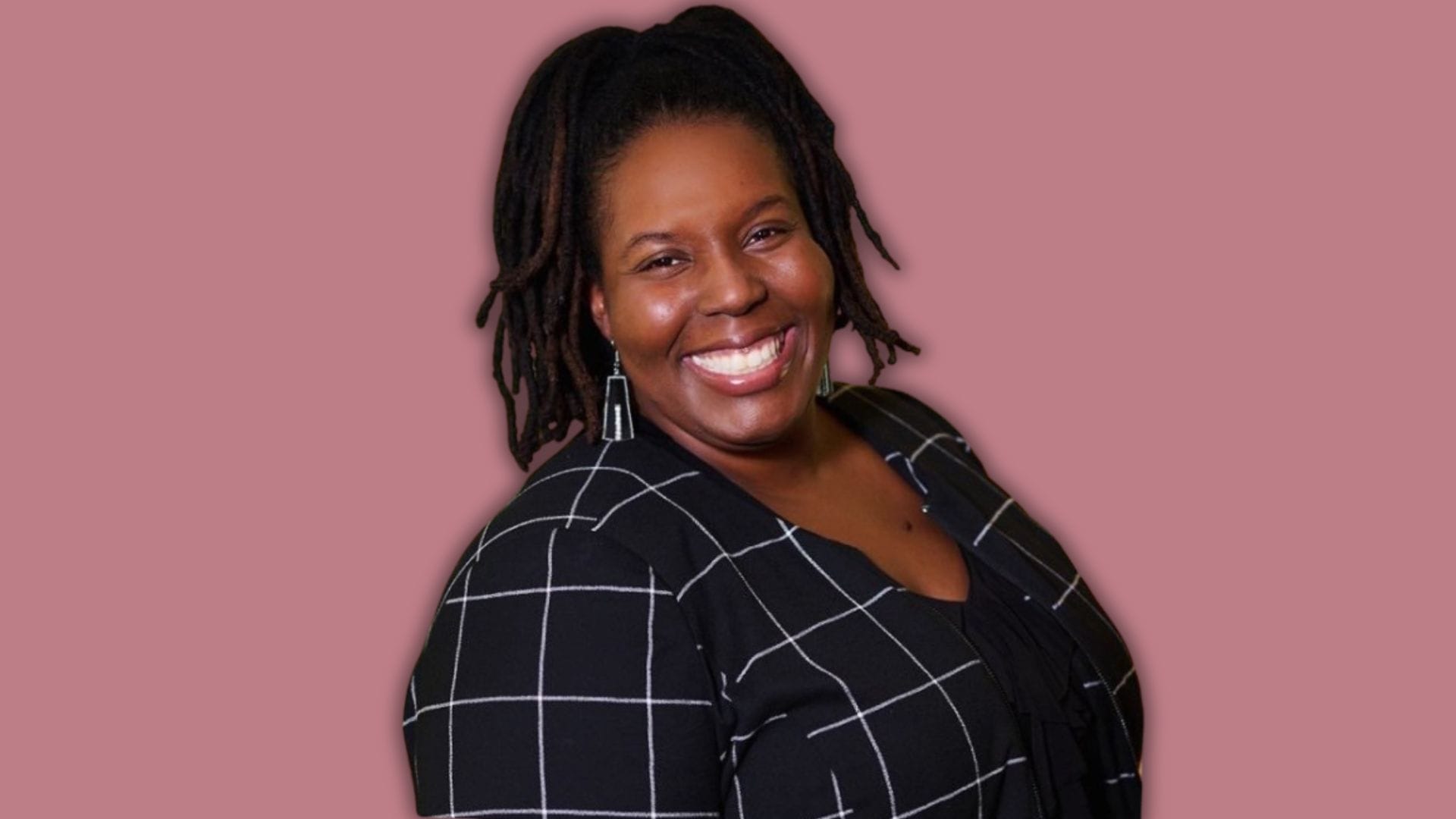
This week’s frontline face: Sharvonne Walker, a community organizer in Indianapolis who’s helping families achieve economic stability. What she’s doing to help create a more equal world: Walker knows from first-hand experience how close many Americans are living to an unexpected crisis that could upend their lives.
Many politicians and wealthy Americans today would like us to see social programs as a drain on our economy. Walker has the first-hand experience to see the emptiness of that claim. Her own family had to rely on public housing and food assistance when she was growing up. Those programs helped her and her family get back on their feet and continue to live productive lives.
What makes the fight so important to her: “Thanks to the help we got, we give back as good as we received and more — that’s how a healthy system works,” says Walker. “If we help families survive rocky times rather than fall deeper into poverty, all of us benefit as a society.” “We shouldn’t be cutting our public programs,” Walker adds. “we should be expanding them.” |
|
|
100+ Progressive Groups Urge Congress to Overhaul the Tax Code in 2025
Most of the federal tax cuts that Donald Trump signed into law in 2017 will be expiring at the end of next year. That reality will force a major congressional battle next year over the future of our tax code, no matter who triumphs in this November’s election.
Over the past several months, the Institute for Policy Studies has participated in a working group to develop a joint agenda for the Big Tax Debate of 2025. Last week, over 100 groups endorsed this agenda in a full-page ad in the New York Times.
The 2017 Trump tax legislation, the groups detailed in their letter to Congress, amounted to a “failure on its own terms.” The tax cut failed to deliver promised wage increases for typical workers and failed to “pay for itself.” Instead, this cut further skewed the federal tax code even more sharply towards the wealthy — and seriously eroded tax revenues.
Click the link below to read more about how we can overhaul our tax code to reduce inequality, sustain the investments that can create an economy that works for all of us, and support financial security and opportunities for all Americans. |
|
|
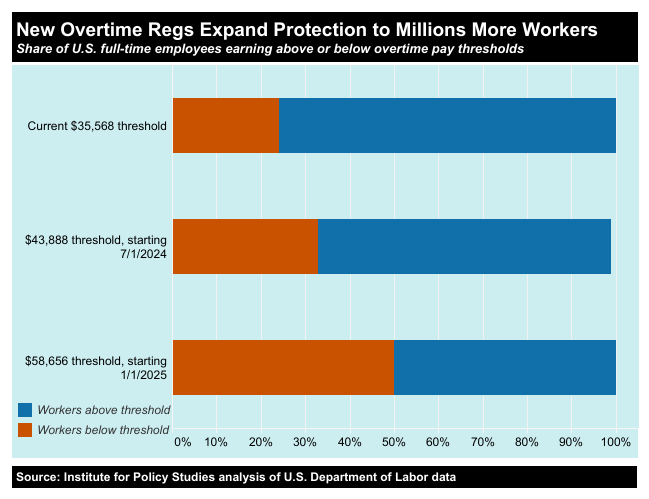
The Biden administration recently expanded the number of U.S. full-time employees who qualify for overtime pay by an estimated 4.3 million. The changes will be phased in, with a bump in the overtime pay threshold set to rise to $43,888 in July and then up to $58,656 in January. Not everyone below those thresholds will qualify, since employers can still deny overtime pay for administrative and professional workers. But this is still a step forward for workplace equity. |
|
| Can Democracy and Billionaires Ever Really Coexist?
One person, one vote. The classic essence of democracy. But what if that one person happens to be a fabulously rich? Does that one person actually have just “one” vote? Can we have anything approaching democracy when some among us are sitting on fortunes grander than the rest of us can even imagine? Americans have been actively debating questions like these ever since we entered the era that Mark Twain quite artfully tagged the “Gilded Age.” We never totally ended that gilded epoch. But we came close. Now we could hardly be further away. Inequality.org co-editor Sam Pizzigati has more.
|
PETULANT PLUTOCRAT OF THE WEEK |
This Billionaire Couple Really Loves Pistachios and Really Hates Unions
This week’s dour deep pockets: Stewart and Lynda Resnick, the California billionaires who own the Wonderful Company, the corporate empire that Forbes has dubbed “the largest agricultural company in the world and one of the largest privately held companies in the United States.”
What has the Resnicks sour: the United Farm Workers campaign to unionize the over 600 workers who labor at the Wonderful Nurseries in California’s Central Valley. Union success at this nursery, notes journalist David Bacon, could speed organizing efforts throughout the huge Wonderful agribusiness complex.
The United Farm Workers this past winter gained bargaining rights at the Wonderful Nurseries, under the terms of the new California labor law that went into effect last year. Now the Resnicks have, the Los Angeles Times reports, “unleashed a nuclear attack” on that law: a lawsuit that seeks to have California’s new unionization process “declared unconstitutional.” The last word: “If the company has all this money for lawyers and consultants,” notes Rosa Silva, a Wonderful Company worker active in the UFW organizing drive, “they can raise the wages and make conditions better. We’re just asking for what’s fair.” |
|
|
Jacob Hacker and Paul Pierson, This Policy Issue Is Critical Above All Others, New York Times. Polling has consistently shown that voters feel the U.S. tax code lets the rich — and the corporations they run — avoid their fair tax share. David Schultz, Newsflash: Inequality in Neoliberal America, CounterPunch. Households in America’s bottom 20 percent now make no more, in real terms, than they made 50 years ago, a new Minneapolis Federal Reserve Board report details.
Bruno Meyerfeld, Brazil’s finance minister: ‘Taxing the super-rich is both an emergency and a necessity,’ Le Monde. Brazilian finance minister Fernando Haddad is working toward a global minimum tax on the world’s 3,000 richest individuals. Their combined wealth: $15 trillion.
Robert Reich, Why is a group of billionaires working to re-elect Trump? Guardian. Oligarchs like Elon Musk and Peter Thiel don’t just oppose progressivism. They oppose American democracy itself. Amos Barshad, Meet the New Kingpin, The Lever. How private equity wheeler-dealers are profiteering off — and hollowing out — bowling, America’s largest mass participating sport.
‘Brazilian proposal at the G20 of taxing very wealthy individuals is absolutely necessary,’ states North American millionaire Morris Pearl, G20 Brazil 2024. An interview with Patriotic Millionaires founder Morris Pearl on inequality, taxing the rich, and hope.
Les Leopold, No Payoffs for Layoffs! Wall Street’s War on Workers. We need legislation that prevents corporations that receive federal contracts from laying off workers and buying back their own shares of stock, moves that today’s largest U.S. firms regularly take to enrich their shareholders and top execs. Simon Torracinta, Inequality Without Class, Dissent. An appreciation of the latest book from the economist Branko Milanovic, one of the top analysts of our ever more unequal world.
Harold Meyerson, Democracy, Deshmocracy: Mega-Financiers Are Flocking to Trump, American Prospect. Leading Wall Street and Silicon Valley pooh-bahs believe the tax cuts he’ll give them make for a bigger deal than preserving democratic norms.
Pranav Jeevan P, The Growing Divide: A Deep Dive into India’s Inequality Crisis, Sabrang. The number of Indians with net wealth over $1 billion increased from just one in 1991 to 162 in 2022. Their total net wealth grew from less than 1 percent of India’s national income in 1991 to 25 percent in 2022. |
David Sirota, Morgan Harper, and Greg Saunier, What Will It Take to Defeat Ticketmaster? The Lever. A musician and an antitrust expert debate whether a potential breakup of Ticketmaster and Live Nation would really improve an inequitable music industry. |
|
|
Our research, editorial, and publishing team depends on hundreds of paid subscribers who make monthly gifts. Some give $3 each month; others give $200! All told, this support enables our team to stay focused on identifying causes and solutions to our deep economic inequality. Paid subscribers have contributed more than $20,000 in the past year. Ready to become a paid subscriber? Sign up today. |
|
|
Inequality.org | www.inequality.org | inequality@ips-dc.org Institute for Policy Studies
1301 Connecticut Avenue Ste 600
Washington, DC 20036
United States
Managing Editor: Chris Mills Rodrigo
Co-Editors: Sarah Anderson, Chuck Collins, Bella DeVaan, and Sam Pizzigati |
|
|
|