A weekly newsletter from the Institute for Policy Studies |
|
|
We hope you all enjoyed your — hopefully — long holiday weekend. Now we’re swinging into that just-before-summer stretch that can feel like a relative lull. But here at Inequality.org we have a lot of exciting projects in the works that we’re looking forward to sharing with you in the weeks and months ahead.
In the meantime, we are always curious about what aspects of — and issues around — economic inequality resonate most powerfully with you. Are you, for instance, most interested in tracking what our world’s wealthiest are doing to lock in their vast fortunes or more eager to get the scoop on how working people worldwide are fighting to claw back the profits that their labor is generating?
The maldistribution of our world’s wealth will always be an incredibly broad issue. We welcome your insights on new angles our Inequality.org ought to be exploring! So if you see something we’ve been missing in our coverage of our ongoing era-defining inequality crisis, please let us know. Just respond to one of these weekly emails. Thanks so much! Chris Mills Rodrigo
for the Institute for Policy Studies’ Inequality.org team |
|
|
INEQUALITY BY THE NUMBERS |
|
|
Exposing Corporate America's Dependence on Forced Labor
This week’s frontline face: Jennifer Turner, a human rights researcher at the American Civil Liberties Union. What she’s doing to help create a more equal world: Turner, the lead author on a groundbreaking 2022 report on prison labor in the United States, has been helping us understand just how much value U.S. prison labor is currently creating.
The latest estimates put that value — created by more than 800,000 prisoners — at roughly $10 billion a year. Some $2 billion of that is enriching private companies outside of the prison system.
Turner’s research is playing a pivotal role in a landmark class-action lawsuit that has 10 plaintiffs challenging what they see as an unconstitutional forced-labor system in Alabama prisons. Government officials, their lawsuit charges, are colluding to deny parole to prisoners — especially prisoners of color — in order to continue providing cheap labor to firms like KFC, McDonald’s, and Wendy’s.
What makes equality so important to her: “The United States,” notes Turner, “has a long, problematic history of using incarcerated workers as a source of cheap labor and to subsidize the costs of our bloated prison system.”
"It’s past time we treat incarcerated workers with dignity,” Turner adds. “If states and the federal government can afford to incarcerate 1.2 million people in prisons, they can afford to pay them fairly for their work.” |
|
|
Private Jets: A ‘Sustainable’ Transit Solution Only Our Richest Could Love
With our global climate crisis only growing, our world’s ultra wealthy, long accustomed to zipping around on private jets, have begun to pay lip service to the importance of going green. Developing bio-fuels, private jetsetters argue, could make their 45-minute private-jet jaunts totally sustainable.
New Institute for Policy Studies research is exposing how farcical that notion will always be. Just the land-use changes alone needed to produce that bio-fuel would make this “solution” a net-negative environmentally.
Instead of trying to make private jet travel “green,” argues IPS researcher Omar Ocampo, we should be working to limit private jet travel overall. And instead of investing in bio-fuels that make billionaires feel less guilty, we should be investing in tried-and-true transit solutions like expanded rail and bus options. More below. |
|
|
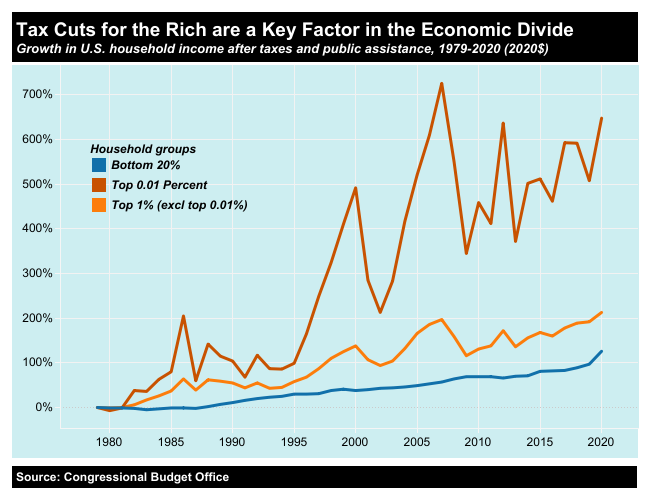
Between 1979 and 2020, the richest 0.01 percent of U.S. households had a cumulative income growth rate of 648 percent, more than five times the 126 percent growth rate for the bottom 20 percent of households. Tax cuts for the rich remain a key driver of this rising inequality. The top U.S. marginal tax rate in 1979 stood at 70 percent, compared to just 37 percent today. For an interactive version of this chart and more on income and inequality, check out the link below. |
|
|
From Massachusetts, Some Serious Tax-the-Rich Inspiration
Living standards for average families, notes the UK High Pay Centre’s Luke Hildyard, only substantially improve when societies put in place mechanisms “to ensure that wealth doesn’t overwhelmingly flow to the people with all the economic and political power.” For starters, Hildyard posits in his newly published Enough: Why it’s Time to Abolish the Super Rich, our modern societies need to significantly tax our top 1 percenters. How best to accomplish that? Progressives in Massachusetts have put in place one new approach that’s now generating some highly encouraging results. Inequality.org co-editor Sam Pizzigati has more.
|
PETULANT PLUTOCRAT OF THE WEEK |
How To Fix Miami? This Billionaire Insists He Has the Answer
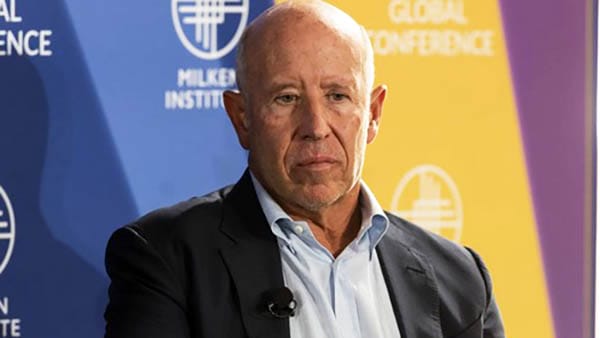
This week’s dour deep pocket: Barry Sternlicht, the billionaire chair and CEO of the Starwood Capital Group, a Miami Beach-based real estate investment firm.
What has Sternlicht sour: If Miami is ever going to become a “Wall Street South,” Sternlicht insisted in a media interview earlier this month, the city is going to have to do something about its schools.
Does that mean that Sternlicht, a powerful Miami political presence, is now going to lead the charge to raise the Miami-Dade County “impact fees” developers must pay to offset the impact of their new developments on schools and other public services? These fees haven’t increased in nearly 30 years, and this failure to keep up with inflation is now annually costing local public schools mega-millions.
Sternlicht could care less. His concerns revolve only around Miami’s private schools. The city has so few elite private schools that deep pockets not used to hearing “no” have been having to offer “five-figure donations” to get their kiddies admitted — on top of tuitions that can run over $30,000 a year.
The last word: Sternlicht also has problems these days with private higher ed. His alma mater, Brown University, peacefully ended a pro-Palestine student encampment last month by agreeing to put divestment in firms that manufacture arms for Israel up for a vote this fall. Sternlicht has attacked that agreement as “unconscionable” and put his contributions to the university on hold.
|
|
|
What's new on Inequality.org
Katherine Charles, I Keep The Affordable Care Act Working but Can’t Afford to See My Own Doctor. The federal healthcare marketplace’s customer service line is run by a for-profit federal contractor that gives its employees little more than the bare minimum.
Elsewhere on the Web
Kathryn Zacharek, What if ... we banned billionaires? New Internationalist. Why we need to stop people from becoming excessively rich to create a world that prioritizes well-being, democracy, and the planet. Martin Sandbu, We are a step closer to taxing the super-rich, Financial Times. Why a global wealth tax could actually arrive sooner than you think. Alex Welch, Better Tax Codes Help Boost Teacher Pay, Just Taxes. U.S. states with more progressive taxes are successfully paying higher wages to educators.
Yuval Rosenberg and Michael Rainey, ‘A Large and Costly Mistake’: Unions Slam Trump Tax Cuts, Fiscal Times. Over 100 unions, advocacy groups, and think tanks are urging Congress to use the upcoming expiration of 2017 Trump tax cuts to make the nation’s rich — and the corporations they run — pay a much larger share of federal taxes.
Jon Queally, ‘Grave Mistake’: Yellen Under Fire for Opposing Global Billionaires Tax, Common Dreams. Rejecting the idea of a global minimum tax cedes to billionaires control of our economies and our democracies to oligarchs and plutocrats. Lawrence Wittner, Donald Trump’s Assault on the Wages of American Workers, CounterPunch. A look at how Trump brought down blue-collar wages during his presidency. Reuven Avi-Yonah, A Five-Year Prison Sentence for a Public Hero, American Prospect. We need leniency for this courageous egalitarian act civil disobedience.
Alexis Keenan, Tesla’s Musk is not the only CEO testing new compensation limits, Yahoo Finance. Elon Musk’s proposed pay deal would be the biggest in corporate history. But plenty of other CEOs are testing new compensation limits. Susan Griffin, How the super rich party at the Monaco Grand Prix, CNN. For the global super rich, this three-day auto race becomes “the center of the universe for a weekend.” Fareed Rahman, World’s ultra-rich to spend $4.4bn to buy property in Dubai, NBusiness. The global ultra rich will lay out an average $36.5 million on Dubai mansion deals this year, says a new report from the global property consultancy Knight Frank. |
Susan Kang, Stylianos Karolidis, Dylan Maraj, and Brendan Radtke, Organizing at Amazon with Amazonians United, Left on Red. A discussion with two Amazon workers about the challenges of organizing an independent union. |
|
|
Our research, editorial, and publishing team depends on hundreds of paid subscribers who make monthly gifts. Some give $3 each month; others give $200! All told, this support enables our team to stay focused on identifying causes and solutions to our deep economic inequality. Paid subscribers have contributed more than $20,000 in the past year. Ready to become a paid subscriber? Sign up today. |
|
|
Inequality.org | www.inequality.org | inequality@ips-dc.org Institute for Policy Studies
1301 Connecticut Avenue Ste 600
Washington, DC 20036
United States
Managing Editor: Chris Mills Rodrigo
Co-Editors: Sarah Anderson, Chuck Collins, Bella DeVaan, and Sam Pizzigati |
|
|
|