A weekly newsletter from the Institute for Policy Studies |
|
|
If we're going to celebrate the labor movement's wins, we also have to acknowledge labor’s losses. Last week, 2,642 workers at a Mercedes plant in Alabama voted not to make the United Auto Workers their bargaining agent. That vote came just a month after workers at a Volkswagen plant in Tennessee gave labor its biggest organizing victory in the South in years.
Welcome to the reality of organizing. The deck in the South remains horribly stacked against labor. In Alabama, as veteran organizer Jane McAlevey noted in The Nation, “top business, political, and community leadership” followed “every nefarious tactic” in the anti-union book to beat back the UAW. In the drive for union workplaces — and a more equal America — wins will never come easy.
The silver lining in the Alabama vote? Despite the fierce anti-union pressure from on high, 2,054 workers at the Mercedes facility voted for unionization, a showing that would have been unthinkable until recently.
“I’ve worked at Mercedes for nearly 25 years and have been part of multiple efforts over those years to build a union,” Mercedes worker Jeremy Kimbrell wrote. “This was the first time we got to a National Labor Relations Board-supervised election on whether to unionize.”
What’s become most important now: to keep fighting — for better workplaces and, ultimately, a more just economy for us all. Chris Mills Rodrigo
for the Institute for Policy Studies’ Inequality.org team |
|
|
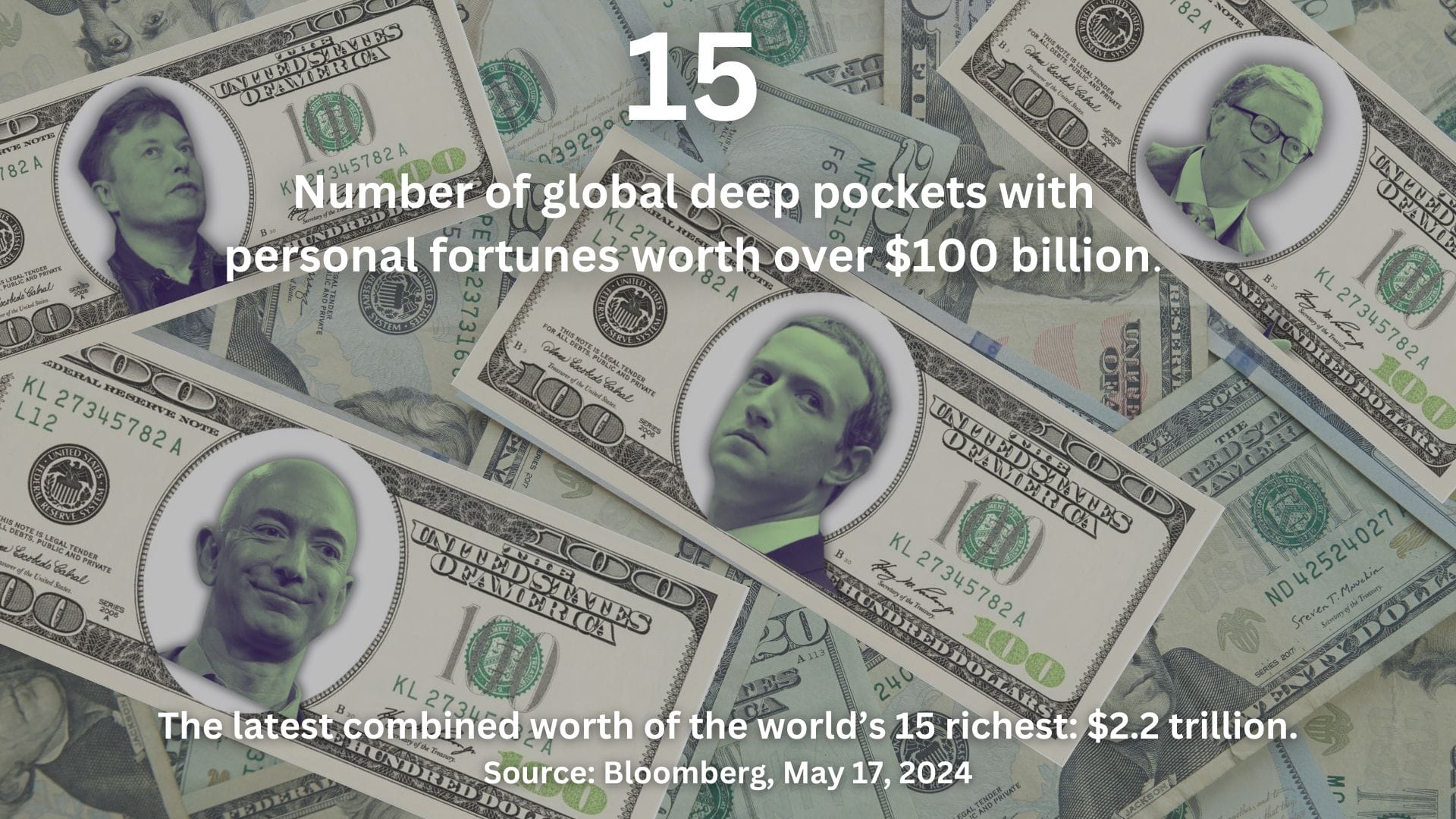
INEQUALITY BY THE NUMBERS |
|
|
Federal Contractors Should Be Paid Like Federal Workers
This week’s frontline face: Katherine Charles, a federal healthcare marketplace customer service specialist at the Maximus call center in Tampa, Florida. What she’s doing to help create a more equal world: Charles got involved in the campaign to unionize Maximus workers with the Communications Workers of America last year.
Despite Maximus pulling in billions from the government to field calls about the federal healthcare marketplace and Medicare, many workers are making a paltry $17 an hour. That simply isn't enough for Charles, a single mother of two, to live her life.
The company's healthcare benefits are ironically not much better, to the point that Charles has not been able to see her doctor for needed treatment on a chronic condition.
What makes equality so important to her: “I’m not going to quit because I don’t feel properly valued or because the benefits are not good,” Charles writes for Inequality.org. “I’m going to stay and fight within the company to make it better, because the ACA is a great program that is helping millions of Americans.”
|
|
|
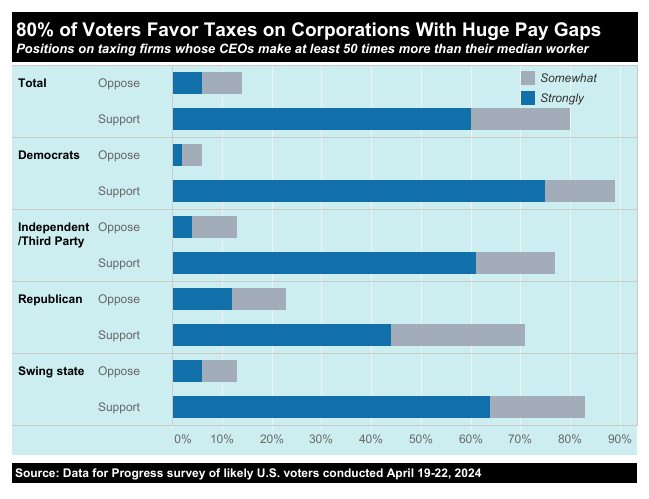
A Wildly Popular Tax on Huge CEO-Worker Pay Gaps
Inequality.org co-editor Sarah Anderson has been conducting her own informal survey of American views about CEO pay. Whenever family or friends ask about her job, she tells them her work involves research on executive compensation. Sarah’s prime findings? Americans across the political spectrum have become fed up with overpaid CEOs — and want to see that overpayment ended.
A new formal poll reinforces Sarah’s sense. Data for Progress recently asked likely voters their views on taxing corporations that pay their CEOs 50 or more times as much as they pay their median worker. Every political group expressed overwhelming support, even including 71 percent of Republicans. In swing states, 83 percent on voters overall gave a thumbs up. As Sarah explains in a new op-ed in The Hill, policies like a tax along these lines would give companies with huge internal disparities two choices: either narrow their pay gaps or face a bigger IRS bill. You can read her op-ed at the link below. |
|
|
A New Take on the Toughest Job Today’s Richest Ever Get To Face?
Lawmakers inclined to tax the rich, fans of grand fortune love to claim, are playing a foolish game they cannot possibly win. People of major means, rich people-friendly analysts argue, will simply pack up and leave any locale silly enough to subject its richest to higher tax bills. But the rich who live in New York, San Francisco, and Los Angeles all face considerably higher tax bills than the rich who live in other metro areas. Yet they haven’t yet picked up and moved elsewhere. What’s going on here? Inequality.org co-editor Sam Pizzigati has more.
|
PETULANT PLUTOCRAT OF THE WEEK |
In a Hollywood Executive Suite: Lights, Camera, Action . . . Greed!
This week’s dour deep pocket: David Zaslav, the CEO of the media and entertainment corporate colossus created two years ago when WarnerMedia spun off from AT&T and merged with Discovery.
What has Zaslav sour: The hostile vibes — from inside and outside his corporate empire — that his just revealed 2023 pay package has generated. Zaslav pocketed $49.7 million for a year that saw his company’s revenue and share price shrink and languish. He took home a mere $39.2 million in 2022.
“All CEOs need to be paid with alignment with shareholders,” Zaslav pronounced in a panel discussion earlier this month, a rather odd declaration given that his company’s shares spent most of 2023 hovering at a fraction of their initial 2022 value. Workers under Zaslav’s corporate reign, Gizmodo reports, have also suffered through “a large number of layoffs.”
The last word: Hollywood execs like Zaslav, the actors’ union president Fran Drescher noted at a strike rally last summer, “plead poverty, that they’re losing money left and right” at the same time they’re “giving hundreds of millions of dollars to their CEOs.” Summed up Drescher: “It’s disgusting.” |
|
|
What's new on Inequality.org
Omar Ocampo, Sustainable Aviation Fuel Investment Actively Undermines Climate Goals. A new report from our Inequality.org team punctures the myth of an environmentally sustainable private jet industry. Elsewhere on the Web
Sarah Anderson, Voters want to tax outrageous CEO pay. Are lawmakers listening? The Hill. Some 80 percent of Americans now support a new tax on corporations that pay their CEOs over 50 times more than what they pay their most typical employees.
Bob Lord, A Whistleblower Exposed Trump’s Tax Avoidance. Biden Should Pardon Him, Rolling Stone. The IRS contractor who revealed the injustice of America’s tax system deserves a pardon, not a maximum prison sentence.
Michael Steinberger, Was the 401(k) a Mistake? New York Times. How an obscure, 45-year-old tax change has transformed retirement in the United States and intensified American income inequality. Hannah Natanson and Emmanuel Felton, Business titans privately urged NYC mayor to use police on Columbia protesters, chats show, Washington Post. How billionaires have wielded their power to shape American views on the Gaza war.
Michael Mechanic, America’s Billionaires Are Really Going to Hate This New Senate Bill, Mother Jones. The legislation erases the neat trick our richest use to enrich their offspring without paying taxes.
Benjamin Wallace-Wells, Class Consciousness for Billionaires, New Yorker. Today’s anxieties about extreme wealth — from its influence on politics to the ethics of philanthropy — turn out to be extraordinarily old. The rich have confused the rest of us right from the beginning. Alex Welch, Better Tax Codes Help Boost Teacher Pay, Just Taxes. The U.S. states with the most progressive tax systems just happen to be paying higher wages to public school educators.
Jeremy Schwartz, Former Far-Right Hard-Liner Says Billionaires Are Using School Board Races to Sow Distrust in Public Education, ProPublica. The largesse from billionaires Tim Dunn and brothers Farris and Dan Wilks has made its way into local politics across Texas. Lee Ying Shan, ‘Wealth can be pretty isolating’: Problems that rich people face, according to therapists, CNBC. Riches come with a stiff, dehumanizing price. |
Adam Reilly, Chuck Collins, and Florian Allroggen, Can 'sustainable jet fuel' help US airlines reach net-zero emissions? GBH News. U.S. airline companies are relying on what are known as Sustainable Aviation Fuels to reach net-zero emissions by 2050, a deadline set by the Biden administration. But a new IPS report argues the industry is far off pace to reach that goal.
|
Tom Goldscheider and Ian Coss, At Sword's Point, New England Public Media. A discussion about a pivotal moment in American history when the furious power of Joseph McCarthy’s Red Scare found its first true target — and the dismantling of American organized labor began. |
|
|
Our research, editorial, and publishing team depends on hundreds of paid subscribers who make monthly gifts. Some give $3 each month; others give $200! All told, this support enables our team to stay focused on identifying causes and solutions to our deep economic inequality. Paid subscribers have contributed more than $20,000 in the past year. Ready to become a paid subscriber? Sign up today. |
|
|
Inequality.org | www.inequality.org | inequality@ips-dc.org Institute for Policy Studies
1301 Connecticut Avenue Ste 600
Washington, DC 20036
United States
Managing Editor: Chris Mills Rodrigo
Co-Editors: Sarah Anderson, Chuck Collins, Bella DeVaan, and Sam Pizzigati |
|
|
|