A weekly newsletter from the Institute for Policy Studies |
|
|
In his State of the Union address last week, President Biden responded to widespread public outrage over wealth concentration by pledging to force big corporations pay their fair share of taxes. Today, we’re releasing a blockbuster report showing just how outrageously unfair our current tax system has become.
Our key finding: Dozens of large and profitable U.S. corporations are actually paying their top executives more than they’re paying in federal income taxes.
“Tax avoidance and excessive executive pay aren’t unrelated,” Inequality.org co-editor Sarah Anderson explains in a Boston Globe story about the report. “Executives have incentives to push for tax cuts because they can reap the windfall.”
Issued jointly with Americans for Tax Fairness, our new report has also garnered coverage today in USA Today, CBS News, and The Guardian.
We have more from Anderson below on how to tackle the intertwined problems of corporate tax dodging and excessive CEO pay. Chuck Collins and Chris Mills Rodrigo
for the Institute for Policy Studies’ Inequality.org team |
|
|
INEQUALITY BY THE NUMBERS |
|
|
Life Will Always Be Unpredictable — But a Real Safety Net Can Help
Xzandria Armstrong felt like her life was running on the right track. Coming out of college, she found a job in the film industry that let her travel the world and mix with celebrities. But then her health started failing.
Armstrong’s health struggles came at the same time that she was having a child, compounding her challenges. Armstrong’s condition, fortunately, did improve, and she stabilized her living situation — with the help of America’s meager safety net. But those programs that helped her through a difficult time — SNAP, Medicaid and the expanded Child Tax Credit — are now facing deep cuts even though the problems they address remain rampant. “What we really need is to renew, expand, and cut red tape for those safety net programs that are proven to keep people above water,” Armstrong notes. “And we need to work together to get it.” Armstrong is now working closely with the Poor People’s Campaign, an effort pushing to bring the concerns of low-income Americans into the political mainstream. |
|
|
Let’s Crack Down on Corporate Tax Dodging and Obscene CEO Pay Corporate tax dodging and CEO pay have both soared so far out of control that a significant number of major U.S. companies are actually paying their top executives more than they’re paying Uncle Sam.
In the report we’re releasing today with Americans for Tax Fairness, we show that 35 large and profitable U.S. firms — including household names ranging from Tesla and Ford to Netflix and T-Mobile — paid less in federal income taxes between 2018 and 2022 than they paid their top five executives. What can be done to repair our broken tax and CEO pay systems?
Congress, for starters, should reverse the 2017 corporate tax rate cut and close loopholes that encourage U.S. firms to shift profits and production offshore. Policymakers should also curb excessive CEO pay via tax and contracting reforms and stronger regulations for reining in stock buybacks and banker bonuses.
For more from report co-author Sarah Anderson on the dual problems of overpaying executives and fleecing Uncle Sam — and what we can do to end these abuses — click the link below. |
|
|
The Gilded Age Back Then, The Gildest Age Right Now
Few nations today — outside the United States — can lay claim to a wealthy elite as gluttonous as India’s. Earlier this month, that insatiability made headlines worldwide. The occasion? A pre-wedding party for a son of India’s richest billionaire. The over 1,000 guests at this three-day, $120-million “ode to excess” included a hefty contingent of America’s super rich, everyone from Bill Gates and Mark Zuckerberg to Ivanka Trump and the CEO of the Disney empire. Years ago, back in the middle of the 20th century, hardly anyone in America could have imagined that the future would bring this sort of over-the-top excess. What happened? Inequality.org co-editor Sam Pizzigati has more.
|
PETULANT PLUTOCRAT OF THE WEEK |
Who’s Pushing Over-the-Top Oil Consumption? Certainly Not Big Oil!
This week’s dour deep pocket: Darren Woods, chief executive of the global oil colossus ExxonMobil. What has him sour: Anyone with the nerve to suggest that fossil fuel giants like ExxonMobil have any appreciable responsibility for the climate crisis. The real responsibility, says Woods, rests with consumers.
“When are people going to be willing to pay for carbon reduction?” Woods recently told Fortune. “We have opportunities to make fuels with lower carbon in it, but people aren’t willing to spend the money to do that.”
ExxonMobil, counters Harvard historian of science Naomi Oreskes, has been working for decades to obfuscate the oil industry’s responsibility for climate change. The company, notes a study Oreskes co-authored last year, has “known since the late 1970s that its fossil fuel products could lead to global warming.”
Woods, corporate filings revealed last April, took home $35.9 million in 2022. The last word: ExxonMobil’s Woods blaming oil consumers for the climate crisis strikes Columbia University economist Gernot Wagner as “like a drug lord blaming everyone but himself for drug problems.”
|
|
|
What's new on Inequality.org
Sarah Anderson, William Rice, and Zachary Tashman, Corporations That Pay Their Executives More Than Uncle Sam. Tesla, Ford, and T-Mobile are among the profitable U.S. firms that pay their top execs more than they pay in federal taxes. Elsewhere on the web
Chuck Marr, Samantha Jacoby, and George Fenton, The 2017 Trump Tax Law Was Skewed to the Rich, Expensive, and Failed to Deliver on Its Promises, Center on Budget and Policy Priorities. A new report makes the case for replacing the Trump tax cut that expires next year with moves that seriously tax the rich.
Jon Whiten, Moving the Needle Toward Tax Fairness in the States, Institute on Taxation and Economic Policy. Forward-thinking state lawmakers are improving tax equity by raising new revenue from the well-off. Maryann Cousens, Americans Support Raising Taxes on the Wealthy and Big Corporations, Navigator Research. Four in five Americans support raising taxes on the rich, including 94 percent of Democrats, 78 percent of independents, and 63 percent of Republicans. Max Lawson, Breakthrough at the Bank, Equals Bulletin. A new approach to measuring inequality at the World Bank, notes Oxfam’s Max Lawson, could have important implications. Daniel Wortel-London, Introducing the Salary Cap Act, Steady State Herald. We can respect planetary boundaries, or we can have billionaires, but not both. Lisa Pelling, Saving the planet means saving the world, Social Europe. Inequality and the climate crisis go hand in hand. So do the alternatives Amos Barshad, The Plutocrats’ Plot To Control America, The Lever. Under the banner of voting reform, a tycoon’s plan could give the rich even more power to buy elections.
Jessica Davis Plüss and Pauline Turuban, Major U.S. Big Pharma companies pay their CEOs more than their European counterparts, SwissInfo. In 2013, Swiss voters granted shareholders a veto right over the salaries of top execs and also banned “golden parachute” severance agreements. |
|
|
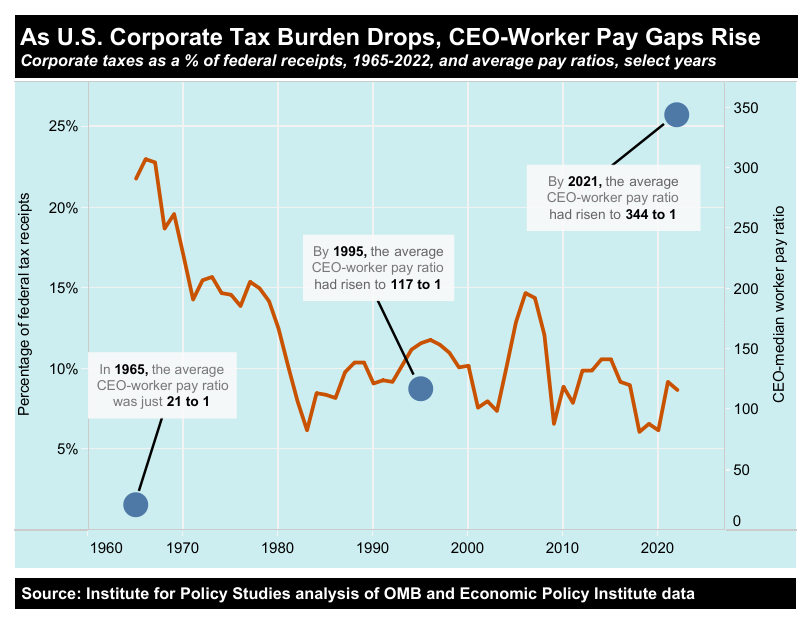
CEOs have a personal incentive to push for corporate tax cuts, since a significant share of windfalls from these cuts often wind up in their own pockets. In 1965, corporate taxes made up 21.8 percent of all federal revenue, according to an Institute for Policy Studies analysis of Office of Management and Budget and Economic Policy Institute data. At that time, the CEO-to-median worker pay ratio ran 21 to 1. By 2022, corporate tax receipts had fallen to just 8.7 percent of federal revenue — and the average pay ratio had risen to 344 to 1. For an interactive version of this chart and more on taxes and inequality, check out the link below.
|
|
|
Inequality.org runs on the loving labor of a small team of researchers, writers, and advocates. More than anything, all of us involved believe deeply in the power of everyday people to come together to accomplish something big! We’ve built this operation around our weekly newsletter, and our paid subscribers make this newsletter possible with monthly donations. Join the ranks of our paid subscribers: Start today. |
|
|
Inequality.org | www.inequality.org | inequality@ips-dc.org Institute for Policy Studies
1301 Connecticut Avenue Ste 600
Washington, DC 20036
United States
Managing Editor: Chris Mills Rodrigo
Co-Editors: Sarah Anderson, Chuck Collins, Bella DeVaan, and Sam Pizzigati
Production: Chris Mills Rodrigo |
|
|
|