A weekly newsletter from the Institute for Policy Studies |
|
|
This Valentine’s Day we’re hoping you can make a little more space in your heart for the workers fighting to be justly compensated for keeping this country running.
Case in point: the rideshare drivers who might have helped you get to your Super Bowl parties or might be delivering that special dinner for a Valentine’s date tonight. To protest the ever-growing slice that Uber and Lyft take from their transactions, these drivers organized a multi-city strike for today.
“This is the bubbling up of anger and complete degradation of drivers all over the country,” says Nicole Moore, a part-time Lyft worker and the president of Rideshare Drivers United, a Los Angeles based group helping lead the action. Drivers in 44 cities across the United States and Canada are turning off their apps for the day and joining pickets calling for pay hikes.
“We have to build driver power to overcome this rampant business model that is designed to destroy labor rights and destroy drivers' lives,” Moore added. In this week’s newsletter, we examine solutions to the stock buyback loophole that enriches top corporate execs and explore the critical importance of keeping a federal program for women with young kids adequately funded. Chuck Collins and Chris Mills Rodrigo
for the Institute for Policy Studies’ Inequality.org team |
|
|
INEQUALITY BY THE NUMBERS |
|
|
Fighting for Child Food Aid in the World’s Richest Country
Candace Baker knows from personal experience that the federal Special Nutrition Assistance Program for Women, Infants, and Children can be a total game-changer for new moms and their babies. After Baker had her first child, this program, known as WIC, helped meet her family’s food needs and allowed her to go back to school, get her high school diploma, enroll in college, and graduate magna cum laude.
But now political leaders in the world’s richest country are refusing to commit to fully funding this essential program. WIC is facing a $1 billion shortfall, which could mean two million mothers and their little ones won’t get the food and health assistance they need. Read more from Baker about how she’s working with the group RESULTS and other advocates to press for congressional action. |
|
|
Tell the SEC: Stand Up to Greedy CEOs on Stock Buybacks
Greedy CEOs are fretting over the growing movement to crack down on stock buybacks — and for good reason. More and more Americans have become outraged over this shady financial maneuver that inflates CEO paychecks while siphoning resources away from worker wages and productive investments.
Government officials have now begun responding to this outrage. The federal Securities and Exchange Commission, for its part, has proposed a new regulation that requires corporations to report their buyback activity on a daily basis — and also reveal whether top execs have timed their own personal stock trades to profit from buyback-fueled bumps in share values. This proposed new regulation, Inequality.org co-editor Sarah Anderson argues, could end the buyback bonanza and help build the case for restoring the pre-1982 outright ban on stock buybacks. CEOs clearly understand this threat to their buyback gravy train all too well. One of their key lobby groups, the Chamber of Commerce, has filed a lawsuit to block the SEC’s buyback move.
Use the link below to sign a petition that presses the SEC to keep fighting for the power to expose CEOs who manipulate buybacks to pad their own pockets. |
|
|
Some New Hope for a Real Check on Corporate CEO Compensation
Delaware has been a favorite refuge for corporate execs ever since the early 20th century, and over two-thirds of the Fortune 500 today still make the corporate-friendly state their legal home. Delaware’s tax and privacy laws, as analysts at Forbes
note, have left the state “internationally recognized as a corporate paradise.” But a Delaware judge has now upset her state’s charming corporate apple cart with a powerful ruling that gives heavy-duty judicial backing to the notion of “excessive” CEO pay. Inequality.org’s Sam Pizzigati has more. |
PETULANT PLUTOCRAT OF THE WEEK |
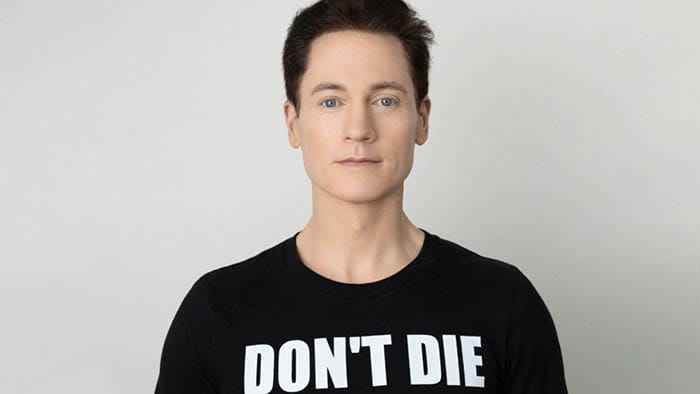
Live to 100? Asks This Centimillionaire: Why Stop There? This week’s dour deep pocket
: Bryan Johnson, a 45-year-old California-based entrepreneur who’s been spending $2 million annually in an extravagantly hyped personal drive to reverse the aging process. What has him sour: Sarcastic and satirical media accounts
about his over-the-top efforts to stay enduringly young. The New York Times has now dubbed Johnson — who “takes up to 111 pills a day” — the new leader “in the race among Silicon Valley rich guys going to extremes in a quest to live forever.”
“Sticks and stones may break my bones,” Johnson, meanwhile, has retorted on his 500,000-follower Instagram account, “but hate will only feed me.” The hate, Johnson apparently feels, can also help him “monetize his popularity.” He’s now offering his fans the opportunity to buy up everything from his branded olive oil to his favorite bloodwork. The last word: The biologist Andrew Steele is blasting Johnson’s pitch to get consumers to spring over $100 a month “on tablets with totally unproven efficacy.” Adds Steele: “If I had $100 a month to spend on my health, I’d buy a pair of running shoes in the first month and then use the $1,100 I saved over the rest of the year to buy vegetables.” |
|
|
What's new on Inequality.org Sarah Anderson, Will Corporate Lobbyists Steamroll Stock Buyback Regulations? The SEC should stand up to the Chamber of Commerce and keep fighting for rules to expose CEOs who manipulate buybacks to pad their own pockets. Elsewhere on the web Chuck Collins,
A Super Bowl Note to Taylor Swift: Love the Music, Park the Private Jet, Common Dreams. Congrats, Taylor, for your talent and decades of consistently great songwriting. You deserve all the accolades and rewards. But... Suzanne Harrington, Can we introduce a maximum wage cap and get rid of the billionaires? Irish Examiner. Capping personal wealth at ten million could reverse threats to democracy and help prevent climate breakdown. William Cohan, How Loud Billionaires Convert Their Wealth Into Power, New York Times. Only the ultra-wealthy, as a practical matter, can afford to speak freely without consequences. Laura Delle Femmine, Gabriel Zucman: ‘It is not up to the rich to decide how much they should pay in taxes,’ El País
. Why we need — and how we could get — an annual 2 percent tax on grand fortunes. How Oxfam crunches its inequality stats, Equals Bulletin
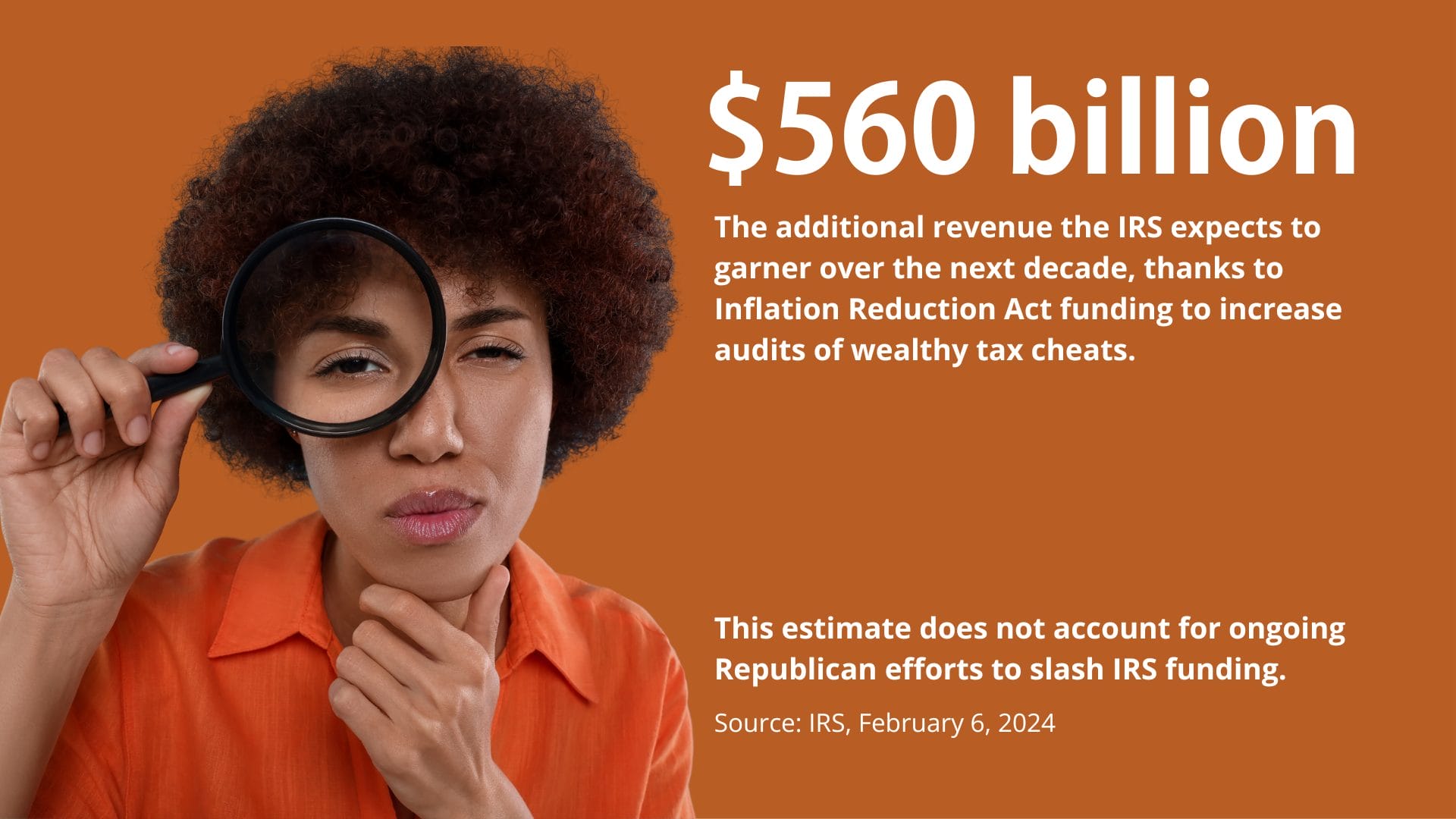
. An inside look at how this global advocate for social justice counts the billions of our wealthiest ahead of the annual World Economic Forum in Davos. Fatima Hussein, More Audits Of Millionaires And Billionaires Could Help IRS Collect Billions In Unpaid Taxes, Associated Press. Tax revenues may rise by as much as $561 billion from 2024 to 2034, thanks to stepped-up enforcement made possible with money from the Inflation Reduction Act enacted in 2022. Maya Srikrishnan, More tax cuts put states’ revenue at risk, Center for Public Integrity. After three years of state tax cuts that disproportionately benefit the wealthy, some states are poised to enact even more. Thom Hartmann, Can Democracy Survive The Morbidly Rich? Eurasia Review. Our wealthiest and the judges and politicians they’ve bought are actively breaking our democratic republic. Chauncey DeVega, Why most millionaires want a wealth tax: ‘There's a certain alarmism among the wealthy about Trump,’ Salon. A growing number of wealthy,
Inequality.org’s Chuck Colllins explains, understand the instabilities that extreme inequalities worldwide are now hastening. Gillian Rutherford,
Preventable hospitalizations and 'deaths of despair' associated with income inequality, Medical Express. Canada’s growing income inequality is having an impact on Canadians' mental and physical health, according to public health researchers at the University of Alberta. |
Daniel Denvir and Luke Messac,
Your Money Or Your Life w/ Luke Messac, The Dig, Medical debt exacerbates poor and working-class people’s physical and psychological suffering while undermining their financial well-being and freedom. Jan Miyasaki, 2023: The Year Of The Strike, 8 O'Clock Buzz. Inequality.org'
s Sarah Anderson on “The Year of the Strike.” At a time when only 6 percent of U.S. workers carry union cards, strikes by auto workers, hotel workers, and Hollywood writers and actors helped strengthen the rights of workers. |
|
|
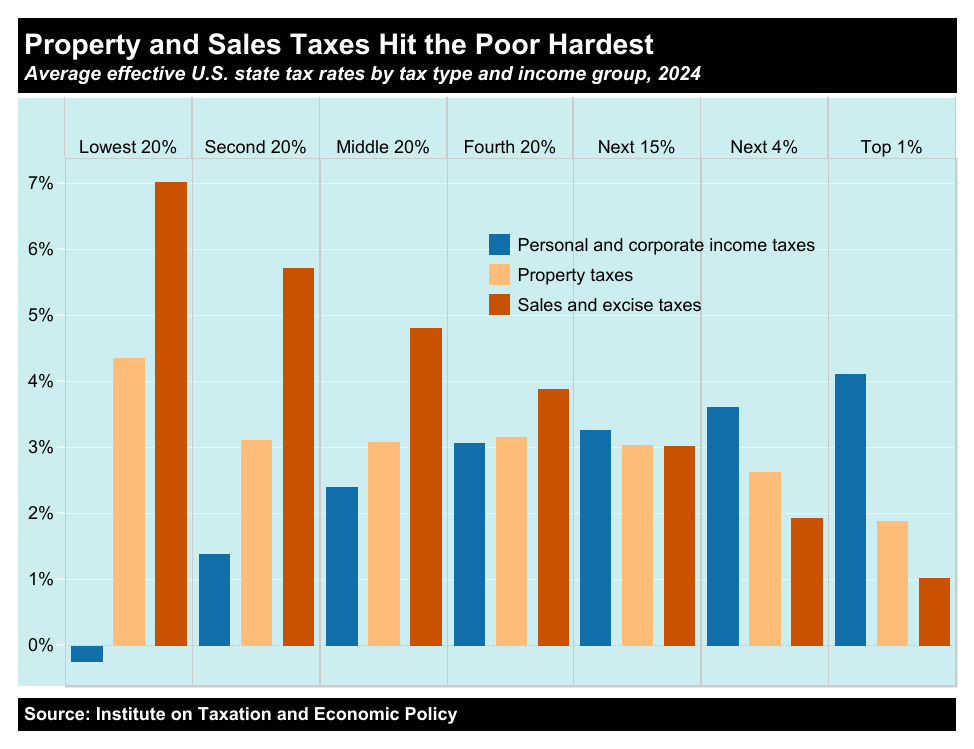
Most American state governments rely heavily on regressive sales and property taxes to pay for public services. This pattern leaves our poorest families paying a larger share of their income on state than our richest. According to the Institute on Taxation and Economic Policy, our poorest 20 percent now face an average effective state sales tax rate of 7 percent. The top 1 percent average rate runs just 1 percent. For interactive charts on taxes and inequality, check out the link below. |
|
|
Inequality.org
runs on the loving labor of a small team of researchers, writers, and advocates. More than anything, all of us involved believe deeply in the power of everyday people to come together to accomplish something big! We’ve built this operation around our weekly newsletter, and our paid subscribers make this newsletter possible with monthly donations. Join the ranks of our paid subscribers: Start today. |
|
|
Inequality.org | www.inequality.org | inequality@ips-dc.org
Managing Editor: Chris Mills Rodrigo
Co-Editors: Sarah Anderson, Chuck Collins, Bella DeVaan, and Sam Pizzigati
Production: Bella DeVaan and Chris Mills Rodrigo |
|
|
|




![Photo of Tahir Amin, founder of the Initiative for Medicines, Access & Knowledge, with the quote overlaid ''Today's patent system has become less an engine real invention than a tool for companies and their lawyers to exploit using sophisticated legal and marketing Jedi tricks. [This] too often comes at an incalculable cost: the cost of people's lives.''](https://inequality.org/wp-content/uploads/2024/02/Tahir-Amin-WoW.jpg "Photo of Tahir Amin, founder of the Initiative for Medicines, Access & Knowledge, with the quote overlaid ''Today's patent system has become less an engine real invention than a tool for companies and their lawyers to exploit using sophisticated legal and marketing Jedi tricks. [This] too often comes at an incalculable cost: the cost of people's lives.''")