A weekly newsletter from the Institute for Policy Studies |
|
|
They’ve parked their private jets, whipped out their Loro Piana cashmere, and started pontificating about AI. Billionaires, political leaders, and corporate scions are convening once again this week high up in the Alps for the annual World Economic Forum. But this year’s Davos gathering has an elephant in the room, and we don’t mean global geopolitical fears over the GOP’s presidential frontrunner.
That elephant: the dire global need to start redistributing wealth. At a forum that’s made “rebuilding trust” its central 2024 theme, writes our co-editor Sam Pizzigati in this week’s issue, redistribution shouldn’t remain a topic that Davos’ talking heads conspicuously neglect. Yet here we are.
Our affluent friends at the Patriotic Millionaires have been pleading to be properly taxed by the Davos set for years. Exasperated by the hold up, they have a simple message for their peers: “We’d be proud to pay more.”
New polling results show that strong majorities of the richest 5 percent in G20 countries would be proud to pay more, too. They’d support higher taxes on themselves if the revenue goes to spending for the common good.
How much money could our world’s richest spare at tax time? A new Oxfam report entitled Inequality Inc. shows just how starkly our economic systems have worsened inequality. Since 2020, our billionaires have become $3.3 trillion richer. We have more this week on how we can bust up extreme wealth concentration.
One final note: We have a new managing editor coming on board at Inequality.org, Chris Mills Rodrigo. I’m excited to introduce him to you all next week — and to tell you about my new role here on our Inequality.org team. Stay tuned! Bella DeVaan
for the Institute for Policy Studies' Inequality.org team |
|
|
INEQUALITY BY THE NUMBERS |
|
|
New Rule Will Extend Labor Protections to Millions of Misclassified Workers
“They have had us in the shadows and because of that they have abused us,” says Romelio, a drywall finisher in Phoenix, Arizona. A company Romelio works for misclassified him as an independent contractor, shorting him some $18,000 dollars of deserved pay.
Bosses believe, Romelio explains, that they can act with impunity when workers have no rights: “If I fire you, you’ll have nothing.”
Stories like Romelio’s abound in every sector, notes his International Union of Painters and Allied Trades. Classifying workers as independent contractors instead of employees allows companies to deny overtime pay, fair wages, and other basic labor protections. The Economic Policy Institute estimated in 2021 that, across 11 commonly misclassified jobs, “independent contractors” could lose out on anywhere from 17.5 to 34.1 percent of their annual pay.
The Department of Labor last week finalized a new rule to crack down on this labor exploitation tactic and ensure that workers get properly classified, entitling them to the benefits of the Fair Labor Standards Act. Learn more about this pivotal revision from Jessica Corbett of Common Dreams at the link below. |
|
|
Baby Bonds Could Help Bust Up Extreme Stock Wealth Concentration
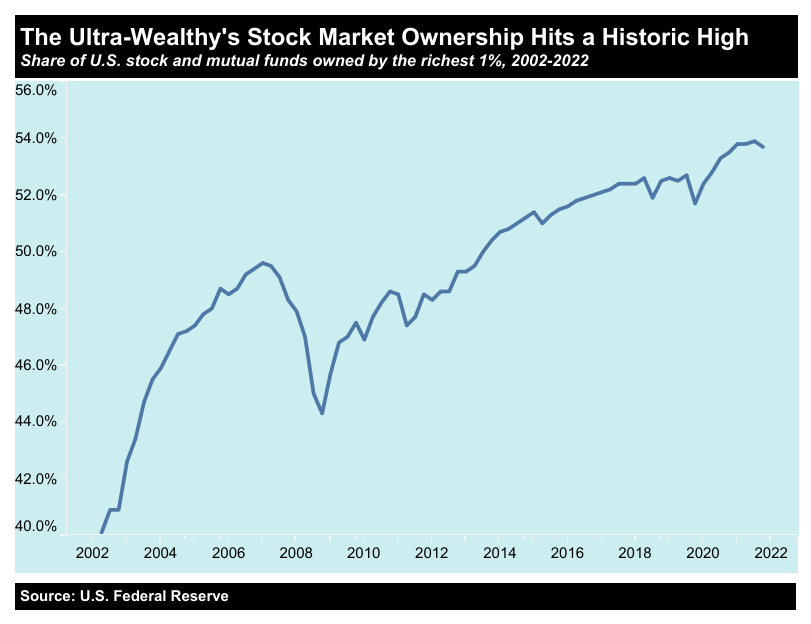
Our Inequality.org analysis of new Federal Reserve data shows that the richest 1 percent have pocketed the lion’s share of stock market gains over the past two decades. This elite group now holds 54 percent of stock market wealth, up from 40 percent in 2002. How do we tackle this extreme wealth concentration at the top and create more opportunities for the bottom half of households?
“Baby Bond” savings accounts for low-wealth families offer one effective strategy. Senator Cory Booker and Representative Ayanna Pressley have introduced the American Opportunity Act to establish a federal baby bond program that would provide each newborn with a $1,000 savings account, with annual contributions up to $2,000, depending on family income. At 18, beneficiaries could withdraw the funds for education, home ownership, and non-speculative investments.
Learn more about how we can bust up the extreme concentration of stock market ownership from Inequality.org co-editor Chuck Collins. |
|
|
What’s Driving Our Contemporary National Epidemic of Distrust?
Back in the late 1950s, notes the Pew Research Center, “about three-quarters of Americans trusted the federal government to do the right thing almost always or most of the time.” But only 15 percent of Americans today, Gallup reports, profess a “great deal” of trust in the nation’s key institutions — and just 11 percent trust these institutions even a “fair amount.” What explains this historically high level of mistrust? Taking a closer look at the institutions Americans distrust the most can offer us up some clues — and those clues all seem to trace back to the growing maldistribution of wealth and power that so defines today’s United States. Inequality.org’s Sam Pizzigati has more.
|
PETULANT PLUTOCRAT OF THE WEEK |
Deep in the Heart of Texas, a Thin-Skinned Big Oil Giant
This week’s dour deep pocket: Kelcy Warren, the billionaire chair of Energy Transfer, the Dallas-based oil and gas pipeline giant that currently transports a third of U.S. natural gas and crude oil.
What has him sour: The Texas Supreme Court last month refused to hear Warren’s claim that former U.S. Representative Beto O’Rourke had “publicly humiliated” him when he described Warren’s $1 million donation to Texas governor Greg Abbott’s 2022 re-election campaign as “pretty close to a bribe” designed to help make sure the governor would “go easy on energy companies.”
The Texas Court of Appeals had earlier last year dismissed Warren’s lawsuit, noting that “an examination” of O’Rourke’s statements “from the position of a reasonable person shows they are non-actionable opinions and fall within the bounds of protected speech.”
The last word: Kelcy Warren and Energy Transfer, Beto O’Rourke noted at a news conference after the Texas power industry’s 2021 winter storm failures, made $2.4 billion from the five days that people deep in the heart of Texas were suffering and even dying from the cold. Opined O’Rourke: “For Abbott’s top donors, the grid failure meant getting rich.”
|
|
|
This week on Inequality.org
Omar Ocampo, A Working Class Victory on Colombia’s Horizon. An advancing labor reform bill could increase overtime pay, expand Social Security for delivery workers, and strengthen workplace rights.
Elsewhere on the Web
Mark John, As Davos crowd gathers, governments urged to rein in ‘billionaire class,’ Yahoo Finance. Our current global inequality in no way rates as no accident. Our billionaire class, notes Oxfam, “is ensuring corporations deliver more wealth to them at the expense of everyone else.”
Nick Hobson, I Finally Understand the Motivations of Billionaires Like Musk and Bezos. It Still Doesn't Make Me Feel Any Better, Inc. Musk and Bezos present themselves as guardians of humanity's future, pushing the boundaries of space travel and technology. But at what cost?
Annie Reneau, A guy and his friends shared their travel plans. The results perfectly explain the wealth gap, Upworthy. A contemplation on living in a society where some of us can routinely budget $80,000 for a three-day vacation getaway. Jared Brey, What the New Wealth Tax in Massachusetts Is Paying For, Governing. New revenue from a 4 percent surtax on high-income earners is helping fund education and transportation projects in Massachusetts.
Robert Reich, How the oligarchy shrank America’s middle class, Substack. Despite living in an economy far more productive than the economy of 50 years ago, the typical American worker today has seen precious little in substantial economic gain.
Rob Copeland, The Billionaires Spending a Fortune to Lure Scientists Away From Universities, New York Times. Wealthy investors are dangling seven-figure paydays to lure highly credentialed university profs to a for-profit bounty hunt.
Harold Vazquez, Combination of poverty and inequality predicts murder rates in the United States, Business News. Scientists have identified a strong connection between rising poverty, income inequality, and increased murder rates across the United States over the three decades between 1990 and 2020.
Noah Kirsch, The Perks and Perils of Being a Tutor for the Super-Rich, Daily Beast. In the exosphere of extreme wealth — where nannies can earn six figures and estate managers many multiples more — high-end tutors are commanding an equally eye-popping share of the pie. |
Benjamin Y. Fong, Organize the Unorganized: Powerful Personalities, Jacobin Radio. Exploring the institutional formation of the CIO labor center and its bold leaders and organizers.
Daniel Denvir, Micah Uetricht, and Ashley Mears, Very Important People, The Dig. What exactly are the wealthy doing with their money on the nightlife circuit? Their bottomless appetites for extravagance have an exploitative impact. |
|
|
Concentration of stock market ownership has hit at an all-time high. The richest 1 percent in the United States now own 54 percent of stock and mutual funds, up from 40 percent in 2002, according to Fed data. For an interactive version of this chart and other wealth inequality charts, check out the link below. |
|
|
Inequality.org runs on the loving labor of a small team of researchers, writers, and advocates. More than anything, all of us involved believe deeply in the power of everyday people to come together to accomplish something big! We’ve built this operation around our weekly newsletter, and our paid subscribers make this newsletter possible with monthly donations. Join the ranks of our paid subscribers: Start today. |
|
|
Inequality.org | www.inequality.org | inequality@ips-dc.org
Managing Editor: Isabella DeVaan
Co-Editors: Sarah Anderson, Chuck Collins, and Sam Pizzigati
Production: Isabella DeVaan and Kufre McIver |
|
|
|