A weekly newsletter from the Institute for Policy Studies |
|
|
Happy 2024! We hope you’ve had a wonderful start to the new year.
On our desks this week: the newly released Who Pays? report from the Institute on Taxation and Economic Policy, a comprehensive state-by-state analysis that makes for a perfect incentive to get going on a year of tax justice advocacy.
In 44 states, this ITEP study finds, tax structures exacerbate inequality. In 41 of those states, the top 1 percent are even paying taxes at a lower rate than everyone else. And in most all of these states, the lower the income, the higher the overall effective state and local tax rate turns out to be. You can check out how your state is faring on ITEP’s website.
On the plus side: Six states — and the District of Columbia — are actually using their tax codes to reduce inequality. What can we learn from these states? Plenty. All these jurisdictions have in place highly progressive income tax brackets, offer targeted and refundable low-income tax credits, and rely much less on regressive consumption taxes.
“The wide variety of results seen across states in this study,” conclude the authors of the new Who Pays? report, “proves that regressive state and local taxation is not inevitable.” We agree. How we tax at every level will always be, as Who Pays? notes, “a policy choice.” Here’s to making transformative egalitarian choices in 2024! Chuck Collins and Bella DeVaan
for the Institute for Policy Studies' Inequality.org team |
|
|
INEQUALITY BY THE NUMBERS |
|
|
A Professor Reckons with Redlining’s Racist Legacy
When Professor Emanuel Carter talks about redlining, he doesn’t mince words. “No good jobs, no good housing, and no good schools,” the associate professor in New York’s state university system observes, “have killed more of our people than a lot of wars.”
Carter grew up in a redlined part of Philadelphia during the 1950s and 1960s. But redlining — denying mortgages and other financial services to communities based on their race, ethnicity, and place — began a generation earlier, with roots in the New Deal's Home Owners’ Loan Act. Its impact can’t be overstated.
In recent years, for instance, the national homeownership rate has hovered around 44 percent for Black families versus 74 percent for white families. And as our colleagues’ recent Still A Dream: Over 500 Years to Black Economic Equality report lays plain, the racial wealth divide stubbornly persists.
Erasing redlining’s legacy, explains our former Next Leader Danielle Browne, will require innovative, reparations-oriented policy action at all levels of government.
“It is time for our country to take a comprehensive approach and marshal our resources in support of that,” adds Dr. Carter. “We must treat our entire population as if it deserves quality housing and, with that, the better opportunity to build community.” Read more from Browne and Carter at the link below. |
|
|
A Working Class Victory on Colombia’s Horizon
When first assuming the presidency of Colombia in 2022, Gustavo Petro made transformative labor reform one of his chief priorities. But Petro's landmark reform bill quickly encountered fierce opposition from the business community and its political representatives.
Despite that opposition, the bill has now advanced to a second round of legislative debate. If passed, Colombia’s government will increase overtime pay, extend social security provisions to delivery and tech platform workers, and strengthen workplace rights by ensuring protections for immigrant workers.
How much does Colombia need labor reform? Right before the New Year, a scandal erupted at a tuna factory in Cartagena. Women workers at that factory, the nation learned, felt obligated to wear diapers on the job since management was tallying their bathroom breaks and deducting those minutes from their pay. Read more from our Inequality.org researcher Omar Ocampo on why a 2024 passage of these reforms will be crucial for Colombian workers. |
|
|
The Billionaires Who Own the Home Next Door
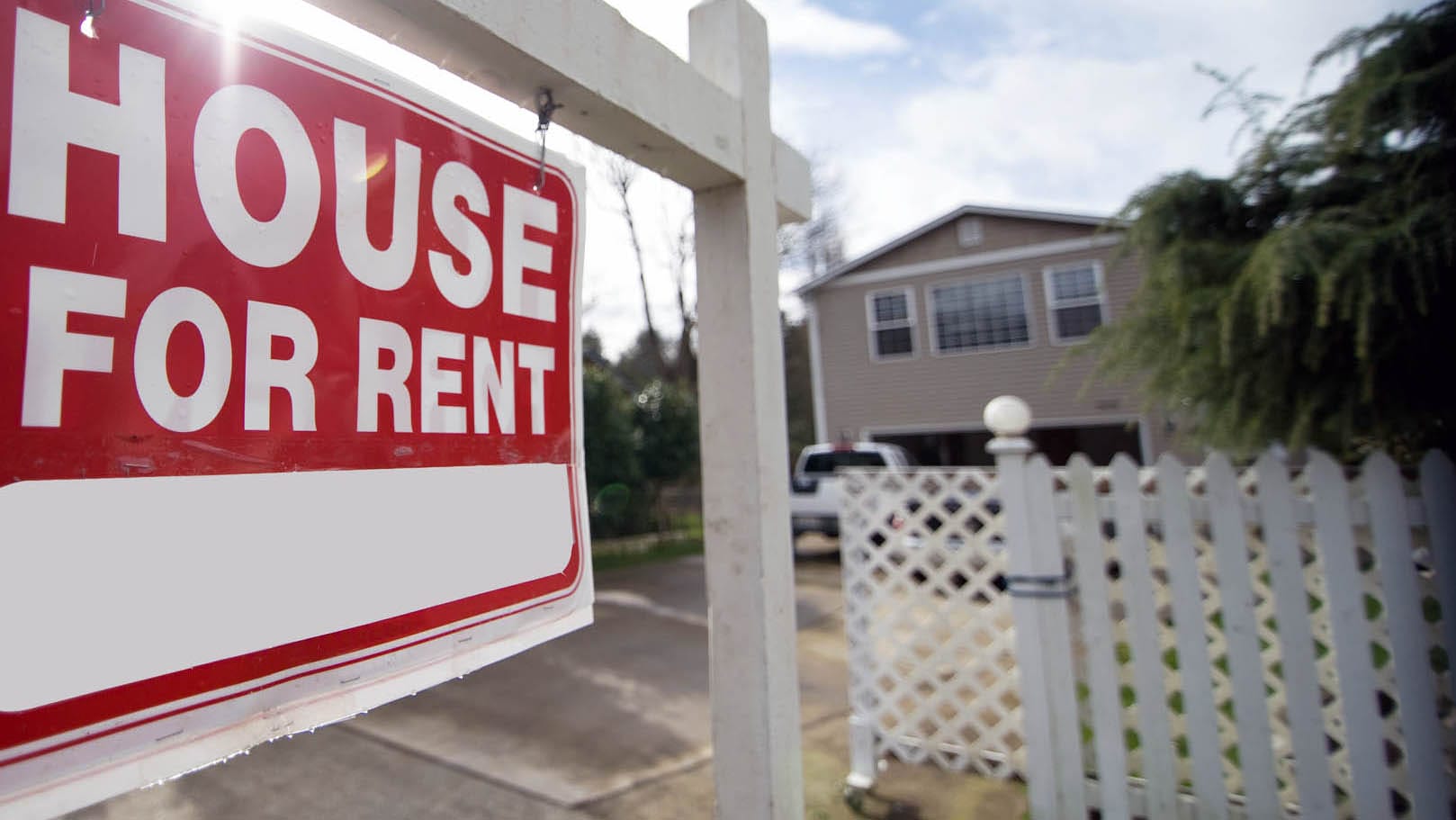
What’s happened to the American dream of owning your own home? The gruesome story: About 85 percent of America’s renting households cannot currently qualify for a mortgage. The economic reality behind that stat: the shrinking share of America’s wealth that belongs to average Americans. And America’s richest aren’t just enjoying that trend. They’re exploiting it — on a wide variety of housing-related fronts. These rich have spent recent years buying up homes for sale on a massive scale and turning their newly purchased single-family houses into rental properties. Inequality.org’s Sam Pizzigati has more.
|
PETULANT PLUTOCRAT OF THE WEEK |
A Needed New Year’s Resolution: Keep Foot in Sock, Not Mouth
This week’s dour deep pocket: Tim Gurner, an Australian luxury property developer currently within hailing distance of billionaire status. What has him sour: The global derision that greeted his tirade last September against workers who need to be reminded “that they work for the employer, not the other way around.”
Speaking before a business conference, Gurner had declared that his nation’s employees “have been paid a lot to do not too much in the last few years, and we need to see that change.” His proposed solution: “We need to see unemployment rise, unemployment has to jump 40, 50 percent.” Summed up Gurner: “We need to see pain in the economy.”
The immediate pain from that pitch would fall on Gurner, who found himself forced days later to “sincerely regret that my words did not convey empathy” for people who lose their jobs.
The last word: Empathy has not exactly been Gurner’s calling card. Earlier in his career, the New York Post notes, “he accused younger workers of spending too much money on smashed avocados.” |
|
|
This week on Inequality.org Sarah Anderson, 10 Victories for the Working Class in 2023. From the picket lines to state houses to the White House, champions in the fight against inequality last year landed huge wins. Scott Klinger, What If Santa — Like the Uber-Rich in Their Private Planes — Opted to Block Tracking of His Sleigh? Private jet-setters and their lobbyists don’t want you to know where they are going.
Helen Flannery, Donor-Advised Funds Now Consume a Quarter of Individual Charitable Giving. The National Philanthropic Trust’s latest report on DAFs reveals just how rapidly these rich-people friendly tools are growing. Elsewhere on the Web
Sarah Anderson, 2023 could be a turning point for labor, Charleston Gazette-Mail. Why we may look back on 2023 as the year a re-energized labor movement began building a much more equal America. Julia Conley, New Massachusetts ‘Tax the Rich’ Law Raises $1.5 Billion for Free School Lunch and More, Common Dreams. The state’s Fair Share Amendment requires people with incomes over $1 million to pay a 4 percent annual surtax.
Lynn Parramore, Renowned Political Scientist: Can We Really Save American Democracy? Institute for New Economic Thinking. Not if we continue to allow the wealthy to amass ever more wealth and power. Les Leopold, Elon Musk’s Swedish Problem: Has the Anti-Union Billionaire Finally Met his Match? Wall Street's War on Workers. For the first time in his life, the world ’s richest man may find himself learning a lesson in labor solidarity. Robert Reich, Powerful donors managed to push out Harvard’s Claudine Gay. But at what cost? Guardian. A stunning and alarming victory for wealthy Harvard alumni. Christer Watson, Studies posit link between wealth, selfishness, Fort Wayne Journal Gazette. A scientist looks at research that speaks to the “connection between wealth and being a jerk.”
Arthur MacEwan, Race Inequality, Class Inequality, Dollars & Sense. A look at how racism in the United States has served to undercut both black and white workers.
Pat Garofalo, The Era of Billion-Dollar Sports Boondoggles Is Here, Boondoggle. The consensus among everyone who has studied taxpayer subsidies for the arenas that billionaire sports franchise owners demand: These arenas provide none of the economic benefits that billionaires promise.
Kenan Malik, A culture of greed, riddled with inequality. Global football is a mirror of our age, Guardian. The major themes in football’s transformation — from the marginalization of fans to the consolidation of new elites — reflect much wider political, social, and economic developments.
Imme Scholz, The sustainability transition needs a new narrative, Social Europe. To ensure broad-based support for wholesale change, policymakers will need to pursue a more equitable climate transformation. |
Sasha Lilley and C. S. Soong, Fueling Change, KPFA's Against the Grain. What does bold and militant action in the face of climate calamity look like? What sorts of individual and collective actions should the movement encompass, embrace, or at least tolerate? Chuck Collins explores these questions in a provocative novel packed with information about real-life activists and iconic campaigns.
David Sirota, Master Plan, Lever News. The upcoming podcast series will expose the 50-year plot to legalize corruption in America. |
|
|
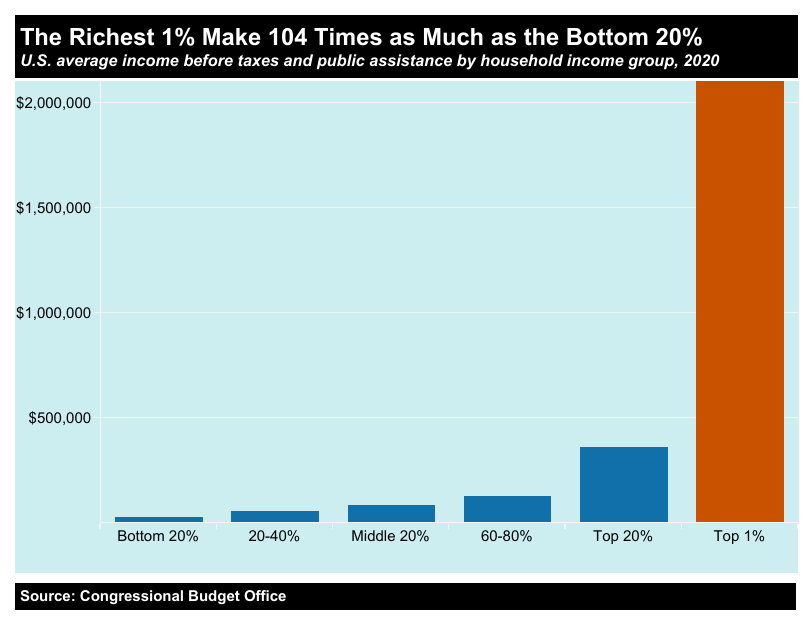
Income disparities have become so pronounced that America’s richest 1 percent of households averaged 104 times as much income as the bottom 20 percent in 2020, according to the Congressional Budget Office. For an interactive version of this chart and other income inequality charts, check out the link below. |
|
|
Inequality.org runs on the loving labor of a small team of researchers, writers, and advocates. More than anything, all of us involved believe deeply in the power of everyday people to come together to accomplish something big! We’ve built this operation around our weekly newsletter, and our paid subscribers make this newsletter possible with monthly donations. Join the ranks of our paid subscribers: Start today. |
|
|
Inequality.org | www.inequality.org | inequality@ips-dc.org
Managing Editor: Isabella DeVaan
Co-Editors: Sarah Anderson, Chuck Collins, and Sam Pizzigati
Production: Isabella DeVaan and Kufre McIver |
|
|
|



![''If a large international company is allowed to [impose itself] on the Swedish labor market and not sign a collective agreement, then what's to say that other companies in the future will accept this model?'' -Jesper Petersson, spokesperson for Swedish Tesla mechanics](https://inequality.org/wp-content/uploads/2024/01/wow-swedish-union-tesla2-e1704489710555.jpg "''If a large international company is allowed to [impose itself] on the Swedish labor market and not sign a collective agreement, then what's to say that other companies in the future will accept this model?'' -Jesper Petersson, spokesperson for Swedish Tesla mechanics")