
|
Email not displaying well? Click here to read online | Subscribe to the Inequality.org weekly
|

A weekly update on our grand divides
|
May 29, 2017 |
|
This Week
The Koch brothers have just emerged out of their relative seclusion — since the November election — to show some heart-felt support for President Trump’s just-released federal budget. These notorious billionaire siblings have made clear in the past that they’re no friends of the president. So their support for his budget can only mean one thing: Watch your wallet!
The Trump budget will, if adopted, hand boatloads of cash to the already cash-heavy. With all that cash up for grabs, the Koch brothers just couldn’t stay away. We can’t take our eyes off the Trump budget either. No federal budget plan since Ronald Reagan’s first in 1981 has posed more of a threat. More on that threat in this week’s issue.
Not all our budget news rates as bad. At the state level, we actually have some reason to cheer. The Illinois state senate voted last week to close the carried interest loophole, an egregious tax clause that lets hedge fund managers dodge billions in taxes. We sat down with one of the organizers of this victory. You’ll like what she has to say.
Finally, we’re excited to share that we’ll soon be launching a redesign of all our Inequality.org online activity. Keep an eye out. We think you’ll like what you see!
Chuck Collins, Director, Program on Inequality
and the Common Good, Institute for Policy Studies
|
|
|
 |
Inequality by the Numbers

Share Facebook
|
|
New This Week on Inequality.org
Lindsay Koshgarian of the National Priorities Project on the president’s budget: a war on the poor.
|
|
|
|
The Inequality Nerd wants you to know... Since taking office on January 20, the New York Times reports, President Donald Trump has met with at least 41 of last year’s 200 best-paid corporate CEOs.
The Inequality Nerd Bob Lord practices tax law in Phoenix. |
|
|
Faces on the Frontlines
A Victory over Hedge Fund Greed

The Illinois state senate is the first legislative body to pass a bill to close a tax loophole that allows billionaire hedge fund managers to pay a lower tax rate than many teachers and firefighters.
With President Trump backtracking on his campaign promises to crack down on Wall Street, state-based lawmakers and activists are taking matters into their own hands.
On May 23, the Illinois state senate became the nation’s first legislative body to pass a bill to end one of the most outrageous examples of Wall Street privilege – the “carried interest” loophole. This mistake in the tax code allows wealthy hedge fund managers to cut their IRS bills nearly in half by claiming most of their income as capital gains.
Abbie Illenberger of the Grassroots Collaborative, an alliance of 11 Illinois membership-based organizations, has been one of the leaders of the campaign to fully tax carried interest. The issue gained momentum much more quickly than expected, she explains, because of the severity of the state’s budget crisis.
| The Illinois bill would impose a new tax on fees earned by hedge fund managers.
|
“We’ve gone without a budget for two years now,” Illenberger last week told Inequality.org. “That’s two years with little or no state funding for summer jobs, after-school programs, youth leadership programs, and street-level violence prevention programs. And at the end of those two years, we’re seeing the highest levels of gun violence in two decades. This is not a coincidence.”
The Illinois carried-interest campaign has effectively translated the $1.7 billion in potential revenue from closing the loophole into things many legislators care about, including the number of seniors who could receive home care.
“We showed this would mean real money that could solve real problems,” says Illenberger. “And we made sure the legislators heard from real people who use those services.”
Lawmakers have introduced similar carried-interest bills in six other states (New York, New Jersey, Connecticut, Rhode Island, Massachusetts, and Maryland), and activists are developing campaigns in several others.
Read more.
|
|
Take Action on Inequality President Trump campaigned on a promise to eliminate the carried interest loophole, but the outline of his tax plan doesn’t even mention the matter. Urge your member of Congress to support bills that would end preferential tax treatment for wealthy hedge and private equity fund managers. Learn more about these bills.
For more info about state and federal campaigns to close the carried interest loophole, including papers with revenue estimates for several states, check out the Hedge Clippers campaign.
|
|
|
Must Read
Capitalism on Trial
The Capitalist
Peter Steiner
2016,
Saint Martin's Press
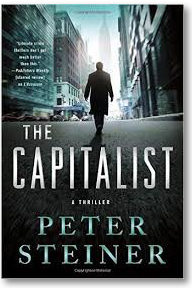
In 2008, in the wake of the financial crisis, almost every evening news cycle seemed to showcase a Wall Street banker getting led out in handcuffs to face justice.
Remember that? Me neither. In real life, only one Wall Street hotshot ever landed in handcuffs on television screens across the country: Bernie Madoff.
Madoff is now serving a 150-year prison sentence for defrauding investors. But Madoff’s crimes don’t hold a candle to the exploits of St. John Larrimer, the villain of Peter Steiner’s latest book, The Capitalist.
With short chapters and quick-moving prose, Steiner brings readers on a whirlwind tour of the global financial system, with an all-too-real depiction of that system’s glossy veneer and slimy underside. Larrimer, inspired by Madoff, makes off with $3 billion of his clients’ money and proceeds to stash both the cash and himself in offshore tax havens beyond the reach of law enforcement.
Escapist fantasy? We wish. Over $7 trillion today sits in offshore tax shelters.
Read our full write-up.
|
|
Reports and Retorts
The combined wealth of Nigeria’s five richest men, notes a new Oxfam study, could eliminate extreme poverty in that country. Nigeria’s richest man earns 8,000 times more in one day than a poor Nigerian will spend on basic needs in a year.
A new analysis from William & Mary Law School's Eric Kades is proposing changes in the U.S. tax code that would give lower-income families a federal tax credit equal to 100 percent of the state income, sales, and property tax they pay. The credit percentage would shrink as household income rises, in the process offsetting the chronic regressivity of most all state tax systems.
|
|
|
|

A commentary on excess and inequality by Sam Pizzigati
How Compassion Turns into Contempt
We need to do more than assail the Trump administration's heartless new budget. We need to understand its roots in our chronic and continuing inequality.
Somebody get this man a dictionary.
Mick Mulvaney, the Trump administration budget chief, desperately needs some serious lexicological support. That became obvious last week when Mulvaney stepped up before reporters to defend the new Trump budget for the federal fiscal year starts in October.
The assembled scribes, noting the hundreds of billions in cuts for the poor and the vulnerable in the new budget plan, wanted to know if Mulvaney considered his budget compassionate.
Mulvaney promptly set about defining “compassion” — in his own terms. We have too many people out there, he told reporters, “who don’t want to work.”
“We’re no longer going to measure compassion by the number of programs or the number of people on those programs,” Mulvaney rolled on, “but by the number of people we help get off of those programs.”
| In unequal societies, a consensus on the importance of mutual support never develops.
|
And getting folks off “those programs,” the budget chief insisted, would be an act of true compassion.
“That,” insisted the White House budget chief, “is how you can help people take charge of their own lives again.”
No, countered Massachusetts congressman Jim McGovern, that would be “a lousy and rotten thing to do to poor people.”
Read the full Too Much column.
Institute for Policy Studies associate fellow Sam Pizzigati co-edits Inequality.org. His most recent book: The Rich Don't Always Win: The Forgotten Triumph over Plutocracy that Created the American Middle Class, 1900–1970. Follow him on Twitter @Too_Much_Online.
|
|
Around the Web
Max Ehrenfreund, How Trump’s budget helps the rich at the expense of the poor, Washington Post, May 23, 2017. Doubling down on the wealthy.
Alex Cuadros, Shave the Billionaire, Baffler, May 23, 2017. Brazil is jailing its tycoons.
Stan Choe, Top 10 highest paid CEOs in 2016, Associated Press, May 23, 2017. Typical CEOs took in an 8.5 percent raise last year.
Marlene Cimons, If you want to solve climate change, you need to solve income inequality, Think Progress, May 24, 2017. Unequal societies inflict more environmental damage.
Yuval Noah Harari, Are we about to witness the most unequal societies in history?, Guardian, May 24, 2017. Biotech and artificial intelligence may split humankind.
Adam Gaffney, The Devastating Effects of Dental Inequality in America, New Republic, May 25, 2017. The state of our teeth reveals — and reinforces — economic disadvantage.
|
|
|
This Week’s Last Glance at Greed

Share Facebook
|
|
Annals of Avarice
The Dutch ship-building firm Damen is betting its future on a fascinating hunch. Billionaires don’t just want superyachts anymore. They want fleets.
Damen has just unveiled The Game Changer, a 227-foot ship that’s designed to trail after a superyacht as a “support vessel.” The basic idea: “Declutter” by shunting living quarters for the staff and storage space for the yacht’s accessories onto a support ship.
The Game Changer sports a helicopter landing pad, 22 cabins for crew, and enough space, notes one press report, “to store everything from James Bond-style speed boats and state-of-the-art seaplanes to a fleet of jet skis.”
|
|
|
|


